Question
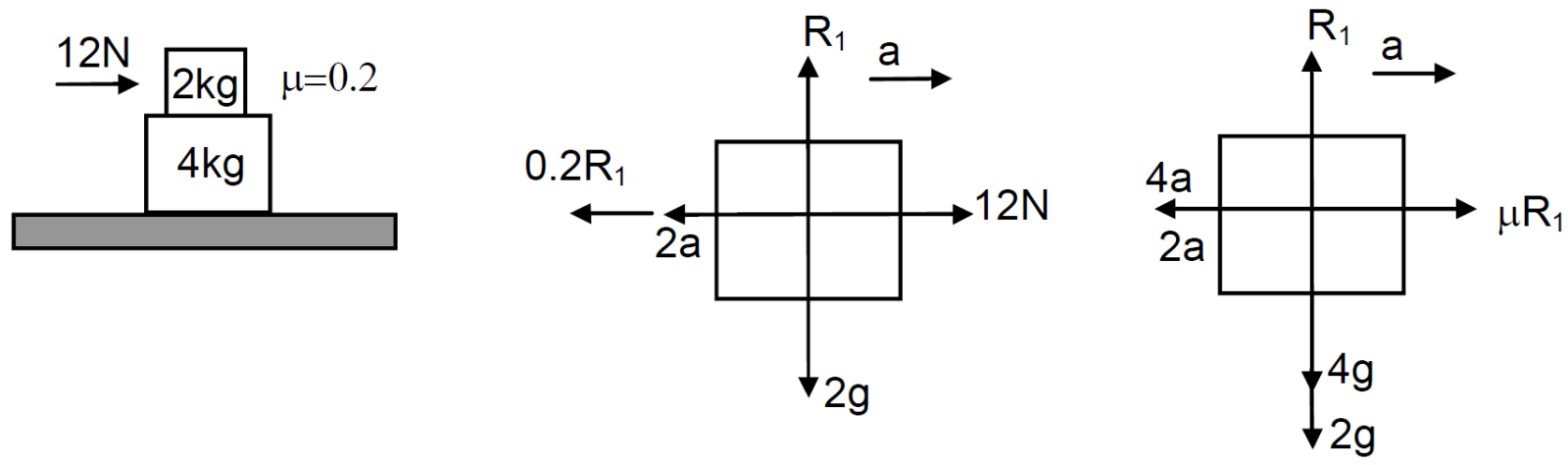
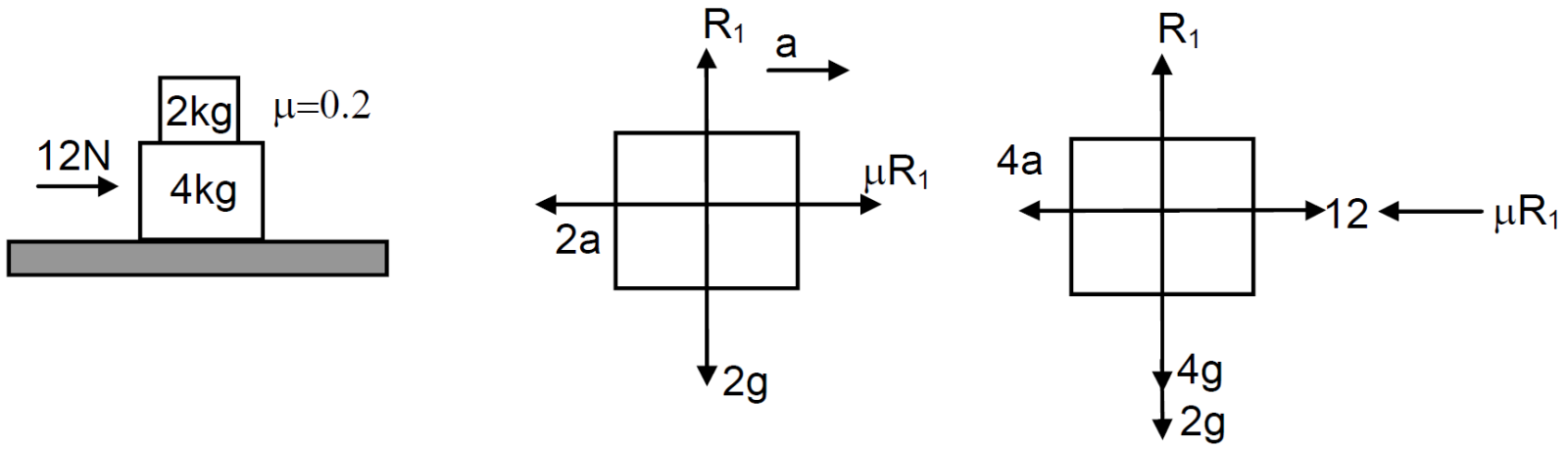
A 2kg block is placed over a 4kg block and both are placed on a smooth horizontal surface. The coefficient of friction between the blocks is 0.20. Find the acceleration of the two blocks if a horizontal force of 12N is applied to:
  1. The upper block.
  2. The lower block. Take $g = 10m/s^2.$
Answer

  1.  

$R_1 - 2g = 0$
$\Rightarrow R_1 = 2 \times 10 = 20$
$2a + 0.2 R_1 - 12 = 0$
$\Rightarrow 2a + 0.2(20) = 12$
$\Rightarrow 2a = 12 - 4 = 8$
$\Rightarrow a = 4m/s^2$
$4\text{a}_1-\mu\text{R}_1=0$
$\Rightarrow4\text{a}_1=\mu\text{R}_1=0.2(20)$
$\Rightarrow 4a_1 = 4$
$\Rightarrow a_1 = 1m/s^2$
$2kg$ block has acceleration $4m/s^2$ & that of 4kg is $1m/s^2$
  1.  

$R_1 = 2g = 20$
$\text{Ma}-\mu\text{R}_1=0$
$\Rightarrow 2a = 0.2(20) = 4$
$\Rightarrow a = 2m/s^2$
$4a + 0.2 \times 2 \times 10 - 12 = 0$
$\Rightarrow 4a + 4 = 12$
$\Rightarrow 4a = 8$
$\Rightarrow a = 2m/s^2$​​​​​​​

Need a full question paper?

Generate a complete, print-ready paper with questions like this in minutes — across 16+ boards, with answer keys.

Start Generating Free

Similar questions

A card sheet divided into squares each of size $1\ mm^2$ is being viewed at a distance of 9 cm through a magnifying glass (a converging lens of focal length 9 cm) held close to the eye.
  1. What is the magnification produced by the lens? How much is the area of each square in the virtual image?
  2. What is the angular magnification (magnifying power) of the lens?
  3. Is the magnification in (a) equal to the magnifying power in (b)? Explain.
The left end of a copper rod (length = 20cm area of cross section = 0.20cm) is maintained at $20^\circ C$ and the right end is maintained at $80^\circ C$. Neglecting any loss of heat through radiation, find,
  1. The temperature at a point 11cm from the left end
  2. The heat current through the rod. Thermal conductivity of copper $=385\text{Wm}^{-1}{^{\circ}}\text{C}^{-1}.$
Consider the potentiometer circuit as arranged in the figure. The potentiometer wire is 600cm long. (a) At what distance from the point A should the jockey touch the wire to get zero deflection in the galvanometer? (b) If the jockey touches the wire at a distance of 560cm from A, what will be the current in the galvanometer?
Can $\text{L}_\alpha$ X-ray of one material have shorter wavelength than $\text{K}_\alpha$ X-ray of another?
Find the potential difference $V_a - V_b$ between the points a and b shown in each part of the figure.


Consider the situation of the previous problem. A charges of $-2.0 \times 10^{-4}C$ is moved from the point A to the point B. Find the change in electrical potential energy $U_B - U_A$ for the cases (a), (b) and (c).
Solve the previous problem if the friction coefficient between the 2.0kg block and the plane below it is 0.5 and the plane below the 4.0kg block is frictionless.
$i$. A coin is placed inside a denser medium. Why does it appear to be raised? Obtain an expression for the height through which the object appears to be raised in terms of refractive index of the medium and real depth.
$ii$. A compound microscope consists of an objective lens of focal length $2 \ cm$ and an eyepiece of focal length $6.25 \ cm$ separated by a distance of $15 \ cm$. How far from the objective should an object be placed in order to obtain the final image at the least distance of distinct vision $(25 \ cm)$ ? Calculate the magnifying power of the microscope.
First a set of n equal resistors of R each are connected in series to a battery of emf E and internal resistance R. A current I is observed to flow. Then the n resistors are connected in parallel to the same battery. It is observed that the current is increased 10 times. What is 'n'?
A small block of mass m is kept on a bigger block of mass M which is attached to a vertical spring of spring constant k as shown in the figure. The system oscillates vertically.
  1. Find the resultant force on the smaller block when it is displaced through a distance x above its equilibrium position.
  2. Find the normal force on the smaller block at this position. When is this force smallest in magnitude?
  3. What can be the maximum amplitude with which the two blocks may oscillate together?