Question
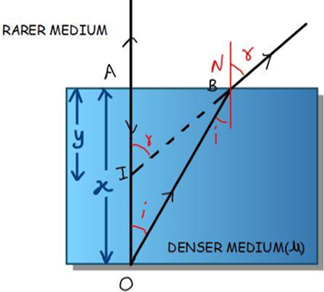
$i$. A coin is placed inside a denser medium. Why does it appear to be raised? Obtain an expression for the height through which the object appears to be raised in terms of refractive index of the medium and real depth.
$ii$. A compound microscope consists of an objective lens of focal length $2 \ cm$ and an eyepiece of focal length $6.25 \ cm$ separated by a distance of $15 \ cm$. How far from the objective should an object be placed in order to obtain the final image at the least distance of distinct vision $(25 \ cm)$ ? Calculate the magnifying power of the microscope.
Answer

$i$. Due to refraction of light
Image
$\text { In } \triangle OAB$
$\sin i =\frac{A B}{O B}$
In $\triangle IAB , \sin r =\frac{A B}{I B}$
According to Snell's law
$\frac{1}{\mu}=\frac{\sin i}{\sin r}=\frac{I B}{O B} $
When angles are small $, OB \approx OA \text { and } IB \approx IA$
$\mu=\frac{O A}{I A}=\frac{x}{y}$
Height through which object is raised $= x - y$
$= x -\frac{x}{\mu}$
$= x \left(1-\frac{1}{\mu}\right)$
$ii. f _0=2 \ cm$
$ f _{ e }=6.25 \ cm$
$L = v _0+\left| u _{ e }\right|=15 \ cm$
$v _{ e }=-25 \ cm$
$\frac{1}{V_e}-\frac{1}{u_e}=\frac{1}{f_e}$
$\frac{1}{-25}-\frac{1}{u_e}=\frac{1}{6.25}$
$u _{ e }=-5 \ cm$
Now, $L=v_0+|-5|=15 \ cm$
$V_o=10 \ cm$
Now $,  \frac{1}{f_o}=\frac{1}{V_o}-\frac{1}{u_o}$
$u _0=2.5 \ cm$
$MP =\frac{V_o}{u_o}\left[1+\frac{D}{f_o}\right]$
$=-20$

Need a full question paper?

Generate a complete, print-ready paper with questions like this in minutes — across 16+ boards, with answer keys.

Start Generating Free

Similar questions

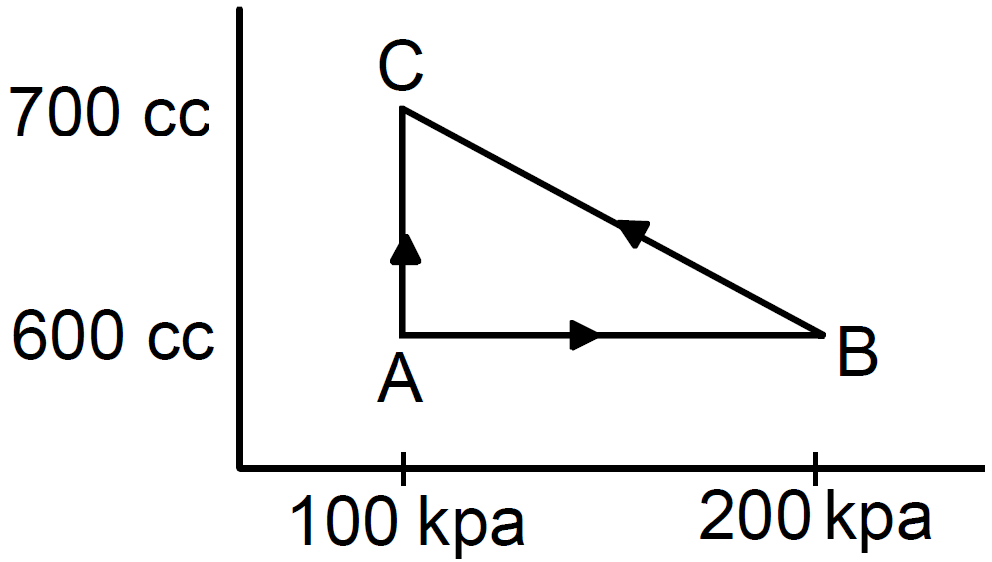
A gas is taken through a cyclic process ABCA as shown in figure. If 2.4 cal of heat is given in the process, what is the value of J?
A narrow beam of singly-charged carbon ions, moving at a constant velocity of $6.0 \times 10^4m s^{-1},$ is sent perpendicularly in a rectangular region of uniform magnetic field B = 0.5T It is found that two beams emerge from the field in the backward direction, the separations from the incident beam being 3.0cm and 3.5cm. Identify the isotopes present in the ion beam. Take the mass of an ion $= A(1.6 \times 10^{-27})kg$, where A is the mass number.
A wave propagates on a string in the positive x-direction at a velocity v. The shape of the string at t = to is given by $\text{g}(\text{x},\text{t}_0)=\text{A}\sin\big(\frac{\text{x}}{\text{a}}\big).$ Write the wave equation for a general time t.
Quite often, connecting wires carrying currents in opposite directions are twisted together in using electrical appliances. Explain how it avoids unwanted magnetic fields.
A circular coil of 200 turns has a radius of 10cm and carries a current of 2.0A.
  1. Find the magnitude of the magnetic field. B at the centre of the coil.
  2. At what distance from the centre along the axis of the coil will the field B drop to half its value at the centre? $\big(\sqrt[3]{4}=1.5874\ ...\big)$
Find the speed at which the kinetic enei:gy of a particle will differ by 1% from its nonrelativistic value $\frac{1}{2}\text{m}_0\text{v}^2$
Two large metal sheets carry surface currents as shown in figure. The current through a strip of width dl is Kdl where K is a constant. Find the magnetic field at the points P, Q and R.
$i$. Using Huygens's construction of secondary wavelets explains how a diffraction pattern is obtained on a screen due to a narrow slit on which a monochromatic beam of light is incident normally.
$ii.$ Show that the angular width of first diffraction fringe is half that of the central fringe.
$iii.$ Explain why the maxima at $\theta=\left(n+\frac{1}{2}\right) \frac{\lambda}{a}$ a become weaker and weaker with increasing $n$.
A cylindrical vessel of diameter 12cm contains $800\pi\text{cm}^3$ of water. A cylindrical glass piece of diameter 8.0 cm and height 8.0cm is placed in the vessel. If the bottom of the vessel under the glass piece is seen by the paraxial rays, locate its image. The index of refraction of glass is 1.50 and that of water is 1.33.
Two current-carrying wires may attract each other. In absence of other forces, the wires will move towards each other increasing the kinetic energy. Does it contradict the fact that the magnetic force cannot do any work and hence cannot increase the kinetic energy?