MCQ
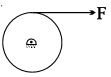
A $2\,kg$ chain is in the form of a heap. Its length is $2\,m$. Its one end is being pulled at constant speed of $2\,m/s$ horizontally. The power delivered to the chain is (in $W$).
  • A
    $20$
  • B
    $12$
  • C
    $16$
  • $8$

Answer

Correct option: D.
$8$
d
$\mathrm{F}=\left(\frac{\mathrm{dm}}{\mathrm{dt}}\right) \overrightarrow{\mathrm{V}}_{\mathrm{r}}=(\lambda \mathrm{V}) \mathrm{V}=\lambda \mathrm{V}^{2}=4$

$\mathrm{P}=\mathrm{F} \cdot \mathrm{V} \cdot=4 \times 2=8$

Need a full question paper?

Generate a complete, print-ready paper with questions like this in minutes — across 16+ boards, with answer keys.
Start Generating Free

Similar questions

A bob is whirled in a horizontal plane by means of a string with an initial speed of $\omega \mathrm{rpm}$. The tension in the string is $T$. If speed becomes $2 \omega$ while keeping the same radius, the tension in the string becomes:
The one division of main scale of vernier callipers reads $1\,mm$ and $10$ divisions of Vernier scale is equal to the $9$ divisions on main scale. When the two jaws of the instrument touch each other the $zero$ of the Vernier lies to the right of $zero$ of the main scale and its fourth division coincides with a main scale division. When a spherical bob is tightly placed between the two jaws, the $zero$ of the Vernier scale lies in between $4.1\,cm$ and $4.2\,cm$ and $6^{\text {th }}$ Vernier division coincides with a main scale division. The diameter of the bob will be $.............10^{-2}\,cm$
Two vibrating tuning forks produce progressive waves given by ${y_1} = 4\,\sin \,\left( {500\pi t} \right)$ and ${y_2} = 2\,\sin \,\left( {506\pi t} \right)$. These tuning forks are held near the ear of a person. The person will hear $\alpha \, beats/s$ with intensity ratio between maxima and minima equal to $\beta $. Find the value of $\beta  - \alpha $
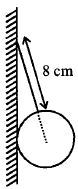
A uniform sphere of weight $W$ and radius $5\, cm$ is being held by a string as shown in the figure. The tension in the string will be
The largest and shortest distance of earth from the sun are $r_1$ and $r_2$. Its distance from the sun when it is perpendicular to the major axis of the orbit drawn from the sun is:
A bottle of sodawater is grasped by the neck and swing briskly in a vertical circle. Near which portion of the bottle do the bubbles collect
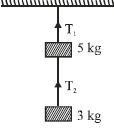
Two masses of $5\, kg$ and $3\, kg$ are suspended with the help of massless inextensible strings as shown in figure. The whole system is going upwards with an acceleration of $2\, ms^{-2}$. The tensions $T_1$ and $T_2$ are respectively (Take $g = 10\, ms^{-2}$)
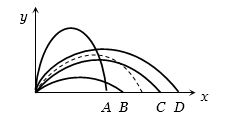
The path of a projectile in the absence of air drag is shown in the figure by dotted line. If the air resistance is not ignored then which one of the path shown in the figure is appropriate for the projectile
Why it is more hotter for same distance over the top of a candle than it in the side of its flame?
$A$ pulley is hinged at the centre and a massless thread is wrapped around it. The thread is pulled with a constant force $F$ starting from rest. As the time increases,