MCQ 11 Mark
At any instant of time $t$, the displacement of any particle is given by $2 t-1$ ($SI$ unit) under the influence of force of $5 \mathrm{~N}$. The value of instantaneous power is (in SI unit):
Answerd
Sol.
$x=2 t-1$
$v=\frac{d x}{d t}=2 \mathrm{~m} \mathrm{~s}^{-1}$
$P=F \cdot v$
$=2 \times 5=10 \mathrm{~W}$
View full question & answer→MCQ 21 Mark
Two bodies $A$ and $B$ of same mass undergo completely inelastic one dimensional collision. The body $A$ moves with velocity $v_1$ while body $B$ is at rest before collision. The velocity of the system after collision is $v_2$. The ratio $v_1: v_2$ is
- ✓
$2: 1$
- B
$4: 1$
- C
$1: 4$
- D
$1: 2$
AnswerCorrect option: A. $2: 1$
a
Before collision $\Rightarrow$
$A$ $\rightarrow v_1$ ($B$)
rest
It undergoes completely inelastic collision
Using conservation of linear momentum
Initial momentum = Final momentum
$\Rightarrow m v_1=m v_2+m v_2$
$\Rightarrow m v_1=2 m v_2$
$\Rightarrow \frac{v_1}{v_2}=\frac{2}{1}$
View full question & answer→MCQ 31 Mark
The potential energy of a long spring when stretched by $2\,cm$ is $U$. If the spring is stretched by $8\,cm$, potential energy stored in it will be $.......\,U$
Answera
$U =\frac{1}{2} k x^2$
$\text { for } x =2$
$U =\frac{1}{2} k (2)^2........(1)$
$U ^{\prime}=\frac{1}{2} k (8)^2..........(2)$
$\text { Eq. (2)/eq. (1) }$
$\Rightarrow \frac{U^{\prime}}{U^{\prime}}=\left(\frac{8}{2}\right)^2$
$\Rightarrow U^{\prime}=16\,U$
View full question & answer→MCQ 41 Mark
An electric lift with a maximum load of $2000\,kg$ (lift+ passengers) is moving up with a constant speed of $1.5\,ms ^{-1}$. The frictional force opposing the motion is $3000\,N$. The minimum power delivered by the motor to the lift in watts is: $\left(g=10\,ms^{-2}\right)$
- A
$20000$
- ✓
$34500$
- C
$23500$
- D
$23000$
AnswerCorrect option: B. $34500$
b
Constant velocity $\Rightarrow a =0$
$\Rightarrow T = W + f$
$=20000+3000$
$=23000\,N$
$\text { Power } = Tv$
$=23000 \times 1.5$
$=34500 \text { watts }$
View full question & answer→MCQ 51 Mark
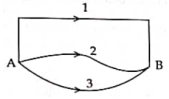
A gravitational field is present in a region and a mass is shifted from $A$ to $B$ through different paths as shown. If $W _1, W _2$ and $W _3$ represent the work done by the gravitational force along the respective paths, then
- ✓
$W _1= W _2= W _3$
- B
$W _1 > W _2 > W _3$
- C
$W _1 > W _3 > W _2$
- D
$W_1 < W_2 < W_3$
AnswerCorrect option: A. $W _1= W _2= W _3$
a
Gravitational force is a conservative force so W.D. is independent of path taken between two points.
View full question & answer→MCQ 61 Mark
The energy that will be ideally radiated by a $100\,kW$ transmitter in $1$ hour is :
- A
$36 \times 10^{4}\,J$
- B
$36 \times 10^{5}\,J$
- C
$1 \times 10^{5}\,J$
- ✓
$36 \times 10^{7}\,J$
AnswerCorrect option: D. $36 \times 10^{7}\,J$
d
$E=P \times t=100 \times 10^{3} \times 3600$
$=36 \times 10^{7}\,J$
View full question & answer→MCQ 71 Mark
A particle is released from height $\mathrm{S}$ from the surface of the Earth. At a certain height its kinetic energy is three times its potential energy. The height from the surface of earth and the speed of the particle at that instant are respectively :
- A
$\frac{\mathrm{S}}{4}, \frac{3 \mathrm{gS}}{2}$
- B
$\frac{\mathrm{S}}{4}, \frac{\sqrt{3 g S}}{2}$
- C
$\frac{\mathrm{S}}{2}, \frac{\sqrt{3 \mathrm{gS}}}{2}$
- ✓
$\frac{\mathrm{S}}{4}, \sqrt{\frac{3 \mathrm{gS}}{2}}$
AnswerCorrect option: D. $\frac{\mathrm{S}}{4}, \sqrt{\frac{3 \mathrm{gS}}{2}}$
d
$\mathrm{PE}+\mathrm{KE}=\mathrm{mgs}$
at given point
$\mathrm{KE}=3 \mathrm{PE}$
So, $4 \mathrm{PE}=\mathrm{mgs}$
$4 \mathrm{mgh}=\mathrm{mgs}$
$\mathrm{H}=\mathrm{s} / 4$
$\mathrm{KE}=\frac{3 \mathrm{mgs}}{4}=\frac{1}{2} \mathrm{mV}^{2}$
$\mathrm{~V}=\sqrt{\frac{3\times 2 \mathrm{gs}}{4}}=\sqrt{\frac{3 \mathrm{gS}}{2}}$
View full question & answer→MCQ 81 Mark
Water falls from a height of $60\, \mathrm{~m}$ at the rate of $15 \,\mathrm{~kg} / \mathrm{s}$ to operate a turbine. The losses due to frictional force are $10\, \%$ of the input energy. How much power is generated by the turbine? $\left(g=10\, \mathrm{~m} / \mathrm{s}^{2}\right)$ (In $\mathrm{~kW}$)
- A
$10.2$
- ✓
$8.1$
- C
$12.3$
- D
$7.0$
Answerb
$\mathrm{E}=\mathrm{mgh}$
$\mathrm{P}_{\text {input }}=\frac{\mathrm{mgh}}{\mathrm{t}}$
$=\frac{15 \times 10 \times 60}{1}=9000=9\, \mathrm{~kW}$
$10 \,\% \operatorname{loss}=0.9 \times 10^{3}$
$\mathrm{P}_{\text {output }}=9 \times 10^{3}-0.9 \times 10^{3}=8.1 \,\mathrm{~kW}$
View full question & answer→MCQ 91 Mark
A point mass '$m$" is moved in a vertical circle of radius 'r" with the help of a string. The velocity of the mass is $\sqrt{7 gr }$ at the lowest point. The tension in the string at the lowest point is .......... $mg$
Answerd
$T - mg =\frac{ mv ^{2}}{ r }$
$T - mg =\frac{ m (7 gr )}{ r }$
$T =8 mg$

View full question & answer→MCQ 101 Mark
The energy required to break one bond in $DNA$ is $10^{-20}\, J.$ This value in $eV$ is nearly
- A
$0.006$
- B
$6$
- C
$0.6$
- ✓
$0.0625$
AnswerCorrect option: D. $0.0625$
d
$E =\frac{10^{-20}}{1.6 \times 10^{-19}} eV$
$=0.625 \times 10^{-1}$
$=0.0625\, eV$
View full question & answer→MCQ 111 Mark
A force $\mathrm{F}=20+10 \mathrm{y}$ acts on a particle in $y$ direction where $\mathrm{F}$ is in newton and $\mathrm{y}$ in meter. Work done by this force to move the particle from $y=0$ to $y=1 \;\mathrm{m}$ is......$J$
Answerc
$\mathrm{W}=\int_{\mathrm{y}_{\mathrm{1}}}^{y_{\mathrm{2}}} \mathrm{F} \mathrm{dy}$
$\Rightarrow \mathrm{W}=\int_{0}^{1}(20+10 \mathrm{y}) \mathrm{dy}$
$\Rightarrow \mathrm{W}=20[\mathrm{y}]_{0}^{1}+10\left[\frac{\mathrm{y}^{2}}{2}\right]_{0}^{1}$
$\Rightarrow \mathrm{W}=25\; \mathrm{J}$
View full question & answer→MCQ 121 Mark
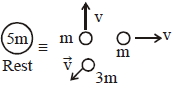
A particle of mass $5 \;\mathrm{m}$ at rest suddenly breaks on its own into three fragments. Two fragments of mass $m$ each move along mutually perpendicetion with speed $v$ each. The energy released during the process is
- A
$\frac{3}{5} \mathrm{mv}^{2}$
- B
$\frac{5}{3} \mathrm{mv}^{2}$
- C
$\frac{3}{2} \mathrm{mv}^{2}$
- ✓
$\frac{4}{3} \mathrm{mv}^{2}$
AnswerCorrect option: D. $\frac{4}{3} \mathrm{mv}^{2}$
d
$3 m \bar{v}+m v \hat{i}+m v \hat{j}=0$
$\Rightarrow \bar{v}=-\frac{v}{3} \hat{i}--\frac{v}{3} \hat{j} \quad|\bar{v}|=\sqrt{2} \frac{v}{3}$
Energy released $=\frac{1}{2} m v^{2}+\frac{1}{2} m v^{2}+\frac{1}{2}(3 m)\left(\frac{2 v^{2}}{9}\right)=\frac{4}{3} m v^{2}$
View full question & answer→MCQ 131 Mark
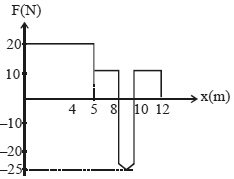
An object of mass $500\; \mathrm{g}$, intitally at rest acted upon by a variable force where $\mathrm{X}$ component varies with $\mathrm{X}$ in the manner shown. The velocities of the object at point $X=8 \;\mathrm{m}$ and $X=12\; \mathrm{m},$ would be the respective values
- A
$18 \;\mathrm{m} / \mathrm{s}$ and $24.4 \;\mathrm{m} / \mathrm{s}$
- B
$23 \;\mathrm{m} / \mathrm{s}$ and $24.4 \;\mathrm{m} / \mathrm{s}$
- ✓
$23 \;\mathrm{m} / \mathrm{s}$ and $20.6 \;\mathrm{m} / \mathrm{s}$
- D
$18 \;\mathrm{m} / \mathrm{s}$ and $20.6 \;\mathrm{m} / \mathrm{s}$
AnswerCorrect option: C. $23 \;\mathrm{m} / \mathrm{s}$ and $20.6 \;\mathrm{m} / \mathrm{s}$
c
${W}={\Delta K E}$
At $x=8\;;\;130=\frac{1}{2}\left(\frac{1}{2}\right) v^{2}$
$\Rightarrow v=2 \sqrt{130}=22.8 \mathrm{ms}^{-1}$
For $\mathrm{v}=20.6 \mathrm{ms}^{-1}$
View full question & answer→MCQ 141 Mark
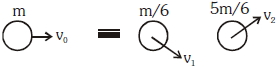
An object flying in alr with velocity $(20 \hat{\mathrm{i}}+25 \hat{\mathrm{j}}-12 \hat{\mathrm{k}})$ suddenly breaks in two pleces whose masses are in the ratio $1: 5 .$ The smaller mass flies off with a velocity $(100 \hat{\mathrm{i}}+35 \hat{\mathrm{j}}+8 \hat{\mathrm{k}}) .$ The velocity of larger piece will be
- ✓
$4 \hat{\mathrm{i}}+23 \hat{\mathrm{j}}-16 \hat{\mathrm{k}}$
- B
$-100 \hat{\mathrm{i}}-35 \hat{\mathrm{j}}-8 \hat{\mathrm{k}} $
- C
$20 \hat{\mathrm{i}}+15 \hat{\mathrm{j}}-80 \hat{\mathrm{k}}$
- D
$-20 \hat{\mathrm{i}}-15 \hat{\mathrm{j}}-80 \hat{\mathrm{k}}$
AnswerCorrect option: A. $4 \hat{\mathrm{i}}+23 \hat{\mathrm{j}}-16 \hat{\mathrm{k}}$
a
Conservation of linear momentum, $\mathrm{mv}_{0}=\frac{\mathrm{m}}{6} \overline{\mathrm{v}}_{1}+\frac{5 \mathrm{m}}{6} \overline{\mathrm{v}}_{2}$
$\Rightarrow m(20 \hat{\imath}+25 \hat{\jmath}-12 \hat{k})=\frac{m}{6}(100 \hat{\imath}+35 \hat{\jmath}+8 \hat{k})+\frac{5 m}{6} \bar{v}_{2} $
$\Rightarrow \bar{v}_{2}=4 \hat{\imath}+23 \hat{\jmath}-16 \hat{k}$
View full question & answer→MCQ 151 Mark
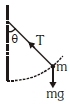
A mass $m$ is attached to a thin wire and whirled in a vertical circle. The wire is most likely to break when
AnswerCorrect option: C. the mass is at the lowest point
c
$\mathrm{T}-\mathrm{mg} \cos \theta=\frac{\mathrm{mv}^{2}}{\mathrm{R}}$
$T$ will be maximum when $\theta=0^{\circ}$
When mass is at lowest point.
View full question & answer→MCQ 161 Mark
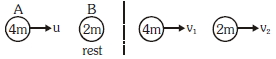
Body $A$ of mass $4 \;\mathrm{m}$ moung with speed $u$ collides with another body $B$ of mass $2\; \mathrm{m}$, at rest. The collision is head on and elastic in nature. After the collision the fraction of energy lost by the colliding body $A$ is
- A
$\frac{1}{9}$
- ✓
$\frac{8}{9}$
- C
$\frac{4}{9}$
- D
$\frac{5}{9}$
AnswerCorrect option: B. $\frac{8}{9}$
b
$v_{1}=\frac{4 m-2 m}{4 m+2 m} u=\frac{2 m u}{6 m}=\frac{u}{3}$
Fraction of energy lost $=\frac{\frac{1}{2}(4 m) u^{2}-\frac{1}{2}(4 m)\left(\frac{u}{3}\right)^{2}}{\frac{1}{2}(4 m) u^{2}}$
$=1-\frac{1}{9}=\frac{8}{9}$
View full question & answer→MCQ 171 Mark
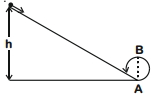
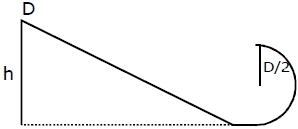
A body initially at rest and sliding along a frictionless track from a height $h$ (as shown in the figure) just completes a vertical circle of diameter $AB =D$ . The height $h$ is equal to
- A
$\;\frac{3}{2}D$
- B
$D$
- ✓
$\frac{5}{4}D\;$
- D
$\frac{7}{5}D$
AnswerCorrect option: C. $\frac{5}{4}D\;$
c
To complete a vertical circle, speed at A should be
$v_{A}=\sqrt{5 g R}$
using energy conservation $m g h=\frac{1}{2} m v_{A}^{2}$
$h=\frac{1}{2} \frac{v_{A}^{2}}{g}=\frac{1}{2} \frac{5 g}{g} \frac{D}{2} \quad\left(R=\frac{D}{2}\right)$
$h=\frac{5 D}{4}$
View full question & answer→MCQ 181 Mark
A moving block having mass $m,$ collides with another stationary block having mass $4\,m$ . The lighter block comes to rest after collision. When the initial velocity of the lighter block is $v,$ then the value of coefficient of restitution $( e)$ will be
- A
$0.5$
- ✓
$0.25$
- C
$0.4$
- D
$0.8$
AnswerCorrect option: B. $0.25$
b
Let final velocity of the block of
mass $ 4 m = v'$
Initial velocity of block of mass $ 4 m = 0 $
Final velocity of block of mass $ m = 0$
According to law of conservation of
linear momentum
$\begin{gathered}
mv + 4m \times 0 = 4mv' + 0 \Rightarrow v' = v/4 \hfill \\
Coefficient\,of\,restitution, \hfill \\
e = \frac{{\operatorname{Re} letive\,velocity\,of\,separation}}{{\operatorname{Re} letive\,velocity\,of\,separation}} \hfill \\
\,\,\, = \,\frac{{v/4}}{v} = 0.25 \hfill \\
\end{gathered} $
View full question & answer→MCQ 191 Mark
A body initially at rest, breaks up into two pieces of masses $2 M$ and $3 M$ respectively, together having a total kinetic energy $E$. The piece of mass $2 M$, after breaking up, has a kinetic energy
- A
$\frac{E}{2}$
- B
$\frac{E}{5}$
- ✓
$\frac{{3E}}{5}$
- D
$\frac{{2E}}{5}$
AnswerCorrect option: C. $\frac{{3E}}{5}$
c
From the law of conservation momentum, $p_{1}=p_{2}$
Kinetic energy, $E=\frac{p^{2}}{2 m}$
$E \propto \frac{1}{m}$
$\frac{E_{1}}{E_{2}}=\frac{m_{2}}{m_{1}}=\frac{3 M}{2 M}=\frac{3}{2}$
$\frac{E_{1}}{E_{1}+E_{2}}=\frac{3}{3+2}=\frac{3}{5}$
$\frac{E_{1}}{E}=\frac{3}{5}$
$E_{1}=\frac{3 E}{5}$
View full question & answer→MCQ 201 Mark
Consider a drop of rain water having mass $1\, g$ falling from a height of $1\, km.$ It hits the ground with a speed of $50\, m s^{-1}$. Take $g$ constant with a value $10 \, m s^{-1}$. The work done by the $(i)$ gravitational force and the $(ii)$ resistive force of air is
- A
$100\;J,\;8.75\;J\;$
- ✓
$10\;J,\;\; - 8.75\;J\;$
- C
$ - 10\;J,\;8.25\;J\;$
- D
$1.25\;J,\; - 8.25\;J\;$
AnswerCorrect option: B. $10\;J,\;\; - 8.75\;J\;$
b
$\begin{gathered}
\,\,\,Here,\,m = 1\,g = {10^{ - 3}}kg,h = 1\,km \hfill \\
\,\,\,\,\,\,\,\,\,\,\,\,\,\,\,\,\,\,\,\,\,\,\,\,\,\,\,\,\, = 100\,m, \hfill \\
v = 50\,m{s^{ - 1}},g = 10m{s^{ - 2}} \hfill \\
\left( i \right)\,The\,work\,done\,by\,the\,gravitational\, \hfill \\
force \hfill \\
\,\,\,\,\,\,\,\,\,\,\,\,\,\,\, = mgh = {10^{ - 3}} \times 10 \times 1000 = 10\,J \hfill \\
\end{gathered} $
$\begin{gathered}
\left( {ii} \right)The\,total\,work\,done\,by\,gravitational\, \hfill \\
force\,and\,the\,resistive\,force\,of\,air\,is\, \hfill \\
equal\,to\,change\,in\,kinetic\,energy\,of\, \hfill \\
rain\,drop. \hfill \\
\therefore \,{W_g} + {W_r} = \frac{1}{2}m{v^2} - 0 \hfill \\
10 + {W_r} = \frac{1}{2} \times {10^{ - 3}} \times 50 \times 50\,or\, \hfill \\
{W_r} = - 8.75\,J \hfill \\
\end{gathered} $
View full question & answer→MCQ 211 Mark
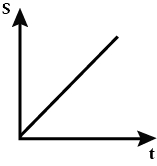
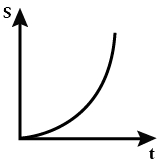
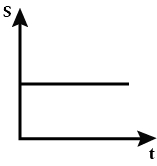
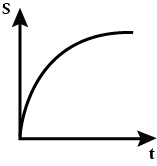
A body starts moving unidirectionally under the influence of a sourceof constant power. Which one of the graph correctly shows the variation of displacement $(s)$ with time $(t)$?
Answerb
Here, $P=\left[M L^2 T^{-3}\right]=$ constant
$\frac{L^2}{T^3}=constant$
$L \propto T^{3 / 2}$
displacement $d \propto t^{3 / 2}$
View full question & answer→MCQ 221 Mark
A particle of mass $10\, g$ moves along a circle of radius $6.4\, cm$ with a constant tangential acceleration. What is the magnitude of this acceleration if the kinetic energy of the particle becomes equal to $8 \times 10^{-4}\,J$ by the end of the second revolution after the beginning of the motion $?$ .............. $\mathrm{m} / \mathrm{s}^{2}$
- A
$0.15$
- B
$0.18$
- C
$0.2$
- ✓
$0.1$
Answerd
$\begin{gathered}
\,\,\,\,\,\,\,\,\,\,\,\,\,\,Here,\,m = 10\,g\, = {10^{ - 2}}\,kg, \hfill \\
R = 6.4\,cm = 6.4 \times {10^{ - 2}}m,\,{K_f} = 8 \times {10^{ - 4}}\,J, \hfill \\
{K_i} = 0,\,{a_{t = }}? \hfill \\
{\text{Using}}\,work\,energy\,theorem, \hfill \\
Work\,done\,by\,all\,the\,forces = Change\,in\,KE \hfill \\
{W_{\tan gential\,force\,}} + {W_{centripetal\,force}} = {K_f} - {K_i} \hfill \\
\Rightarrow {a_t} = \frac{{{K_f}}}{{4\pi Rm}} = \frac{{8 \times {{10}^{ - 4}}}}{{4 \times \frac{{22}}{7} \times 6.4 \times {{10}^{ - 2}} \times {{10}^{ - 2}}}} \hfill \\
\,\,\,\,\,\,\,\,\,\,\,\, = 0.099 \approx 0.1\,m\,{s^{ - 2}} \hfill \\
\end{gathered} $
View full question & answer→MCQ 231 Mark
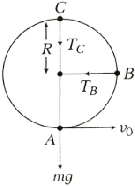
What is the minimum velocity with which a body of mass $m$ must enter a vertical loop of radius $R$ so that it can complete the loop $?$
- A
$\sqrt {2gR} $
- ✓
$\;\sqrt {5gR} $
- C
$\;\sqrt {3gR} $
- D
$\;\sqrt {gR} $
AnswerCorrect option: B. $\;\sqrt {5gR} $
b
Let the tension at point $A$ be $T_{A} .$ So, from Newton's second law
$T_{A}-m g=\frac{m v_{c}^{2}}{R}$
Energy at point $A=\frac{1}{2} m v_{0}^{2}$ $...(i)$
Energy at point $C$ is
$\frac{1}{2} m v_{c}^{2}+m g \times 2 R \ldots .$ $...(ii)$
Applying Newton's second law at point $C$
$T_{c}+m g=\frac{m v_{c}^{2}}{R}$
To complete the loop $T_{c} \geq 0$
So, $m g=\frac{m v_{c}^{2}}{R}$
$\Rightarrow \quad v_{c}=\sqrt{g R}$ $...(ii)$
From Eqs. $(i)$ and $(ii)$ by conservation of energy
$\frac{1}{2} m v_{0}^{2}=\frac{1}{2} m v_{c}^{2}+2 m g R$
$\Rightarrow \quad \frac{1}{2} m v_{0}^{2}=\frac{1}{2} m g R+2 m g R \quad\left(\because v_{c}=\sqrt{g R}\right)$
$\Rightarrow \quad v_{0}^{2}=g R+4 g R$
$\Rightarrow \quad v_{0}=\sqrt{5 g R}$
View full question & answer→MCQ 241 Mark
A particle moves from a point $\left( { - 2\hat i + 5\hat j} \right)$ to $\left( {4\hat i + 3\hat j} \right)$ when a force of $\left( {4\hat j + 3\hat k} \right)$ is applied. How much work has been done by the force ?......$J$
Answera
$\begin{array}{l}
\,\,\,\,\,Here\,\overrightarrow r = \left( { - 2\hat i + 5\hat j} \right)m,\,{\overrightarrow r _2} = \left( {4\hat j + 3\hat k} \right)m\\
\overrightarrow F = \left( {4\hat i + 3\hat j} \right)\,N,\,W = ?\\
Work\,done\,by\,force\,F\,in\,moving\,from\\
{\overrightarrow r _1}\,to{\overrightarrow {\,r} _2},\\
W = \overrightarrow F .\left( {\overrightarrow {{r_2}} - \overrightarrow {{r_1}} } \right)\\
\Rightarrow W = \left( {4\hat i + 3\hat j} \right).\left( {4\hat j + 3\hat k + 2\hat i - 5\hat j} \right)\,\,\\
= \left( {4\hat i + 3\hat j} \right).\left( {2\hat i - \hat j + 3\hat k} \right) = 8 + \left( { - 3} \right) = 5\,J
\end{array}$
View full question & answer→MCQ 251 Mark
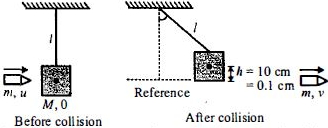
A bullet of mass $10\, g$ moving horizontally with a velocity of $400\, m s^{-1}$ strikes a wood block of mass $2\, kg$ which is suspended by light inextensible string of length $5\, m.$ As a result, the centre of gravity of the block found to rise a vertical distance of $10\, cm.$ The speed of the bullet after it emerges out horizontally from the block will be ................... $\mathrm{ms}^{-1}$
Answerb
$\begin{array}{l}
\,\,\,\,\,Mass\,of\,bullet,\,m = 10\,g = 0.01kg\\
Initial\,speed\,of\,bullet,\,u = 400\,m{s^{ - 1}}\\
Mass\,of\,block,\,M = 2\,kg\\
Lenght\,of\,string\,l = 5\,m\\
Speed\,of\,the\,block\,after\,collision = {v_1}\\
Speed\,of\,the\,bullet\,on\,emerging\,from\\
block,\,v = ?\\
{\rm{Using}}\,energy\,conseravtion\,principel\\
for\,the\,block,
\end{array}$
$\begin{array}{l}
\,\,\,\,\,\,\,\,\,\,\,{(KE + PE)_{{\mathop{\rm Re}\nolimits} ference}} = {\left( {KE + PE} \right)_h}\\
\Rightarrow \,\frac{1}{2}Mv_1^2 = Mgh\,\,\,or,\,\,\,{v_1} = \sqrt {2gh} \\
\,\,\,\,\,{v_1} = \sqrt {2 \times 10 \times 0.1} = \sqrt 2 \,m{s^{ - 1}}\\
{\rm{Using}}\,momentum\,conservation\,principle\\
for\,block\,and\,bullet\,system,
\end{array}$
$\begin{array}{l}
{\left( {M \times 0 + mu} \right)_{Before\,collision}} = {\left( {M \times {v_1} + mv} \right)_{After\,collision}}\\
\Rightarrow \,0.01 \times 400 = 2\sqrt 2 + 0.01 \times v\\
\Rightarrow v = \frac{{4 - 2\sqrt 2 }}{{0.01}} = 117.15\,m{s^{ - 1}} \approx 120\,m{s^{ - 1}}
\end{array}$
View full question & answer→MCQ 261 Mark
A body of mass $1\, kg$ begins to move under the action of a time dependent force $\overrightarrow {\;F\;} = (2t\hat i + 3{t^2}\hat j$) $N$ where $\hat i$ and $\hat j$ are unit vectors along $x$ and $y$ axis. What power will be developed by the force at the time $t$?
- A
$(2t^2+4t^4)\;W$
- B
$(2t^3+3t^4)\;W$
- ✓
$(2t^3+3t^5)\;W$
- D
$(2t^2+3t^3)\;W$
AnswerCorrect option: C. $(2t^3+3t^5)\;W$
c
$\begin{array}{l}
\,\,\,\,\,\,\,\,Here,\,\overrightarrow F = \left( {2t\hat i + 3{t^2}\hat j} \right)N,\,m = 1\,kg\\
Acceleration\,of\,the\,body,\,\overrightarrow a = \frac{{\overrightarrow F }}{m}\\
\,\, = \frac{{\left( {2t\hat i + 3{t^2}\hat j} \right)N}}{{1\,kg}}\\
Velocity\,of\,the\,body\,at\,time\,t,
\end{array}$
$\begin{array}{l}
\overrightarrow v = \int {\overrightarrow a dt = \int {\left( {2t\hat i + 3{t^2}\hat j} \right)dt = {t^2}\hat i + {t^3}\hat j\,m{s^{ - 1}}} } \\
\therefore \,power\,devloped\,by\,the\,force\,at\,time\,t,\\
P = \overrightarrow F .\overrightarrow v \, = \left( {2t\hat i + 3{t^2}\hat j} \right).\left( {{t^2}\hat i + {t^3}\hat j\,} \right)\\
W = \left( {2{t^3} + 3{t^5}} \right)W
\end{array}$
View full question & answer→MCQ 271 Mark
Two identical balls $A$ and $B$ having velocities of $0.5\, m s^{-1}$ and $-0.3 \, m s^{-1}$ respectively collide elastically in one dimension. The velocities of $B$ and $A$ after the collision respectively will be
- A
$-0.3\;m/s,0.5\;m/s$
- B
$0.3\;m/s,0.5\;m/s$
- C
$-0.5\;m/s,0.3\;m/s$
- ✓
$0.5\;m/s,-0.3\;m/s$
AnswerCorrect option: D. $0.5\;m/s,-0.3\;m/s$
d
Masses of the balls are same and collision is elastic, so their velocity will be interchanged after collision.
View full question & answer→MCQ 281 Mark
A force $\vec F = 3\hat i + c\hat j + 2\hat k$ acting on a particle causes a displacement $\vec S = - 4\hat i + 2\hat j - 3\hat k$ in its own direction. If the work done is $6J$, then the value of $c$ will be
Answera
(a) $W = \overrightarrow F .\overrightarrow s = (3\hat i + c\hat j + 2\hat k).( - 4\hat i + 2\hat j - 3\hat k)$$ = - 12 + 2c - 6$
Work done $ = 6J$ (given)
$\therefore $ $ - 12 + 2c - 6 = 6$$ \Rightarrow $ $c = 12$
View full question & answer→MCQ 291 Mark
A particle moves from position ${\vec r_1} = \,3\hat i + 2\hat j - 6\hat k$ to position ${\vec r_2} = 14\hat i + 13\hat j + 9\hat k$ under the action of force $4\hat i + \hat j + 3\hat k\,N.$ The work done will be ............ $\mathrm{J}$
Answera
(a)$W = \overrightarrow F .(\overrightarrow {{r_2}} - \overrightarrow {{r_1}} ) = (4\hat i + \hat j + 3\hat k)(11\hat i + 11\hat j + 15\hat k)$
$W = 44 + 11 + 45 = 100\,Joule$
View full question & answer→MCQ 301 Mark
A force $(\vec F) = 3\hat i + c\hat j + 2\hat k$ acting on a particle causes a displacement: $(\vec s)\, = - 4\hat i + 2\hat j + 3\hat k$ in its own direction. If the work done is $6\,J,$ then the value of $'c'$is
Answerc
(c)$W = (3\hat i + c\hat j + 2\hat k).( - 4\hat i + 2\hat j + 3\hat k) = 6\,Joule$
$W = - 12 + 2c + 6 = 6$
$⇒$ $c = 6$
View full question & answer→MCQ 311 Mark
A ball is released from the top of a tower. The ratio of work done by force of gravity in first, second and third second of the motion of the ball is
- A
$1:2:3$
- B
$1:4:9$
- ✓
$1:3:5$
- D
$1:5:3$
AnswerCorrect option: C. $1:3:5$
c
(c) When the ball is released from the top of tower then ratio of distances covered by the ball in first, second and third second
${h_I}:{h_{II}}:{h_{III}} = 1:3:5:$[because ${h_n} \propto (2n - 1)]$
Ratio of work done $mg{h_I}:mg{h_{II}}:mg{h_{III}}$$= 1:3:5$
View full question & answer→MCQ 321 Mark
A particle of mass $0.01 \;kg$ travels with velocity given by $4 \hat{ i }+16 \hat{ k } \;ms ^{-1}$. After sometime, its velocity becomes $8 \hat{ i }+20 \hat{ j }\;ms ^{-1}$. The work done on particle during this interval of time is ...... $J$
- A
$0.32$
- B
$6.9$
- C
$9.6$
- ✓
$0.96$
AnswerCorrect option: D. $0.96$
d
${v_1} = \sqrt {{4^2} + {{16}^2}} = \sqrt {272} $ and ${v_2} = \sqrt {{8^2} + {{20}^2}} = \sqrt {464}$
$W $ = $\frac{1}{2}m[v_2^2 - v_1^2] = \frac{1}{2} \times 0.01[464 - 272] = 0.96J$.
View full question & answer→MCQ 331 Mark
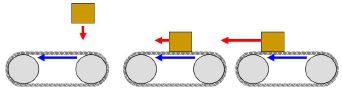
A $300\ kg$ crate is dropped vertically onto a conveyor belt that is moving at $1.20\ m/s$. A motor maintains the belt's constant speed. The belt initially slides under the crate, with a coefficient of friction of $0.400$. After a short time, the crate is moving at the speed of the belt. During the period in which the crate is being accelerated, find the work done by the motor which drives the belt :- ................. $\mathrm{J}$
Answera
Work done by the friction on block is = $-216 J$
Therefore the work done by the motor is = $2 × 216 J = 432 J$
View full question & answer→MCQ 341 Mark
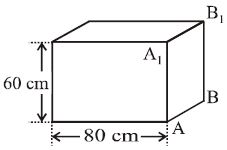
Calculate the minimum amount of work necessary to over-turn a crate of weight $100 \ kg$, first about edge $AB$, then about edge $A_1B_1$. The dimensions of the crate are given in the figure ............... $\mathrm{J}$
Answerc
$W = 1000 (0.5 - 0.3) + 1000 (0.5 - 0.4)$
= $1000 [0.2 + 0.1]$
$W$ = $300 J$
View full question & answer→MCQ 351 Mark
A ball of mass $m$ is attached to a string whose other end is fixed. The system is free to rotate in vertical plane. When the ball swings, no work is done on the ball by the tension in the string. Which of the following statements is the correct explanation?
- ✓
Tension is always perpendicular to the direction of motion of the ball.
- B
Tension is an internal force for the ball.
- C
Tension is an external force for the ball.
- D
Since the ball is swinging about the axis, total displacement is zero.
AnswerCorrect option: A. Tension is always perpendicular to the direction of motion of the ball.
a
Tension acts radially inward and velocity is tangential so tension is always $\perp $ to the direction of motion of ball.
View full question & answer→MCQ 361 Mark
A particle is made to move from the origin in three spells of equal distances, first along the $x-axis$ , second parallel to $y-axis$ and third parallel to $z-axis$ . One of the forces acting on it is has constant magnitude of $50\ N$ and always acts along the direction of motion. Work done by this force in the three spells of motion are equal and total work done in all the three spells is $300\ J$ . The final coordinates of the particle will be
- ✓
$(2, 2, 2)\ m$
- B
$(4, 4, 4)\ m$
- C
$(6, 6, 6)\ m$
- D
$(10, 10, 10)\ m$
AnswerCorrect option: A. $(2, 2, 2)\ m$
a
$\because \quad \mathrm{W}=\overrightarrow{\mathrm{F}} \cdot \overrightarrow{\mathrm{S}}$
$\Rightarrow(\mathrm{S})=\frac{\mathrm{W}}{\mathrm{F}}=\frac{300}{50}=6$
$\Rightarrow S=|x|+|y|+|z| \quad and \quad \because|x|=|y|=|z|$
$\Rightarrow$ Final cordinate of point is $(2,2,2)$
View full question & answer→MCQ 371 Mark
A force of magnitude $50\, N$ acting along $\widehat i + \widehat j + \widehat k$, displaces a point mass from $(5, 9, 7)$ to $(4, 8, 6)$. The work done by this force during this displacement is :-
- A
$150\, J$
- B
$50 \sqrt 3 \,J$
- ✓
$-50 \sqrt 3 \,J$
- D
$50/ \sqrt 3 \,J$
AnswerCorrect option: C. $-50 \sqrt 3 \,J$
c
$\overrightarrow{\mathrm{F}}=\frac{50}{\sqrt{3}}(\hat{\mathrm{i}}+\hat{\mathrm{j}}+\hat{\mathrm{k}}), \mathrm{dx}=\vec{\mathrm{r}}_{2}-\vec{\mathrm{r}}_{1}=-\hat{\mathrm{i}}-\hat{\mathrm{j}}-\hat{\mathrm{k}}$
$\therefore \mathrm{W}=\overrightarrow{\mathrm{F}} \cdot \mathrm{d} \overrightarrow{\mathrm{x}}=-50 \sqrt{3} \mathrm{J}$
View full question & answer→MCQ 381 Mark
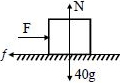
A heavy box of $40\, kg$ is pushed along $20\, m$ by two coolies over a railway platform whose coefficient of friction with the box is $0.4.$ The work done by two coolies is :- .................. $\mathrm{J}$
- ✓
$3200$
- B
$-3200$
- C
$1600$
- D
$-1600$
AnswerCorrect option: A. $3200$
a
$\mathrm{F}_{\mathrm{av}}=f=\mu \mathrm{mg}=0.4 \times 40 \mathrm{g}=160 \mathrm{N}$
$\mathrm{W}_{man}=\mathrm{F}_{\mathrm{av}} \hat{\mathrm{i}} \cdot \mathrm{s} \hat{\mathrm{i}}=160 \times 20=3200 \mathrm{J}$
View full question & answer→MCQ 391 Mark
If a person is pushing a box inside a moving train, the work done in the frame of the earth will be: (where $\vec s$ is the displacement of the box in the train and $\vec s_0$ is the displacement of the train relative to the ground)
AnswerCorrect option: C. $\vec F.\left( {\vec s + \overrightarrow {{s_0}} } \right)$
c
Displacement $w.r.t.$ ground $=v e s s+\vec{s}_{0}$
since train is moving with constant velocity net force acting on block is
$=\vec{F}$
Therefore work done $.-\vec{F} \cdot(\vec{S}+\vec{s}_{0})$
View full question & answer→MCQ 401 Mark
A particle of mass $m$ is projected at an angle $\alpha $ to the horizontal with initial velocity $u\,m/s$ then work done by gravity during the time it reaches its highest point
- A
$u^2\,sin^2\,\alpha $
- B
$\frac{{m{u^2}\,{{\cos }^2}\,\alpha }}{2}$
- ✓
$\frac{-{m{u^2}\,{{\sin }^2}\,\alpha }}{2}$
- D
$\frac{{m{u^2}\,g\,{{\sin }^2}\,\alpha }}{2}$
AnswerCorrect option: C. $\frac{-{m{u^2}\,{{\sin }^2}\,\alpha }}{2}$
c
$\begin{gathered}
\vec F\, = \,mg( - \hat j) \hfill \\
\vec S\, = \,\frac{R}{2}\hat i\, + \,H\hat j \hfill \\
\end{gathered} $
Work done by gravity $=\,\vec F.\vec S$
$ = \,-mgH\,\, = \, - \,mg\,\left( {\frac{{{u^2}\,{{\sin }^2}\,\alpha }}{{2g}}} \right)$
View full question & answer→MCQ 411 Mark
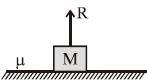
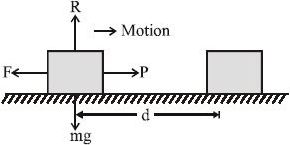
If reaction is $R$ and coefficient of friction is $\mu,$ what is work done against friction in moving a body by distance $d$ slowly ?
- A
$\frac {\mu Rd}{4}$
- B
$2\mu Rd$
- ✓
$\mu Rd$
- D
$\mu Rd/2$
AnswerCorrect option: C. $\mu Rd$
c
As shown a block of mass $\mathrm{M}$ is lying over a rough horizontal surface. Let $\mu$ be the coefficient of kinetic friction between the two surfaces in contact. The force of friction between the block and horizontal surface is given by$:$
$\mathrm{f}=\mu \mathrm{R}=\mu \mathrm{Mg} \quad(\because \mathrm{R}=\mathrm{Mg})$
To move the block without acceleration, the
force $(P)$ required will be just equal to the force of friction, i.e..
$P=f=\mu R$
If $\mathrm{d}$ is the distance moved, then work done is
gievn by$:$
$w=P \times d=\mu R d$
View full question & answer→MCQ 421 Mark
A weightlifter lifts a weight off the ground and holds it up
- A
work is done in lifting as well as holding the weight
- B
no work is done in both lifting and holding the wieght
- ✓
work is done in lifting the weigth but no work is required to be done in holding it up
- D
no work is done in lifting the weight but work is required to be done in holding it up
AnswerCorrect option: C. work is done in lifting the weigth but no work is required to be done in holding it up
c
When a weight lifter lifts a weight,
$(i)$ Work done by the lifting force $F$,
$\mathrm{W}_{1}=\mathrm{Fs} \cos 0^{\circ}=+\mathrm{Fs}$
but $(ii)$ work done in holding it up,
$\mathrm{W}_{2}=0$
(because the displacement $\overrightarrow{\mathrm{s}}=0$ )
View full question & answer→MCQ 431 Mark
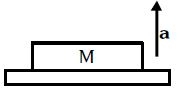
A block of mass $M$ is kept on a platform which starts accelerating upwards from rest with a constant acceleration $a$ . During the time interval $T$ the work done by contact force on mass $M$ is
AnswerCorrect option: C. $\frac {1}{2}\,M(g+a)aT^2$
c
$\mathrm{W}=\overrightarrow{\mathrm{F}} \cdot \overrightarrow{\mathrm{S}}$
$\mathrm{W}=\mathrm{R} \cdot \mathrm{S} \cdot \cos 0^{\circ}$
$=\mathrm{M}(\mathrm{g}+\mathrm{a}) \times \mathrm{S} \times 1$
$=\mathrm{M}(\mathrm{g}+\mathrm{a}) \times\left(\frac{1}{2} \mathrm{aT}^{2}\right)$
View full question & answer→MCQ 441 Mark
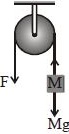
A block of mass $M$ is hanging over a smooth and light pulley through a light string. The other end of the string is pulled by a constant force $F$. The kinetic energy of the block increases by $20\,J$ in $1\, s$.
- A
The tension in the string is $Mg.$
- ✓
The tension in the string is $F$
- C
The work done by the tension on the block is $20\, J$ in the above $1\, s$.
- D
The work done by the force of gravity is $20\, J$ in the above $1\, s$.
AnswerCorrect option: B. The tension in the string is $F$
b
$\mathrm{T}=F$
Net work done $=20 \mathrm{J}$
$(\mathrm{T}-\mathrm{Mg})$ (displacement) $=20$
$(\mathrm{F}-\mathrm{Mg})$ (displacement) $=20$
View full question & answer→MCQ 451 Mark
A force of magnitude of $30\, N$ acting along $\hat i + \hat j + \hat k$ , displaces a particle from point $(2, 4, 1)$ to $(3, 5, 2)$ . The work done during this displacement is
- A
$90\,J$
- B
$30\,J$
- ✓
$30\sqrt 3\,J$
- D
$30/\sqrt 3\,J$
AnswerCorrect option: C. $30\sqrt 3\,J$
c
$W=\vec{F} \cdot \vec{S}$ where $\vec{F}=\frac{30(\hat{i}+\hat{j}+\hat{k})}{\sqrt{3}}$
and $\vec{S}=\hat{i}+\hat{j}+\hat{k}$
$30 \sqrt 3$
View full question & answer→MCQ 461 Mark
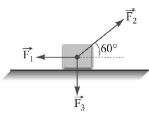
Figure shows three forces applied to a trunk that moves leftward by $3\, m$ over a smooth floor. The force magnitudes are $F_1 = 5\,N, F_2 = 9\,N$, and $F_3 = 3\,N$. The net work done on the trunk by the three forces ............... $\mathrm{J}$
AnswerCorrect option: A. $1.50$
a
$\begin{array}{l}
\overrightarrow F = - 5\hat i + 9\cos {60^ \circ }\hat i + 9\sin {60^ \circ }\hat j - 3\hat j\\
\,\,\,\,\, = \,\, - 5\hat i + \frac{9}{2}\hat i + \frac{{9\sqrt 3 }}{2}\hat j - 3\hat j\\
\,\,\,\,\, = - \frac{{\hat i}}{2} + \left( {\frac{{9\sqrt 3 }}{2} - 3} \right)\hat j\\
\overrightarrow s = - 3\hat i.\\
W = \overrightarrow F \overrightarrow s = \left[ { - \frac{{\hat i}}{2} + \left( {\frac{{9\sqrt 3 }}{2} - 3} \right)\hat j} \right].\left( { - 3\hat i} \right)\\
\,\,\,\,\,\,\,\,\,\,\,\, = 1.5\,J.
\end{array}$
View full question & answer→MCQ 471 Mark
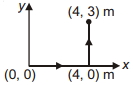
A force $\vec{F}=(3 \vec{i}+4 \vec{j}) \;N$ acts on a particle moving in $x-y$ plane. Starting from origin, the particle first goes along $x$-axis to the point $(4,0) \,m$ and then parallel to the $y$-axis to the point $(4,3) \,m$. The total work done by the force on the particle is ............. $J$
Answerd
(d)
$\vec{F}=3 \hat{i}+4 \hat{j}$
Displacement vector $(\vec{x})=4 \hat{i}+3 \hat{j}$
$\vec{F} \cdot \vec{x}=(3 i+4 \hat{j}) \cdot(4 \hat{i}+3 \hat{j})$
$=12+12=24 \,J$
View full question & answer→MCQ 481 Mark
A body of mass $m$ is allowed to fall with the help of string with downward acceleration $\frac{g}{6}$ to a distance $x$. The work done by the string is .............
- A
$\frac{m g x}{6}$
- B
$-\frac{m g x}{6}$
- ✓
$-\frac{5 m g x}{6}$
- D
$\frac{5 m g x}{6}$
AnswerCorrect option: C. $-\frac{5 m g x}{6}$
c
(c)
$m g-T=\frac{m g}{6}$
$\Rightarrow T=\frac{5}{6} m g$
$W=\frac{-5}{6} \operatorname{mgx}$
View full question & answer→MCQ 491 Mark
A string is used to pull a block of mass $m$ vertically up by a distance $h$ at a constant acceleration $\frac{g}{3}$. The work done by the tension in the string is ..............
- A
$\frac{2}{3} m g h$
- B
$\frac{-m g h}{3}$
- C
$m g h$
- ✓
$\frac{4}{3} m g h$
AnswerCorrect option: D. $\frac{4}{3} m g h$
d
(d)
$T-m g=m a$
$T=m(g+a)$
$=\frac{4}{3} m g$
Work $(w)=T . h$
$=\frac{4}{3} m g h$

View full question & answer→MCQ 501 Mark
A string is used to pull a block of mass $m$ vertically up by a distance $h$ at a constant acceleration $\frac{g}{4}$. The work done by the tension in the string is ...............

- A
$+\frac{3 m g h}{4}$
- B
$-\frac{m g h}{4}$
- ✓
$+\frac{5}{4} m g h$
- D
$+mgh$
AnswerCorrect option: C. $+\frac{5}{4} m g h$
c
(c)
$T-m g=m a$
$T=m(g+a) \Rightarrow T=m\left(g+\frac{g}{4}\right)=\frac{5}{4} m g$
$W=T \cdot h=\frac{5}{4} m g h$
View full question & answer→