A $30\,\mu F$ capacitor is charged by a constant current of $30\, mA$. If the capacitor is initially uncharged, how long does it take for the potential difference to reach $400\, V$.....$s$
Medium


Download our appand get started for free
Experience the future of education. Simply download our apps or reach out to us for more information. Let's shape the future of learning together!No signup needed.*
Similar Questions
- 1A condenser of $2\,\mu F$ capacitance is charged steadily from $0$ to $5$ $Coulomb$. Which of the following graphs correctly represents the variation of potential difference across its plates with respect to the charge on the condenserView Solution
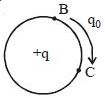
- 2A circle of radius $R$ is drawn with charge $+ q$ at the centre. A charge $q_0$ is brought from point $B$ to $C$, then work done isView Solution
- 3An elementary particle of mass $m$ and charge $ + e$ is projected with velocity $v$ at a much more massive particle of charge $Ze,$ where $Z > 0.$What is the closest possible approach of the incident particleView Solution
- 4Four identical charges $ + \,50\,\mu C$ each are placed, one at each corner of a square of side $2\,m$. How much external energy is required to bring another charge of $ + \,50\,\mu C$ from infinity to the centre of the square......$J$ $\left( {{\rm{Given}}\frac{{\rm{1}}}{{{\rm{4}}\pi {\varepsilon _{\rm{0}}}}} = 9 \times {{10}^9}\,\frac{{N{m^2}}}{{{C^2}}}} \right)$View Solution
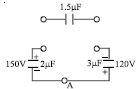
- 5Two capacitors of $2$ $\mu F$ and $3$ $\mu F$ are charged to $150$ $volt$ and $120$ $volt$ respectively. The plates of capacitor are connected as shown in the figure. A discharged capacitor of capacity $1.5$ $\mu F$ falls to the free ends of the wire. ThenView Solution
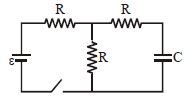
- 6View SolutionThe time constant of given circuit is
- 7Two condensers of capacity $0.3\,\mu F$ and $0.6\,\mu F$ respectively are connected in series. The combination is connected across a potential of $6\,volts$. The ratio of energies stored by the condensers will beView Solution
- 8A charge is spread non-uniformly on the surface of a hollow sphere of radius $R$, such that the charge density is given by $\sigma=\sigma_0(1-\sin \theta)$, where $\theta$ is the usual polar angle. The potential at the centre of the sphere isView Solution
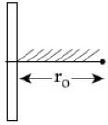
- 9A positive point charge is released from rest at a distance $r_0$ from a positive line charge with uniform density. The speed $(v)$ of the point charge, as a function of instantaneous distance $r$ from line charge, is proportional toView Solution
- 10The work done to take an electron from rest where potential is $-60\, V$ to another point where potential is $-20\, V$ is given by.....$eV$View Solution