MCQ
A $4 \,kg$ mass and a $1\, kg$ mass are moving with equal kinetic energies. The ratio of the magnitudes of their linear momenta is
  • A
    $1:2$
  • B
    $1:1$
  • $2:1$
  • D
    $4:1$

Answer

Correct option: C.
$2:1$
c
(c)$P = \sqrt {2mE} .$ If $E$ are const. then $\frac{{{P_1}}}{{{P_2}}} = \sqrt {\frac{{{m_1}}}{{{m_2}}}} = \sqrt {\frac{4}{1}} $$= 2$

Need a full question paper?

Generate a complete, print-ready paper with questions like this in minutes — across 16+ boards, with answer keys.
Start Generating Free

Similar questions

A body is projected from the ground at an angle of $45^{\circ}$ with the horizontal. Its velocity after $2s$ is $20 \,ms ^{-1}$. The maximum height reached by the body during its motion is $m$. (use $g =10\, ms ^{-2}$ )
For any $S.H.M.$, amplitude is $6\, cm$. If instantaneous potential energy is half the total energy then distance of particle from its mean position is .... $cm$
The unit of self inductance of a coil is
A mass $m$ is moving with a constant velocity along a line parallel to the $x-$axis away from the origin. Its angular momentum w.r.t. the origin is:
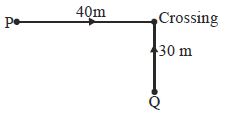
A car $P$ approaching a crossing at a speed of $10\, m/s$ sounds a horn of frequency $700\, Hz$ when $40\, m$ in front of the crossing. Speed of sound in air is $340\, m/s$. Another car $Q$ is at rest on a road which is perpendicular to the road on which car $P$ is reaching the crossing (see figure). The driver of car $Q$ hears the sound of the horn of car $P$ when he is $30\, m$ in front of the crossing. The apparent frequency heard by the driver of car $Q$ is .... $Hz$
Which of the following statements is incorrect regarding the polar satellite.
A river is flowing from west to east at a speed of 5 metres per minute. A man on the south bank of the river, capable of swimming at 10 metres per minute in still water, wants to swim across the river in the shortest time. He should swim in a direction:
Which of the following equations represents a travelling wave ?
Energy equals of a mass of one microgram in kilo joules is:
Consider the following two statements
$1.$ Linear momentum of a system of particles is zero
$2.$ Kinetic energy of a system of particles is zeroThen