Question
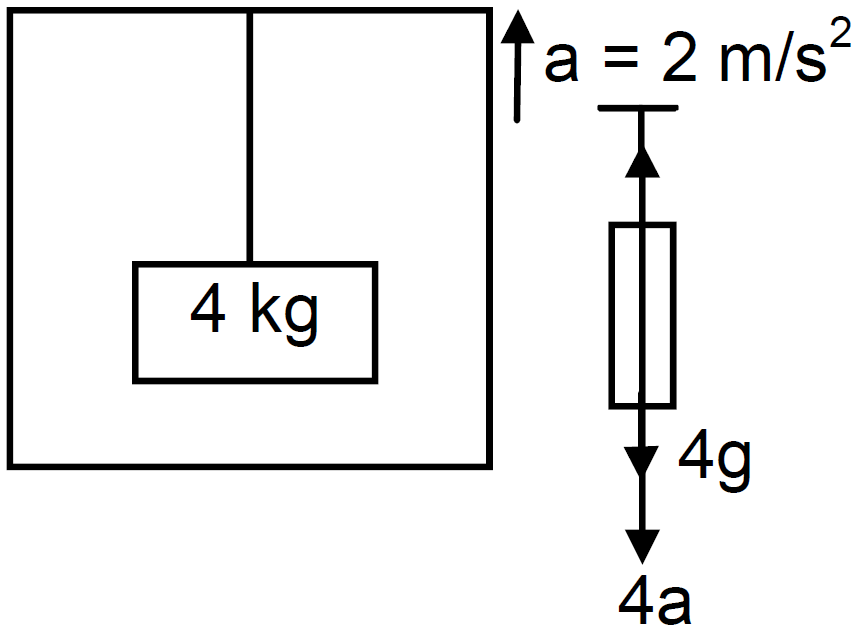
A $4.0\ kg$ block is suspended from the ceiling of an elevator through a, string having a linear mass density of $19.2 \times 10^{-3}kg/m.$ Find the speed $($with respect to the string$)$ with which a wave pulse can proceed on the string if the elevator accelerates up at the rate of $2.0m/s^2$. Take $g = 10m/s^2.$
Answer


$\text{m}=19.2\times10^{-3}\text{kg/m}$
From the freebody diagram,$\text{T}-4\text{g}-4\text{a}=0$
$\Rightarrow\text{T}=4(\text{a}+\text{g})=48\text{N}$
Wave speed, $\text{v}=\sqrt{\Big(\frac{\text{T}}{\text{m}}\Big)}=50\text{m/s}$

Need a full question paper?

Generate a complete, print-ready paper with questions like this in minutes — across 16+ boards, with answer keys.

Start Generating Free

Similar questions

Suppose the density of air at Madras is $P_0$ and atomospheric pressure is $P_0.$ If we go up, the density and the pressure both decrease. Suppose we wish to calculate the pressure at a height $10\ km$ above Madras. If we use the equation $P_{0 }- P = pogz,$ will we get a pressure more than the actual or less than the actual? Neglect the variation in $g.$ Does your answer change if you also consider the variation in $g$?
Two long bar magnets are placed with their axes coinciding in such a way that the north pole of the first magnet is 2·0cm from the south pole of the second. If both the magnets have a pole strength of 10A-m, find the force exerted by one magnet on the other.
A tangent galvanometer shows a deflection of $45^\circ$ when $10mA$ of current is passed through it. If the horizontal component of the earth's magnetic field is $B_H = 3.6\times 10^{-5}\ T$ and radius of the coil is 1$0\ cm,$ find the number of turns in the coil.
A uniform magnetic field of $0.20 \times 10^{-3} T$ exists in the space. Find the change in the magnetic scalar potential as one moves through $50\ cm$ along the field.
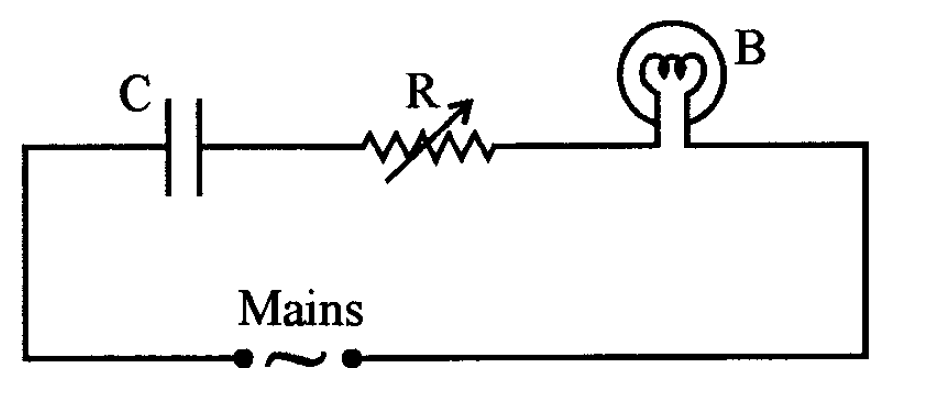
A capacitor'C', a variable resistor 'R' and a bulb 'B' are connected in series to the ac mains in circuit as shown. The bulb glows with some brightness. How will the glow of the bulb change if (i) a dielectric slab is introduced between the plates of the capacitor, keeping resistance R to be the same; (ii) the resistance R is increased keeping the same capacitance?
The absolute temperature of air in a region linearly increases from $T_1$ to $T_2$ in a space of width d. Find the time taken by a sound wave to go through the region in terms of $T_1, T_2$, d and the speed v of sound at $273K$. Evaluate this time for $T_1 = 280K, T_2 = 310K, d = 33m$ and $v = 330\ m/s.$
A van is standing on a frictionless portion of a horizontal road. To start the engine, the vehicle must be set in motion in the forward direction. How can the persons sitting inside the van do it without coming out and pushing from behind?
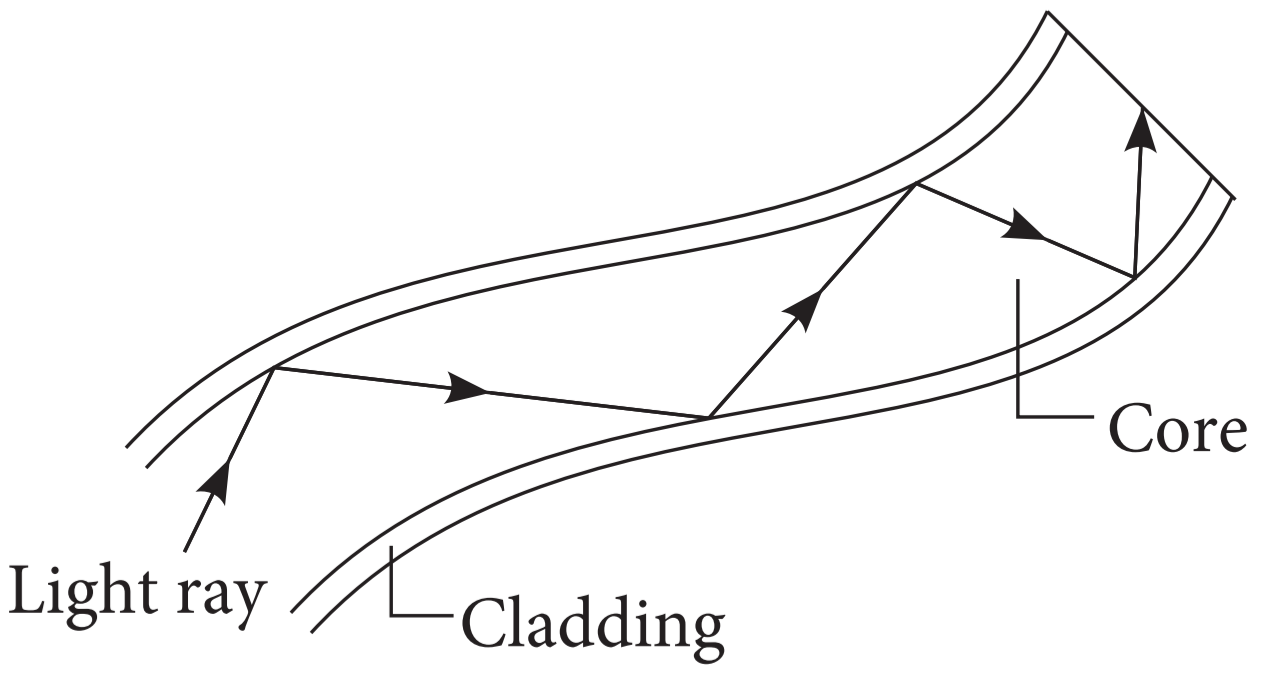
An optical fibre is a thin tube of transparent material that allows light to pass through, without being refracted into the air or another external medium. It make use of total internal reflection. These fibres are fabricated in such a way that light reflected at one side of the inner surface strikes the other at an angle larger than critical angle. Even, if fibre is bent, light can easily travel along the length.
  1. Which of the following is based on the phenomenon of total internal reflection of light?
  1. Sparkling of diamond.
  2. Optical fibre communication.
  3. Instrument used by doctors for endoscopy.
  4. All of these.
  1. A ray of light will undergo total internal reflection inside the optical fibre, if it.
  1. Goes from rarer medium to denser medium.
  2. Is incident at an angle less than the critical angle.
  3. Strikes the interface normally.
  4. Is incident at an angle greater than the critical angle.
  1. If in core, angle of incidence is equal to critical angle, then angle of refraction will be.
  1. $0^\circ$
  2. $45^\circ$
  3. $90^\circ$
  4. $180^\circ$
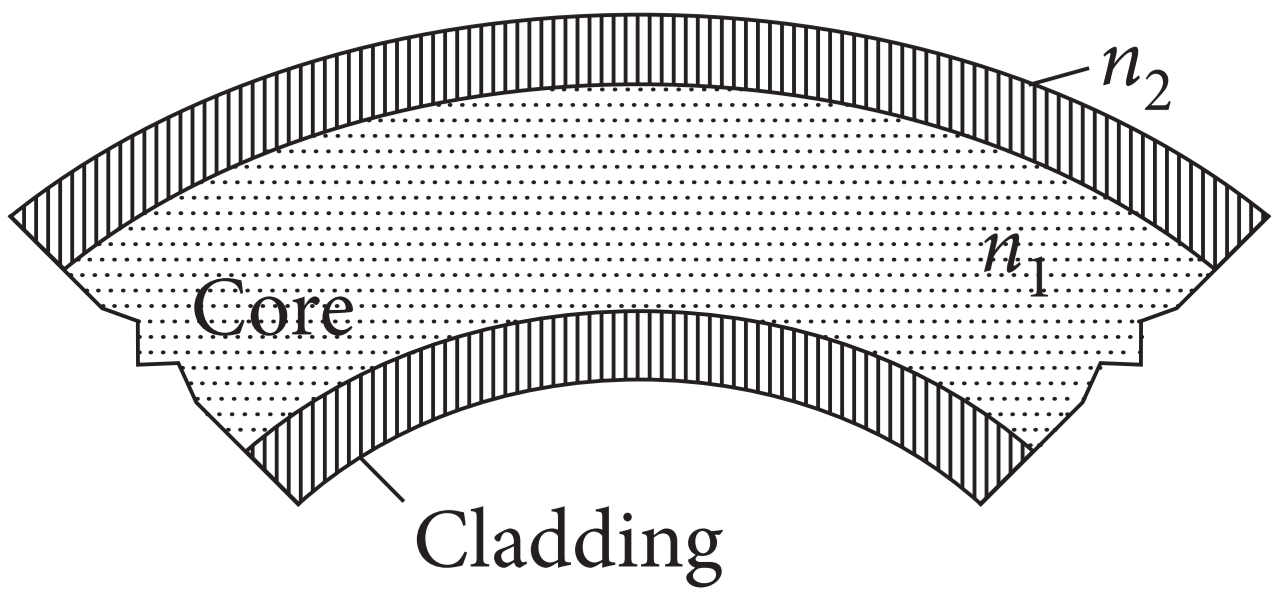
  1. In an optical fibre $($shown$),$ correct relation for refractive indices of core and cladding is:
  1. $n_1 = n_2$
  2. $n_1 > n_2$
  3. $n_1 < n_2$
  4. $n_1 + n_2 = 2$
  1. If the value of critical angle is $300$ for total internal reflection from given optical fibre, then speed of light in that fibre is:
  1. $3 \times 10^8ms^{-1}$
  2. $1.5 \times 10^8ms^{-1}$
  3. $6 \times 10^8ms^{-1}$
  4. $4.5 \times 10^8ms^{-1}$
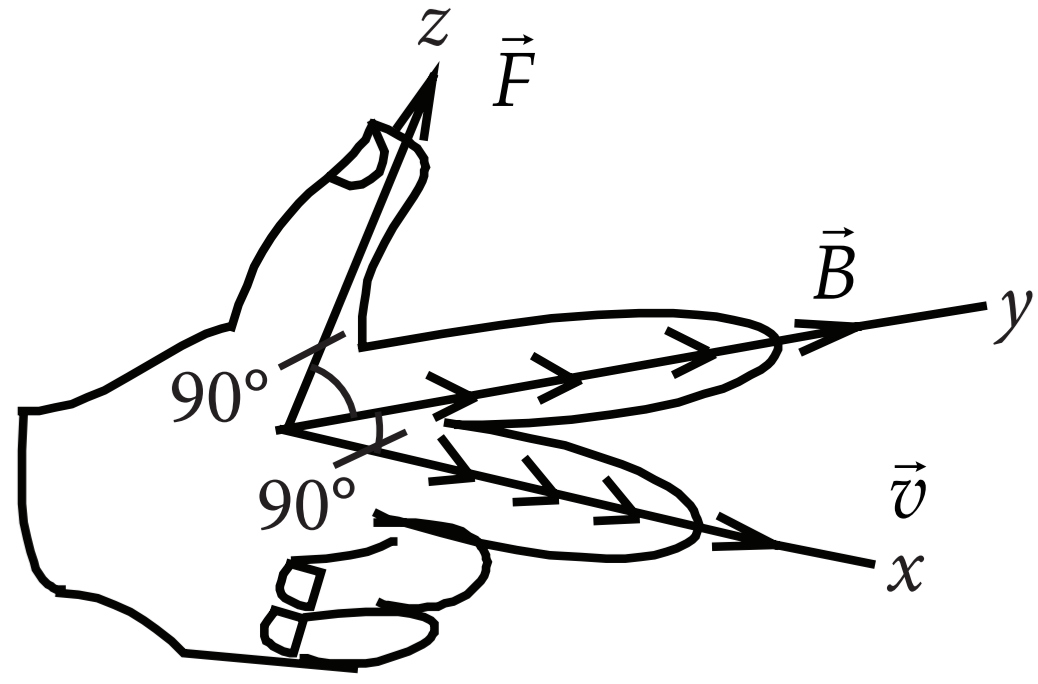
A charged particle moving in a magnetic field experiences a force that is proportional to the strength of the magnetic field, the component of the velocity that is perpendicular to the magnetic field and the charge of the particle. This force is given by $\vec{\text{F}}=\text{q}(\vec{\text{v}}\times\vec{\text{B}})$ where $q$ is the electric charge of the particle, $v$ is the instantaneous velocity of the particle, and Bis the magnetic field $($in tesla$).$ The direction of force is determined by the rules of cross product of two vectors. Force is perpendicular to both velocity and magnetic field. Its direction is same as $\vec{\text{v}}\times\vec{\text{B}}$ if $q$ is positive and opposite of $\vec{\text{v}}\times\vec{\text{B}}$ if $q$ is negative. The force is always perpendicular to both the velocity of the particle and the magnetic field that created it. Because the magnetic force is always perpendicular to the motion, the magnetic field can do no work on an isolated charge. It can only do work indirectly, via the electric field generated by a changing magnetic field.
  1. When a magnetic field is applied on a stationary electron, it:
  1. Electric field only.
  2. Magnetic field only.
  3. Both electric and magnetic field.
  4. None of these.
  5. Moving charge will produce.
  6. In $z-y$ plane.
  7. Along $-y$ axis.
  8. Along $+z$ axis.
  9. Along $-z$ axis.
  10. A charge $q$ moves with a velocity $2m s^{-1}$ along $x-$axis in a uniform magnetic field $\vec{\text{F}}=(\vec{\text{i}}+2\vec{\text{j}}+3\vec{\text{k}})\text{T,}$ charge will experience a force.
  11. The particle is stationary and magnetic field is perpendicular.
  12. The particle is moving and magnetic field is perpendicular to the velocity.
  13. The particle is stationary and magnetic field is parallel.
  14. The particle is moving and magnetic field is parallel to velocity.
  15. A charged particle experiences magnetic force in the presence of magnetic field. Which of the following statement is correct?
  16. The proton will be accelerated along the axis.
  17. The proton path will be circular about the axis.
  18. The proton moves along helical path.
  19. The proton will continue to move with velocity $v$ along the axis.
  20. A proton is projected with a uniform velocity $v$ along the axis of a current carrying solenoid, then,
  21. Remains stationary.
  22. Spins about its own axis.
  23. Moves in the direction of the field.
  24. Moves perpendicular to the direction of the field.
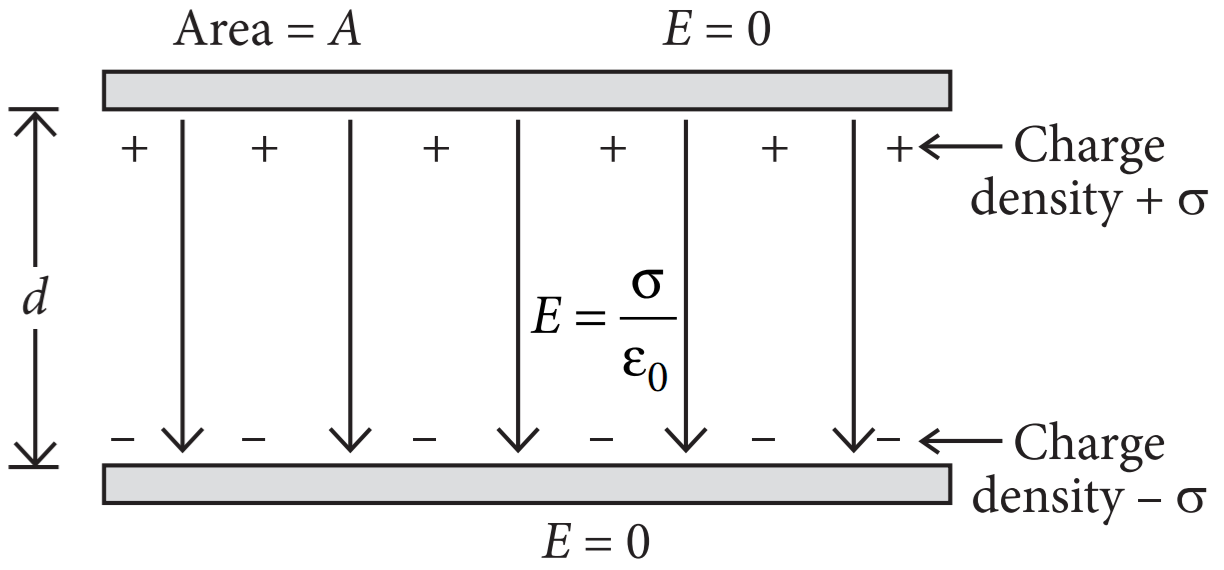
The simplest and the most widely used capacitor is the parallel plate capacitor. It consists of two large plane parallel conducting plates, separated by a small distance. In the outer regions above the upper plate and below the lower plate, the electric fields due to the two charged plates cancel out. The net field is zero. In the inner region between the two capacitor plates, the electric fields due to the two charged plates add up. The net field is $\frac{\sigma}{\epsilon_0}.$
For a uniform electric field, potential difference between the plates $=$ Electric field x distance between the plates. Capacitance of the parallel plate capacitor is the charge required to supplied to either of the conductors of the capacitor so as to increase the potential difference between then by unit amount.
  1. A parallel plate capacitor is charged and then isolated. The effect of increasing the plate separation on charge, potential and capacitance respectively are:
  1. Increases, decreases, decreases.
  2. Constant, increases, decreases.
  3. Constant, decreases, decreases.
  4. Constant, decreases, increases.
  1. In a parallel plate capacitor, the capacity increases if:
  1. Area of the plate is decreases.
  2. Distance between the plates increases.
  3. Area of the plate is increases.
  4. Dielectric constant decreases.
  1. A parallel plate capacitor has two square plates with equal and opposite charges. The surface charge densities on the plates are $+\sigma$ and $-\sigma$ respectively. In the region between the plates the magnitude of the electric field is:
  1. $\frac{\sigma}{2\epsilon_0}$
  2. $\frac{\sigma}{\epsilon_0}$
  3. $0$
  4. None of these.
  1. If a parallel plate air capacitor consists of two circular plates of diameter $8\ cm$. At what distance should the plates be held so as to have the same capacitance as that of sphere of diameter $20\ cm$?
  1. $9\ mm$
  2. $4\ mm$
  3. $8\ mm$
  4. $2\ mm$
  1. If a charge of $+ 2.0 \times 10^{-8}C$ is placed on the positive plate and a charge of $- 1.0 \times 10^{-8}C$ on the negative plate of a parallel plate capacitor of capacitance $1.2\times10^{-3}\mu\text{F},$ then the potential difference developed between the plates is:
  1. $6.25V$
  2. $3.0V$
  3. $12.5V$
  4. $25V$