Question types

Wave Motion and Waves on a String question types

80 questions across 5 question groups — pick any mix to generate a Physics paper with step-by-step answer keys.

80
Questions
5
Question groups
5
Question types
Sample Questions

Wave Motion and Waves on a String questions

One sample from each question group in this chapter. Select any group above to see the full set with answer keys.
Consider two waves passing through the same string. Principle of superposition for displacement says that the net displacement of a particle on the string is sum of the displacements produced by the two waves individually. Suppose we state similar principles for the net velocity of the particle and the net kinetic energy of the particle. Such a principle will be valid for:
  1. Both the velocity and the kinetic energy.
  2. The velocity but not for the kinetic energy.
  3. The kinetic energy but not for the velocity.
  4. Neither the velocity nor the kinetic energy.
View full solution
A cork floating in a calm pond executes simple harmonic motion of frequency v when a wave generated by a boat passes by it. The frequency of the wave is:
  1. $\text{v}$
  2. $\frac{\text{v}}{2}$
  3. $2\text{v}$
  4. $\sqrt{2}\text{v}.$
View full solution
A wave is represented by an equation $\text{y}=\text{c}_1\sin(\text{c}_2\text{x}+\text{c}_3\text{t}).$ In which direction is the wave going ? Assume that $c_1, c_2$ and $c_3$ are all positive.
View full solution
Show that for a wave travelling on a string:$\frac{\text{y}_\text{max}}{\text{u}_\text{max}}=\frac{\text{v}_\text{max}}{\text{a}_\text{max}},$
Where the symbols have usual meanings. Can we use componendo and dividendo taught in algebra to write,$\frac{\text{y}_\text{max}+\text{v}_\text{max}}{\text{y}_\text{max}-\text{v}_\text{max}}=\frac{\text{v}_\text{max}+\text{a}_\text{max}}{\text{v}_\text{max}-\text{a}_\text{max}}?$
View full solution
Q 113 Marks Question3 Marks
A steel wire of mass $4.0g$ and length $80\ cm$ is fixed at the two ends. The tension in the wire is $50N$. Find the frequency and wavelength of the fourth harmonic of the fundamental.
View full solution
Q 123 Marks Question3 Marks
A $2$ in long string fixed at both ends is set into vibrations in its first overtone. The wave speed on the string is $200m/s$ and thee amplitude is $0.5\ cm.$
  1. Find the wavelength and the frequency.
  2. Write the equation giving the displacement of different points as a function of time. Choose the $X-$axis along the string with the origin at one end and $t = 0$ at the instant when the point $x = 50\ cm$ has reached its maximum displacement.
View full solution
Q 133 Marks Question3 Marks
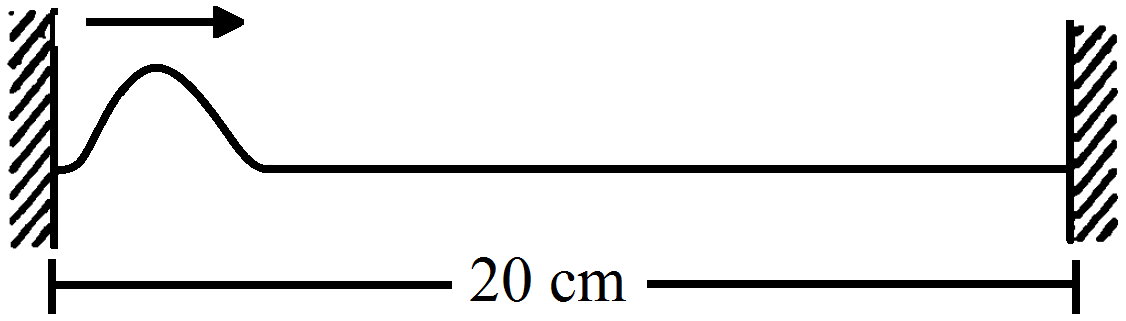
A string of length 20cm and linear mass density 0.40g/cm is fixed at both ends and is kept under a tension of 16N. A wave pulse is produced at t = 0 near an end as shown in figure, which travels towards the other end.
  1. When will the string have the shape shown in the figureagain
  2. Sketch the shape of the string at a time half of that found in part (a).
View full solution
Q 143 Marks Question3 Marks
Two long strings $A$ and $B,$ each having linear mass density $1.2 \times 10^{-2}\ kg/m$, are stretched by different tensions $4.8N$ and $7.5N$ respectively and are kept parallel to each other with their left ends at $x = 0.$ Wave pulses are produced on the strings at the left ends at $t = 0$ on string $A$ and at $t = 20\ ms$ on string $B.$ When and where will the pulse on $B$ overtake that on $A$?
View full solution
Q 153 Marks Question3 Marks
A $40\ cm$ wire having a mass of $3.2g$ is stretched between two fixed supports $40.05\ cm$ apart. In its fundamental mode, the wire vibrates at $220\ Hz$. If the area of cross-section of the wire is $1.0mm^2$, find its Young's modulus.
View full solution
A $4.0\ kg$ block is suspended from the ceiling of an elevator through a, string having a linear mass density of $19.2 \times 10^{-3}kg/m.$ Find the speed $($with respect to the string$)$ with which a wave pulse can proceed on the string if the elevator accelerates up at the rate of $2.0m/s^2$. Take $g = 10m/s^2.$
View full solution
A wave is described by the equation$\text{y}=(1.0\text{mm})\sin\pi\Big(\frac{\text{x}}{2.0\text{cm}}-\frac{\text{t}}{0.01\text{s}}\Big).$
  1. Find the time period and the wavelength.
  2. Write the equation for the velocity of the particles. Find the speed of the particle at x = 1.0cm at time t = 0.01s.
  3. What are the speeds of the particles at x = 3.0cm, 5.0cm and 7.0cm at t 0.01s?
  4. What are the speeds of the particles at x 1.0cm at t = 0.011, 0.012, and 0.013s?
View full solution
Two waves, each having a frequency of $100Hz$ and a wavelength of $2.0\ cm,$ are travelling in the same direction on a string. What is the phase difference between the waves,
  1. If the second wave was produced $0.015s$ later than the first one at the same place.
  2. If the two waves were produced at the same instant but the first one was produced a distance $4.0\ cm$ behind the second one?
  3. If each of the waves has an amplitude of $2.0\ mm,$ what would be the amplitudes of the resultant waves in part $(a)$ and $(b)$?
View full solution
The equation of a wave travelling on a string stretched along the X-axis is given by-$\text{y}=\text{A}\text{e}^{-\Big(\frac{\text{x}}{\text{a}}+\frac{\text{t}}{\text{T}}\Big)^2}.$
  1. Write the dimensions of A, a and T.
  2. Find the wave speed.
  3. In which direction is the wave. travelling?
  4. Where is the maximum of the pulse located at t = T? at t = 2T?
View full solution
A wave propagates on a string in the positive $x-$direction at a velocity v. The shape of the string at $t =$ to is given by $\text{g}(\text{x},\text{t}_0)=\text{A}\sin\big(\frac{\text{x}}{\text{a}}\big).$ Write the wave equation for a general time t.
View full solution
A wave travels along the positive x-direction with a speed of 20m/s. The amplitude of the wave is 0.20cm and the wavelength 2.0cm.
  1. Write a suitable wave equation which describes this wave.
  2. What is the displacement and velocity of the particle at x = 2.0cm at time t = 0 according to the wave equation written? Can you get different values of this quantity if the wave equation is written in a different fashion?
View full solution

Generate a Wave Motion and Waves on a String paper free

Pick question groups from the list above, set marks and difficulty, and export a branded PDF with step-by-step answer keys. First 3 chapters free — no signup.

Download App