Question
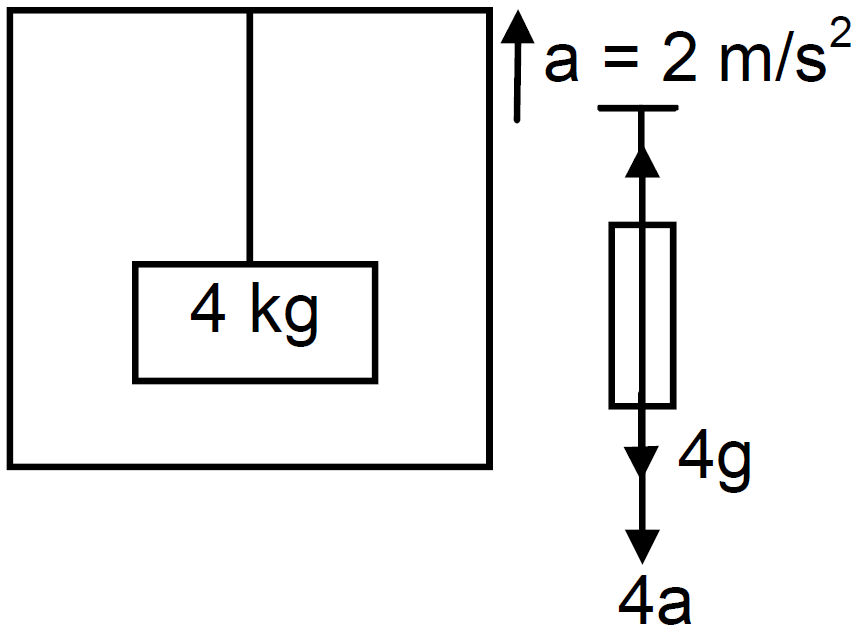
A 4.0kg block is suspended from the ceiling of an elevator through a, string having a linear mass density of $19.2 \times 10^{-3}kg/m.$ Find the speed (with respect to the string) with which a wave pulse can proceed on the string if the elevator accelerates up at the rate of $2.0m/s^2.$ Take $g = 10m/s^2.$
Answer


$\text{m}=19.2\times10^{-3}\text{kg/m}$
From the freebody diagram,$\text{T}-4\text{g}-4\text{a}=0$
$\Rightarrow\text{T}=4(\text{a}+\text{g})=48\text{N}$
Wave speed, $\text{v}=\sqrt{\Big(\frac{\text{T}}{\text{m}}\Big)}=50\text{m/s}$

Need a full question paper?

Generate a complete, print-ready paper with questions like this in minutes — across 16+ boards, with answer keys.

Start Generating Free

Similar questions

A long bar magnet has a pole strength of 10A-m. Find the magnetic field at a point on the axis of the magnet at a distance of 5cm from the north pole of the magnet.
ln Young's double slit experiment, the width of the central bright fringe is equal to the distance between the first dark fringes on the two sides of the central bright fringe.
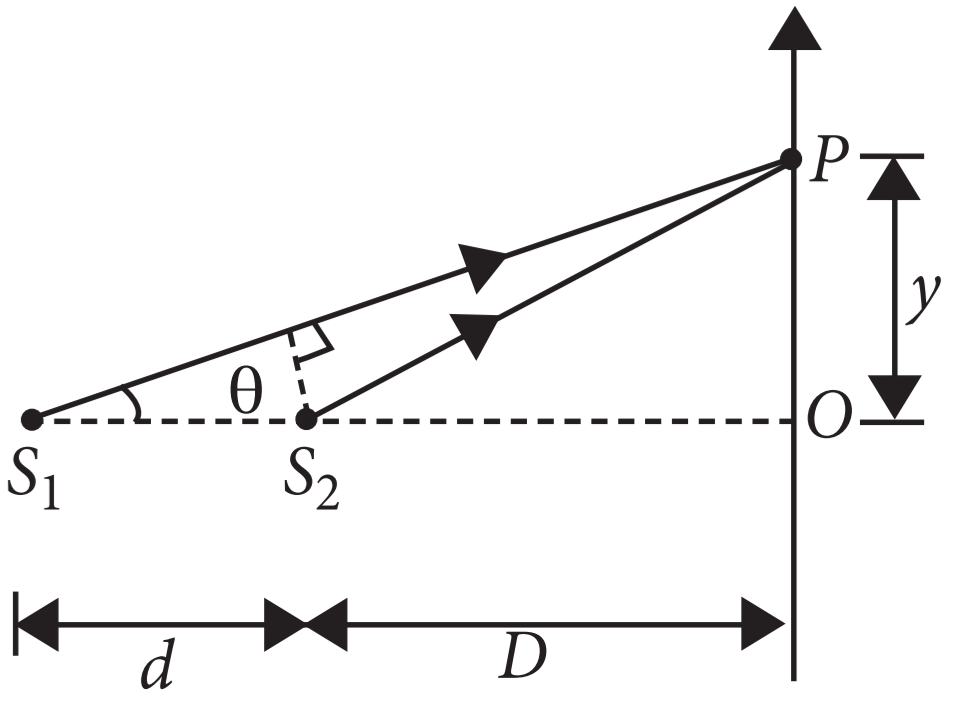
ln given figure below a screen is placed normal to the tine joining the two point coherent source $S_1$ and $S_2.$ The interference pattern consists of concentric circles.
  1. The optical path difference at P is:
  1. $\text{d}\Big[1+\frac{\text{y}^2}{2\text{D}}\Big]$
  2. $\text{d}\Big[1+\frac{2\text{D}}{\text{y}^2}\Big]$
  3. $\text{d}\Big[1-\frac{\text{y}^2}{2\text{D}^2}\Big]$
  4. $\text{d}\Big[2\text{D}-\frac{1}{\text{y}^2}\Big]$
  1. Find the radius of the $n^{th}$ bright fringe.
  1. $\text{D}\sqrt{1\Big(1-\frac{\text{n}\lambda}{\text{d}}\Big)}$
  2. $\text{D}\sqrt{2\Big(1-\frac{\text{n}\lambda}{\text{d}}\Big)}$
  3. $2\text{D}\sqrt{2\Big(1-\frac{\text{n}\lambda}{\text{d}}\Big)}$
  4. $\text{D}\sqrt{2\Big(1-\frac{\text{n}\lambda}{2\text{d}}\Big)}$
  1. If $\text{d}=0.5\text{mm}.\lambda=5000\mathring{\text{A}}$ and D = 100cm, find the value of n for the closest second bright fringe.
  1. $888$
  2. $830$
  3. $914$
  4. $998$
  1. The coherence of two light sources means that the light waves emitted have.
  1. Same frequency.
  2. Same intensity.
  3. Constant phase difference.
  4. Same velocity.
  1. The phenomenon of interference is shown by:
  1. Longitudinal mechanical waves only.
  2. Transverse mechanical waves only.
  3. Electromagnetic waves only.
  4. All of these.
A magnetic needle is free to rotate in a vertical plane which makes an angle of 60° with the magnetic meridian. If the needle stays in a direction making an angle of $\tan^{-1}\Big(\frac{2}{\sqrt{3}}\Big)$ with the horizontal, what would be the dip at that place?
Ram is a student of class X in a village school. His uncle gifted him a bicycle with a dynamo fitted in it. He was very excited to get it. While cycling during night, he could light the bulb and see the objects on the road. He however, did not know this device works. He asked this question to his teacher. the teacher considered it an opportunity to explain the working to the whole class.
Answer the following question:
  1. State the principle and working of a dynamo.
  2. Write two values each displayed by Ram and his school teacher.
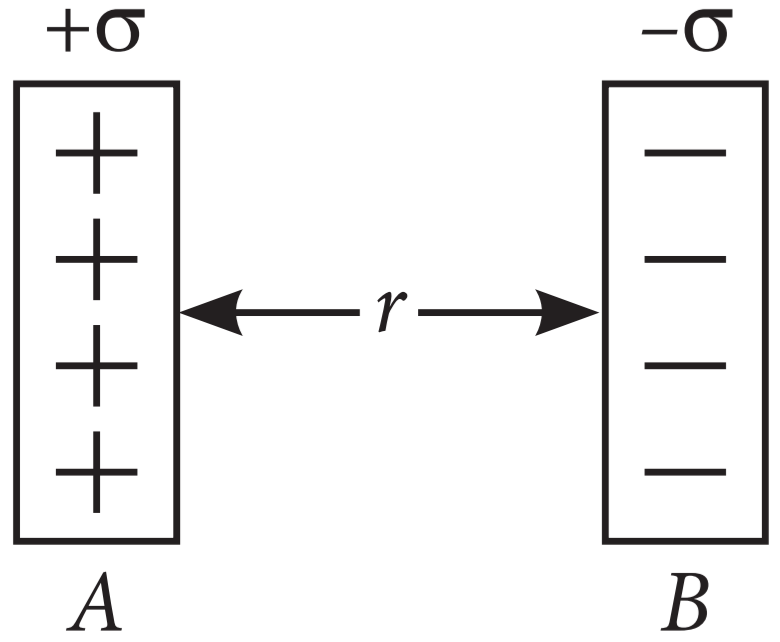
Surface charge density is defined as charge per unit surface area of surface charge distribution. i.e., $\sigma=\frac{\text{dq}}{\text{dS}}.$ Two large, thin metal plates are parallel and close to each other. On their inner faces, the plates have surface charge densities of opposite signs having magnitude of $17.0 \times 10^{-22}Cm^{-2}$ as shown. The intensity of electric field at a point is $\text{E}=\frac{\sigma}{\in_0},$ where$\in_0=$ permittivity of free space.
  1. E in the outer region of the first plate is:
  1. $17 \times 10^{-22} N/C$
  2. $1.5 \times 10^{-25} N/C$
  3. $1.9 \times 10^{-10} N/C$
  4. Zero.
  1. E in the outer region of the second plate is:
  1. $17 \times 10^{-22} N/C$
  2. $1.5 \times 10^{-15} N/C$
  3. $1.9 \times 10^{-10} N/C$
  4. Zero.
  1. E between the plates is:
  1. $17 \times 10^{-22} N/C$
  2. $1.5 \times 10^{-15} N/C$
  3. $1.9 \times 10^{-10} N/C$
  4. Zero.
  1. The ratio of E from right side of B at distances 2cm and 4cm, respectively is:
  1. 1 : 2
  2. 2 : 1
  3. 1 : 1
  4. $1:\sqrt{2}$
  1. ln order to estimate the electric field due to a thin finite plane metal plate, the Gaussian surface considered is:
  1. Spherical.
  2. Spherical.
  3. Straight line.
  4. None of these.
When white radiation is passed through a sample of hydrogen gas at room temperature, absorption lines are observed in Lyman series only. Explain.
A uniform magnetic field of $0.20 \times 10^{-3}$ T exists in the space. Find the change in the magnetic scalar potential as one moves through 50cm along the field.
In pair annihilation, an electron and a positron destroy each other to produce gamma radiation. How is the momentum conserved?
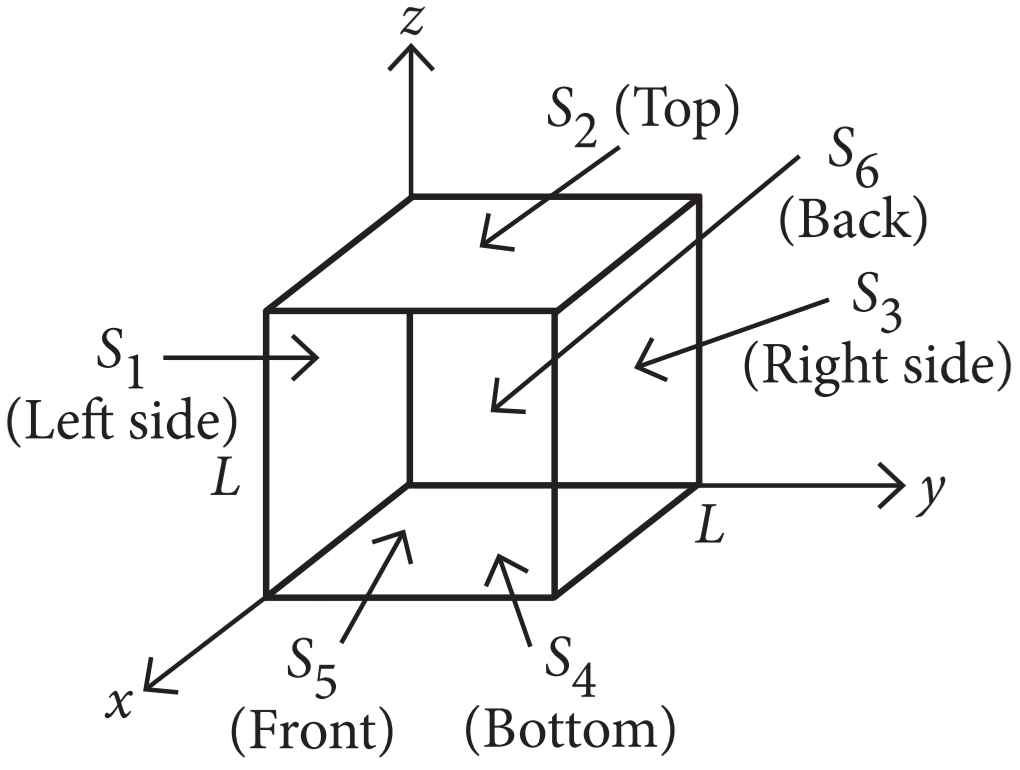
Net electric flux through a cube is the sum of fluxes through its six faces. Consider a cube as shown in figure, having sides of length L = 10.0cm. The electric field is uniform, has a magnitude $E = 4.00 \times 10^3N C^{-1}$ and is parallel to the xy plane at an angle of 37º measured from the + x - axis towards the + y - axis.
  1. Electric flux passing through surface $S_6$ is:
  1. $-24N\ m^2C^{-1}$
  2. $24N\ m^2C^{-1}$
  3. $32N\ m^2C^{-1}$
  4. $-32N\ m^2C^{-1}$
  1. Electric flux passing through surface $S_1$ is:
  1. $-24N\ m^2C^{-1}$
  2. $24N\ m^2 C^{-1}$
  3. $32N\ m^2 C^{-1}$
  4. $-32N\ m^2 C^{-1}$
  1. The surfaces that have zero flux are:
  1. $S_1$ and $S_3$
  2. $S_5$ and $S_6$
  3. $S_2$ and $S_4$
  4. $S_1$ and $S_2$
  1. The total net electric flux through all faces of the cube is:
  1. 8N $m^2\ C^{-1}$
  2. -8N $m^2\ C^{-1}$
  3. 24N $m^2\ C^{-1}$
  4. Zero.
  1. The dimensional formula of surface integral $\oint\vec{\text{E}}\cdot\text{d}\vec{\text{S}}$ of an electric field is:
  1. $[M\ L^2T^{-2} A^{-1}]$
  2. $[M\ L^3T^{-3} A^{-1}]$
  3. $[M\ L^{-1}T^3 A^{-3}]$
  4. $[M\ L^{-3}T^{-3} A^{-1}]$