Question
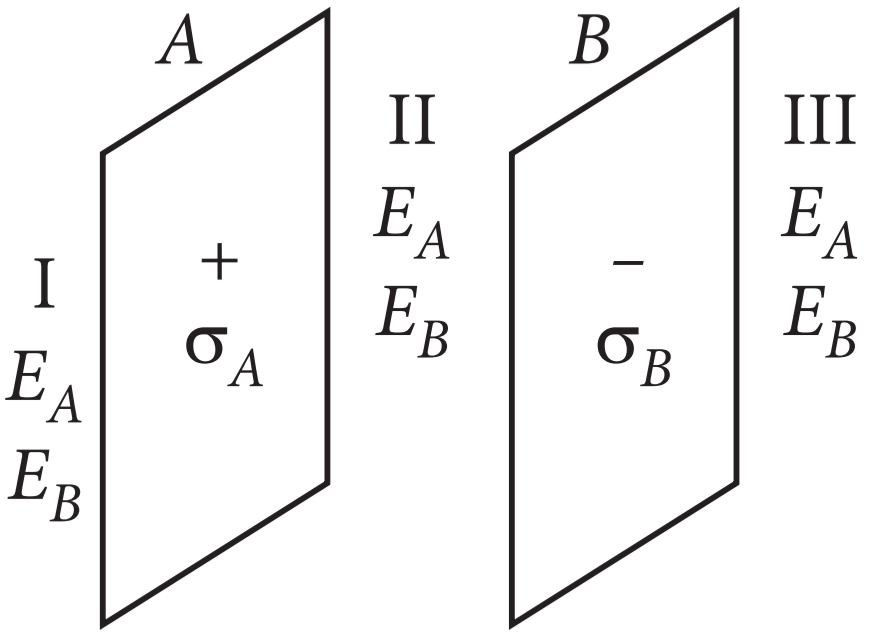
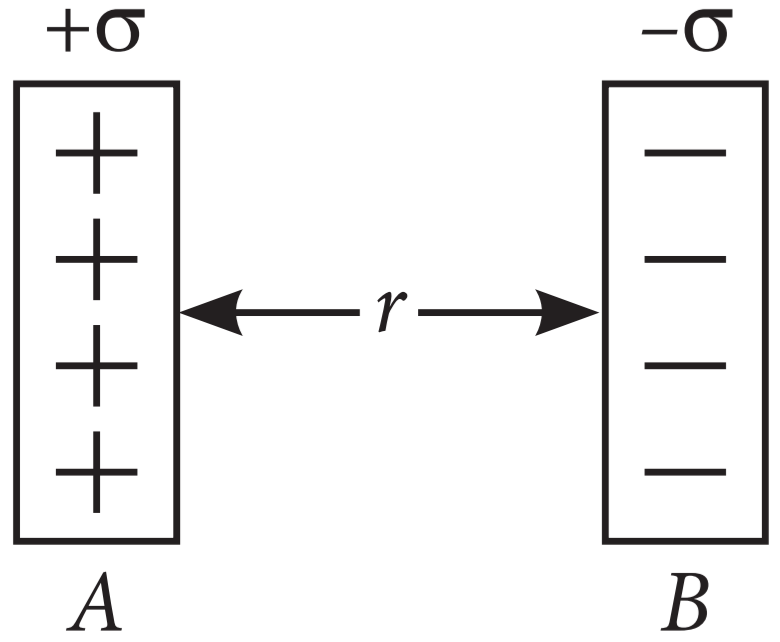
Surface charge density is defined as charge per unit surface area of surface charge distribution. i.e., $\sigma=\frac{\text{dq}}{\text{dS}}.$ Two large, thin metal plates are parallel and close to each other. On their inner faces, the plates have surface charge densities of opposite signs having magnitude of $17.0 \times 10^{-22}Cm^{-2}$ as shown. The intensity of electric field at a point is $\text{E}=\frac{\sigma}{\in_0},$ where$\in_0=$ permittivity of free space.
  1. E in the outer region of the first plate is:
  1. $17 \times 10^{-22} N/C$
  2. $1.5 \times 10^{-25} N/C$
  3. $1.9 \times 10^{-10} N/C$
  4. Zero.
  1. E in the outer region of the second plate is:
  1. $17 \times 10^{-22} N/C$
  2. $1.5 \times 10^{-15} N/C$
  3. $1.9 \times 10^{-10} N/C$
  4. Zero.
  1. E between the plates is:
  1. $17 \times 10^{-22} N/C$
  2. $1.5 \times 10^{-15} N/C$
  3. $1.9 \times 10^{-10} N/C$
  4. Zero.
  1. The ratio of E from right side of B at distances 2cm and 4cm, respectively is:
  1. 1 : 2
  2. 2 : 1
  3. 1 : 1
  4. $1:\sqrt{2}$
  1. ln order to estimate the electric field due to a thin finite plane metal plate, the Gaussian surface considered is:
  1. Spherical.
  2. Spherical.
  3. Straight line.
  4. None of these.

Answer

  1. (d) Zero.
Explanation:
There are two plates A and B having surface charge densities,

$\sigma_\text{A}=17.0\times10^{-22}\text{C/m}^2$
on A and $\sigma_\text{B}=-17.0\times10^{-22}\text{C/m}^2$on B, respectively. According to Gauss' theorem, if the plates have same surface charge density but having opposite signs, then the electric field in region I is zero.
$\text{E}_\text{I}=\text{E}_\text{A}+\text{E}_\text{B}$
$=\frac{\sigma}{2\in_0}+\Big(-\frac{\sigma}{2\in_0}\Big)=0$
  1. (d) Zero.
Explanation:
The electric field in region III is also zero.
$\text{E}_\text{III}=\text{E}_\text{A}+\text{E}_\text{B}$
$=\frac{\sigma}{2\in_0}+\Big(-\frac{\sigma}{2\in_0}\Big)=0$
  1. (c)$ 1.9 \times 10^{-10} N/C$
​​​​​​​​​​​​​​​​​​​​​​​ Explanation:
In region II or between the plates, the electric field.
$\text{E}_\text{II}=\text{E}_\text{A}-\text{E}_\text{B}$
$=\frac{\sigma}{2\in_0}+=\frac{\sigma}{2\in_0}$
$=\frac{\sigma(\sigma_\text{A}\text{ or }\sigma_\text{B})}{\in_0}=\frac{17.0\times10^{-22}}{8.85\times10^{-12}}$
$E = 1.9 \times 10^{-10} N/C$​​​​​​​
  1. (c) 1 : 1
​​​​​​​​​​​​​​​​​​​​​​​​​​​​​​​​​​​ Explanation:
Since electric field due to an infinite-plane sheet of charge does not depend on the distance of observation point from the plane sheet of charge. So, for the given distances, the ratio of E will be 1 : 1.
  1. (b) Spherical.
​​​​​​​​​​​​​​​​​​​​​​​​​​​​​​​​​​​​​​​​​​ Explanation:
ln order to estimate the electric field due to a thin finite plane metal plate, we take a cylindrical cross-sectional area A and length 2r as the gaussian surface.

Need a full question paper?

Generate a complete, print-ready paper with questions like this in minutes — across 16+ boards, with answer keys.

Start Generating Free

Similar questions

A charge is a property associated with the matter due to which it experiences and produces an electric and magnetic field. Charges are scalar in nature and they add up like real numbers. Also, the total charge of an isolated system is always conserved. When the objects rub against each other charges acquired by them must be equal and opposite.
Image
(i) The cause of charging is:
(a) the actual transfer of atoms
(b) the actual transfer of protons
(c) the actual transfer of electrons
(d) the actual transfer of neutrons

(ii) Pick the correct statement.
i. The glass rod gives protons to silk when they are rubbed against each other.
ii. The glass rod gives electrons to silk when they are rubbed against each other.
iii. The glass rod gains protons from silk when they are rubbed against each other.
iv. The glass rod gains electrons when they are rubbed against each other.
(a) Option (i) (b) Option (iv) (c) Option (iii) (d) Option (ii)

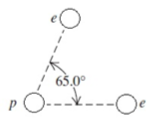
(iii) If two electrons are each $1.5 \times 10^{-10} m$ from a proton, as shown in Figure, magnitude of the net electric force they will exert on the proton is
Image

(a) $1.97 \times 10^{-8} N$
(b) $3.83 \times 10^{-8} N$
(c) $4.63 \times 10^{-8} N$
(d) $2.73 \times 10^{-8} N$

(iv) A charge is a property associated with the matter due to which it produces and experiences:
(a) electric effects only
(b) magnetic effects only
(c) both electric and magnetic effects
(d) non magnetic effects only

OR

The cause of quantization of electric charges is:
(a) transfer of an integral number of electrons
(b) transfer of an integral number of neutrons
(c) transfer of an integral number of protons
(d) transfer of an integral number of Atom
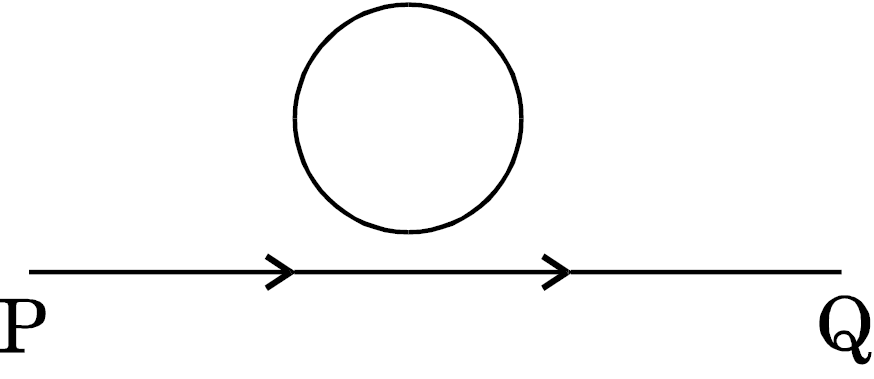
A conducting loop is held above a current carrying wire ‘PQ’ as shown in the figure. Depict the direction of the current induced in the loop when the current in the wire PQ is constantly increasing.
Two q charges of the same nature are located at a distance d from each other, the third charge of value Q Coulomb is at the mid-point of the line joining them. For what value of Q will the system be in equilibrium?
Consider a coin of Example 1.20. It is electrically neutral and contains equal amounts of positive and negative charge of magnitude 34.8kC. Suppose that these equal charges were concentrated in two point charges seperated by,
  1. 1cm $\Big(\sim\frac{1}{2}\times\text{diagonalof theone paisa coin}\Big)$,
  2. 100m (~ length of a long building), and
  3. $10^6m$ (radius of the earth). Find the force on each such point charge in each of the three cases. What do you conclude from these results?
When a ferromagnetic material goes through a hysteresis loop, its thermal energy is increased. Where does this energy come from?
In an electromagnetic wave both the electric and magnetic fields are perpendicular to the direction of propagation, that is why electromagnetic waves are transverse in nature. Electromagnetic waves carry energy as they travel through space and this energy is shared equally by the electric and magnetic fields. Energy density of an electromagnetic waves is the energy in unit volume of the space through which the wave travels.
(i) The electromagnetic waves propagated perpendicular to both $\vec{E}$ and $\vec{B}$. The electromagnetic waves travel in the direction of
(a) $\vec{E} \cdot \vec{B}$
(b) $\vec{B} \cdot \vec{E}$
(c) $\vec{E} \times \vec{B}$
(d) $\vec{B} \times \vec{E}$

(ii) Fundamental particle in an electromagnetic wave is
(a) photon (b) phonon (c) electron (d) proton

(iii) Electromagnetic waves are transverse in nature is evident by
(a) diffraction (b) interference (c) polarisation (d) reflection

OR

The electric and magnetic fields of an electromagnetic waves are
(a) in opposite phase and parallel to each other
(b) in phase and parallel to each other.
(c) in phase and perpendicular to each other
(d) in opposite phase and perpendicular to each other

(iv) d) in opposite phase and perpendicular to each other
(a) frequency (b) wavelength (c) velocity (d) all these depend on each other
You are waiting for a train on a railway platform. Your three year old niece is standing on your iron trunk containing the luggage. Why does the trunk not recoil as she jumps off on the platform?
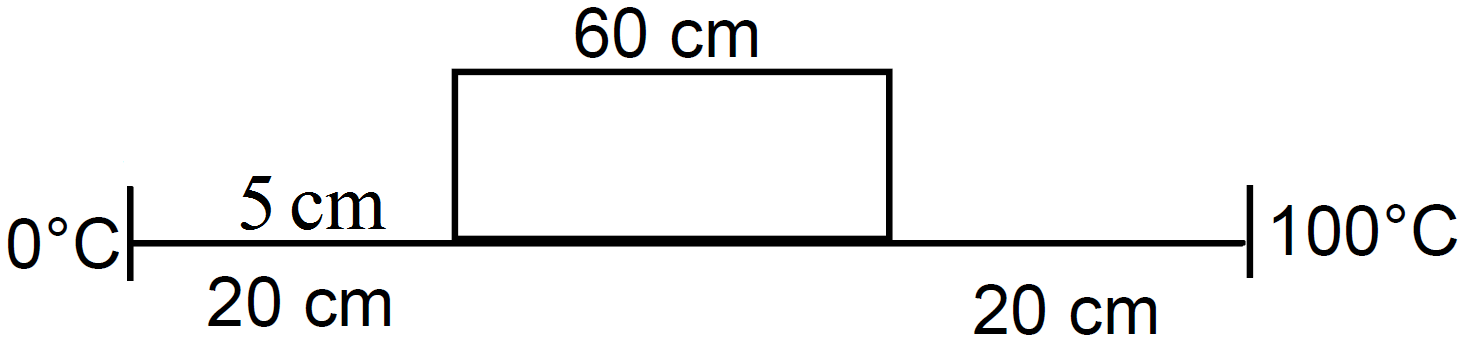
Consider the situation shown in figure. The frame is made of the same material and has a uniform cross-sectional area everywhere. Calculate the amount of heat flowing per second through a cross section of the bent part if the total heat taken out per second from the end at 100°C is 130J.
Electrons oscillating in a circuit give rise to radiowaves. A transmitting antenna radiates most effectively the radiowaves of wavelength equal to the size of the antenna. The infrared waves incident on a substance set into oscillation all its electrons, atoms and molecules. This increases the internal energy and hence the temperature of the substance.

(i) If $v_g, v_X$ and $v_m$ are the speeds of gamma rays, $X$-rays and microwaves respectively in vacuum, then
(a) $v_g>v_X>v_m$
(b) $v_g<v_X<v_m$
(c) $v_g>v_X>v_m$
(d) $v_g=v_X=v_m$

(ii) Which of the following will deflect in electric field?
(a) ultraviolet rays
(b) $\gamma$-rays
(c) X-rays
(d) cathode rays

(iii) $\gamma$-rays are detected by
(a) point contact diodes
(c) thermopiles
(b) ionization chamber
(d) photocells

OR

We consider the radiation emitted by the human body. Which one of the following statements is true?
i. The radiation emitted is in the infrared region
ii. The radiation is emitted only during the day.
iii. The radiation is emitted during the summers and absorbed during the winters.
iv. The radiation emitted lies in the ultraviolet region and hence it is not visible
(a) Option(iv) (iii) (b) Option (ii) (c) Option (d) Option (i)

(iv) The frequency of electromagnetic wave, which best suited to observe a particle of radius $3 \times 10^{-4} cm$ is the order of
(a) $10^{14} Hz$
(b) $10^{12} Hz$
(c) $10^{13} Hz$
(d) $10^{15} Hz$
When light of sufficiently high frequency is incident on a metallic surface, electrons are emitted from the metallic surface. TI1is phenomenon is called photoelectric emission. Kinetic energy of the emitted photoelectrons depends on the wavelength of incident tight and is independent of the intensity of light. Number of emitted photoelectrons depends on intensity. $(\text{h}\upsilon-\phi)$ is the maximum kinetic energy of emitted photoelectrons (where $\phi$ is the work function of metallic surface). Reverse effect of photo emission produces X-ray. X-ray is not deflected by electric and magnetic fields. Wavelength of a continuous X-ray depends on potential difference across the tube. Wavelength of characteristic X-ray depends on the atomic number.
  1. Einstein's photoelectric equation is:
  1. $\text{E}_\text{max}=\text{h}\upsilon-\phi$
  2. $\text{E}=\text{mc}^2$
  3. $\text{E}^2=\text{p}^2\text{c}^2+\text{m}_0^2\text{c}^4$
  4. $\text{E}=\frac{1}{2}\text{mv}^2$
  1. Light of wavelength $\lambda$ which is less than threshold wavelength is incident on a photosensitive material. If incident wavelength is decreased so that emitted photoelectrons are moving with some velocity then stopping potential will:
  1. Increase.
  2. Decrease.
  3. Be zero.
  4. Become exactly half.
  1. When ultraviolet rays incident on metal plate then photoelectric effect does not occur, it occur by incident of:
  1. Infrared rays
  2. X-rays
  3. Radio wave
  4. Micro wave
  1. If frequency $(\upsilon>\upsilon_0)$ of incident light becomes n times the initial frequency $(\upsilon)$, then K.E. of the emitted photoelectrons becomes ($\upsilon_0$ threshold frequency).
  1. N times of the initial kinetic energy.
  2. More than n times of the initial kinetic energy.
  3. Less than n times of the initial kinetic energy.
  4. Kinetic energy of the emitted photoelectrons remains unchanged.
  1. A monochromatic light is used in a photoelectric experiment. The stopping potential.
  1. Is related to the mean wavelength.
  2. Is related to the shortest wavelength.
  3. Is not related to the minimum kinetic energy of emitted photoelectrons.
  4. Intensity of incident tight.