Question
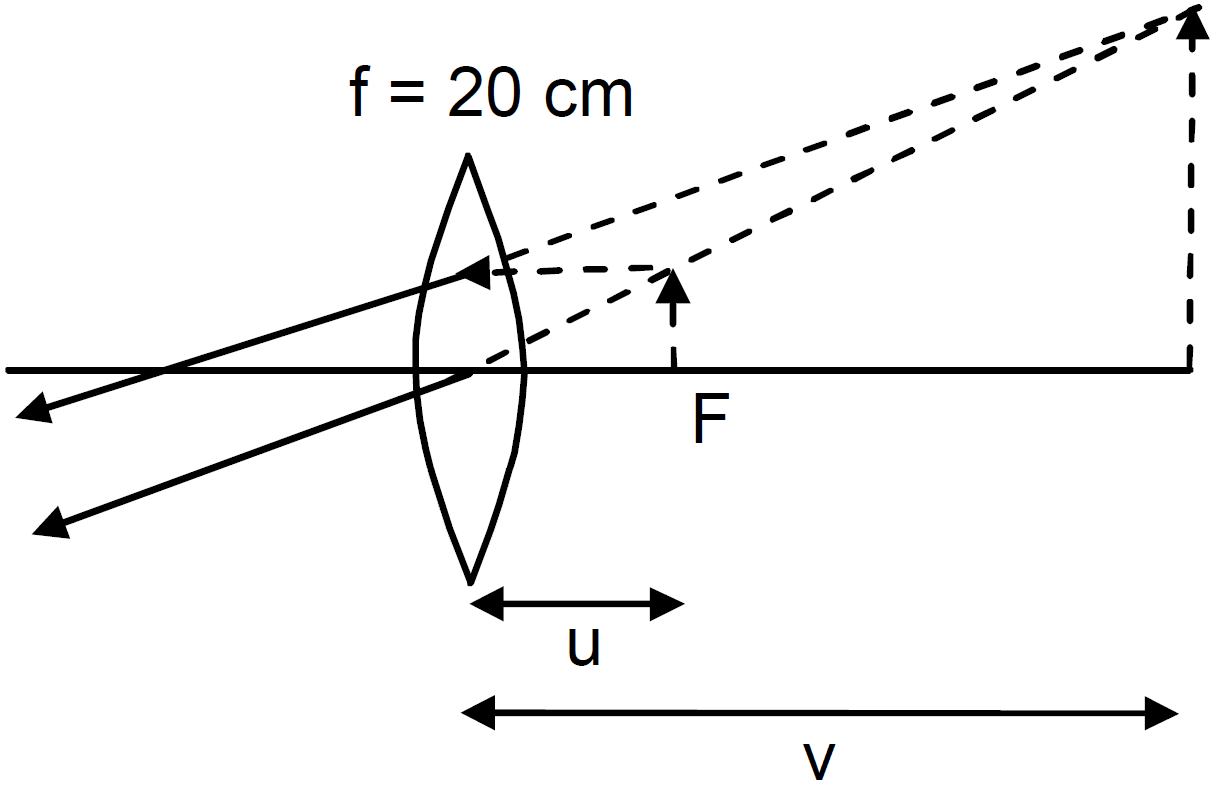
A 5.0 diopter lens forms a virtual image which is 4 times the object placed perpendicularly on the principal axis of the lens. Find the distance of the object from the lens.
Answer

Given, P = 5 diopter (convex lens)$\Rightarrow\text{f}=\frac{1}{5}\text{m}=20\text{cm}$
Since, a virtual image is formed, u and v both are negative.Given, $\frac{\text{v}}{\text{u}}=4$$\Rightarrow\text{v}=4\text{u} \ ...(1)$
From lens formula, $\frac{1}{\text{v}}-\frac{1}{\text{u}}=\frac{1}{\text{f}}$$​​\Rightarrow\frac{1}{\text{f}}=\frac{1}{4\text{u}}-\frac{1}{\text{u}}​​\Rightarrow\frac{1}{20}=\frac{1-4}{4\text{u}}=-\frac{3}{4\text{u}}$
$\Rightarrow\text{u}=-15\text{cm}$
$\therefore$ Object is placed 15cm away from the lens.

Need a full question paper?

Generate a complete, print-ready paper with questions like this in minutes — across 16+ boards, with answer keys.
Start Generating Free

Similar questions

The centre of gravity of a body on the earth coincides with its centre of mass for a ‘small’ object whereas for an ‘extended’ object it may not. What is the qualitative meaning of ‘small’ and ‘extended’ in this regard? For which of the following the two coincides? A building, a pond, a lake, a mountain?
Two equal and opposite forces act on a rigid body. Under what conditions will the body (i) rotate (ii) not rotate?
A rod of length $L$ is placed along the $X-$axis between $x = 0$ and $x = L$. The linear density $($mass$/$ length$) \rho$ of the rod varies with the distance $x$ from the origin as $\rho=\text{a + bx.}$
  1. Find the $SI$ units of $a$ and $b$.
  2. Find the mass of the rod in terms of $a, b$ and $L.$
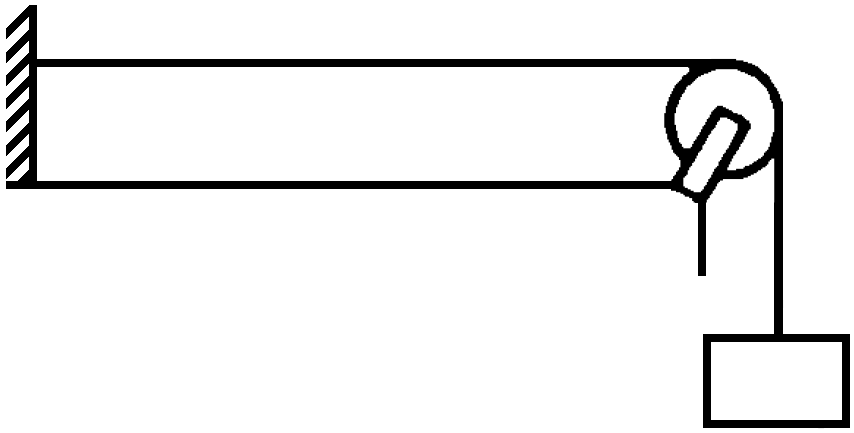
Figure, shows a string stretched by a block going over a pulley. The string vibrates in its tenth harmonic in unison with a particular tuning fork. When a beaker containing water is brought under the block so that the block is completely dipped into the beaker, the string vibrates in its eleventh harmonic. Find the density of the material of the block.
A bullet of mass $10g$ and speed $500m/s$ is fired into a door and gets embedded exactly at the centre of the door. The door is $1.0m$ wide and weighs $12kg$. It is hinged at one end and rotates about a vertical axis practically without friction. Find the angular speed of the door just after the bullet embeds into it. (Hint: The moment of inertia of the door about the vertical axis at one end is $ML^2/3$).
A vessel containing one mole of a monatomic ideal gas (molecular weight =$20gmol^{-1}$) is moving on a floor at a speed of $50ms^{-1}$. The vessel is stopped suddenly. Assuming that the mechanical energy lost has gone into the internal energy of the gas, find the rise in its temperature.
Two small bodies of masses $10kg$ and $20kg$ are kept a distance $1.0m$ apart and released, Assuming that only mutual gravitational forces are acting, find the speeds of the particles when the separation decreases to $0.5m$.
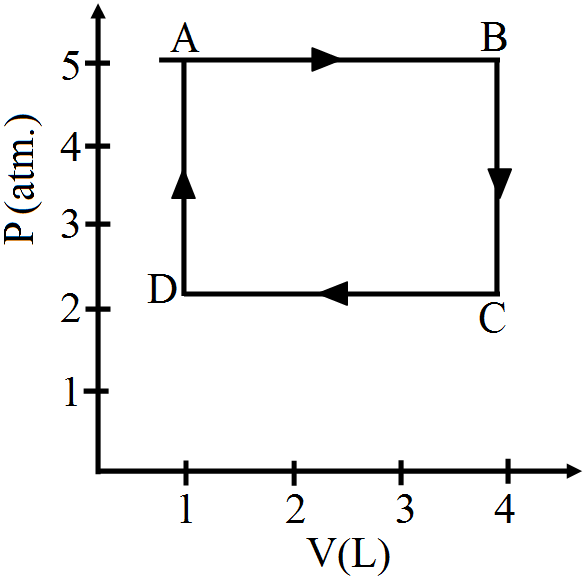
One mole of an ideal gas undergoes a cyclic change ABCD. From the given diagram, calculate the net work done in the process. $1$ atmosphere = $10^\circ dyne\ cm^{-2}$.
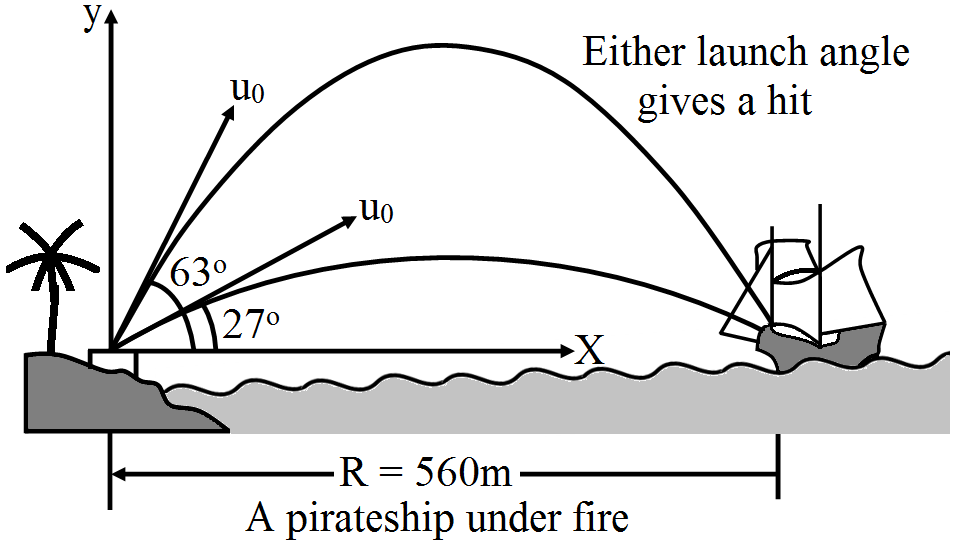
Figure shows a pirateship $560m$ from a fort defending a harbour entrance. A defence cannon, located at sea level, fires balls at initial speed, $u_0 = 82m/ s$.
  1. At what angle, $\theta_0$ from the horizontal must a ball be fired to hit the ship?
  2. What is the maximum range of the cannon balls?
The resultant of two vector $\vec{P}$ and $\vec{Q}$ is $\vec{R}$. If the direction of $\vec{Q}$ is reversed, then the resulting vector becomes $\vec{S}$. Then prove that,
$
R ^2+ S ^2=2\left( P ^2+ Q ^2\right)
$