Question
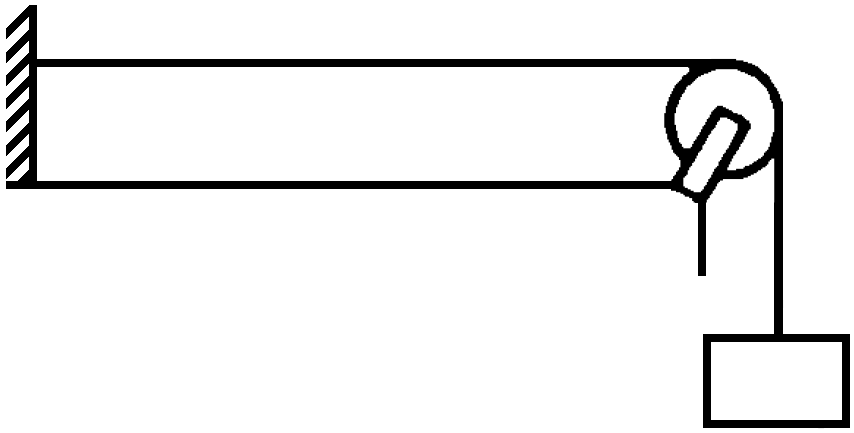
Figure, shows a string stretched by a block going over a pulley. The string vibrates in its tenth harmonic in unison with a particular tuning fork. When a beaker containing water is brought under the block so that the block is completely dipped into the beaker, the string vibrates in its eleventh harmonic. Find the density of the material of the block.
Answer

Let, $\rho\rightarrow$ density of the block Weight $\rho\text{Vg}$ where V = volume of block The same turning fork resonates with the string in the two cases$\text{f}_{10}=\frac{10}{2\text{l}}\sqrt{\frac{\text{T}-\rho_\text{w}\text{Vg}}{\text{m}}}=\frac{11}{2\text{l}}\sqrt{\frac{(\rho-\rho_\text{w})\text{Vg}}{\text{m}}}$
As the f of tuning fork is same,$\text{f}_{10}=\text{f}_{11}\Rightarrow\frac{10}{2\text{l}}\sqrt{\frac{\rho\text{Vg}}{\text{m}}}=\frac{11}{2\text{l}}\sqrt{\frac{(\rho-\rho_\text{w})\text{Vg}}{\text{m}}}$
$\Rightarrow\frac{10}{11}=\sqrt{\frac{\rho-\rho_\text{w}}{\text{m}}}$
$\Rightarrow\frac{\rho-1}{\rho}=\frac{100}{121}$ $\big($because, $\rho_\text{w}=1\text{gm/cc}\big)$
$\Rightarrow100\rho=121\rho-121$
$\Rightarrow5.8\times10^{3}\text{kg/m}^3$

Need a full question paper?

Generate a complete, print-ready paper with questions like this in minutes — across 16+ boards, with answer keys.

Start Generating Free

Similar questions

A person has near point at $100\ cm.$ What power of lens is needed to read at $20\ cm$ if he/ she uses.
  1. Contact lens,
  2. Spectacles having glasses $2.0\ cm$ separated from the eyes?
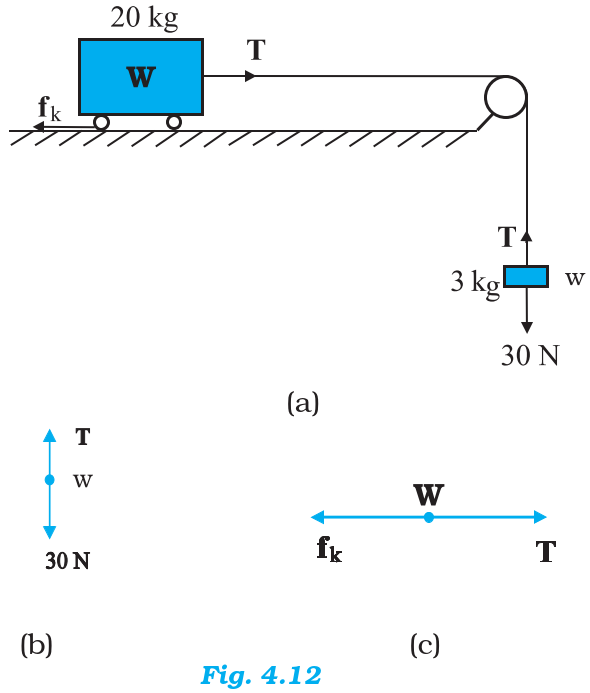
What is the acceleration of the block and trolley system shown in a Fig. 4.12(a), if the coefficient of kinetic friction between the trolley and the surface is 0.04 ? What is the tension in the string? (Take $g=$ $10 m s ^{-2}$ ). Neglect the mass of the string.
Image
Rain is falling vertically with a speed of $30m s^{-1}$. A woman rides a bicycle with a speed of $10ms^{-1}$ in the north to south direction. What is the direction in which she should hold her umbrella?
  1. What is meant by Simple Harmonic Motion $\text{(S.H.M)}$?
  2. At what points is the energy entirely kinetic and potential in $\text{S.H.M}$?
  3. What is the total distance travelled by a body executing $\text{S.H.M}$ in a time equal to its time period, if its amplitude is $A$?
A rocket with a lift-off mass $20,000kg$ is blasted upwards with an initial acceleration of $5.0ms^{-2}$. Calculate the initial thrust (force) of the blast.
An underwater swimmer sends a sound signal to the surface. It produces $5$ beats per second when compared with the fundamental note of a pipe 20 cm long closed at one end. What is the wavelength of sound in water? Given velocities of sound in air and water are $360 ms^{-1}$ and $1500 ms^{-1}$ respectively.
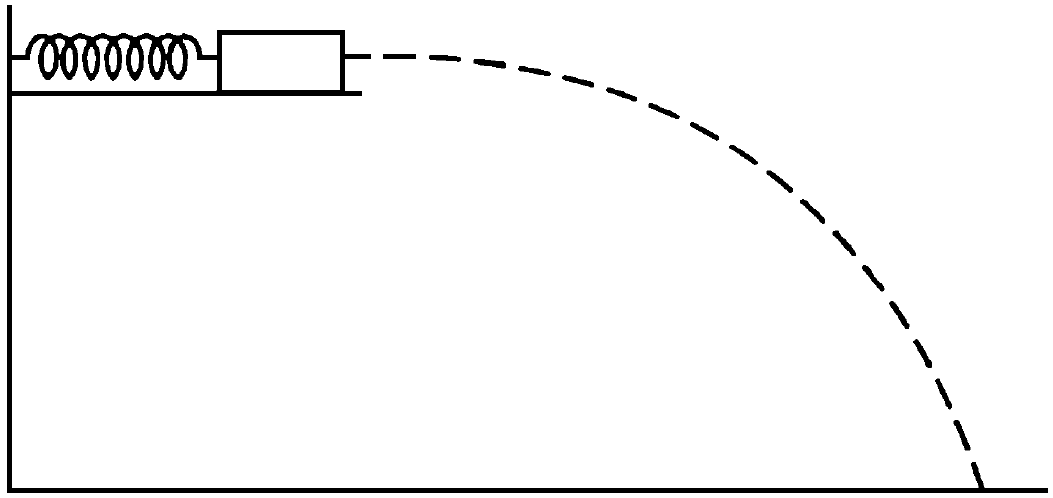
A small block of mass 100g is pressed against a horizontal spring fixed at one end to compress the spring through 5.0cm (figure). The spring constant is 100N/m. When released, the block moves horizontally till it leaves the spring. Where will it hit the ground 2m below the spring?
The velocity of sound $v$ in the air depends on the air pressure, P and density of air $d$. Establish the possible formula by dimensional method :
$
v= K \sqrt{\frac{ P }{d}}
$
There are energy bands in a solid. Do we have really continuous energy variation in a band or do we have very closely spaced but still discrete energy levels?
A harmonic oscillation is represented by $\text{y}=0.34\cos(3000\text{t}+0.74),$ where $y$ and $t$ are in $m$ and $s$ respectively. Deduce: $(i)$ the amplitude, $(ii)$ the frequency and angular frequency, $(iii)$ the period, and $(iv)$ the initial phase.