Question
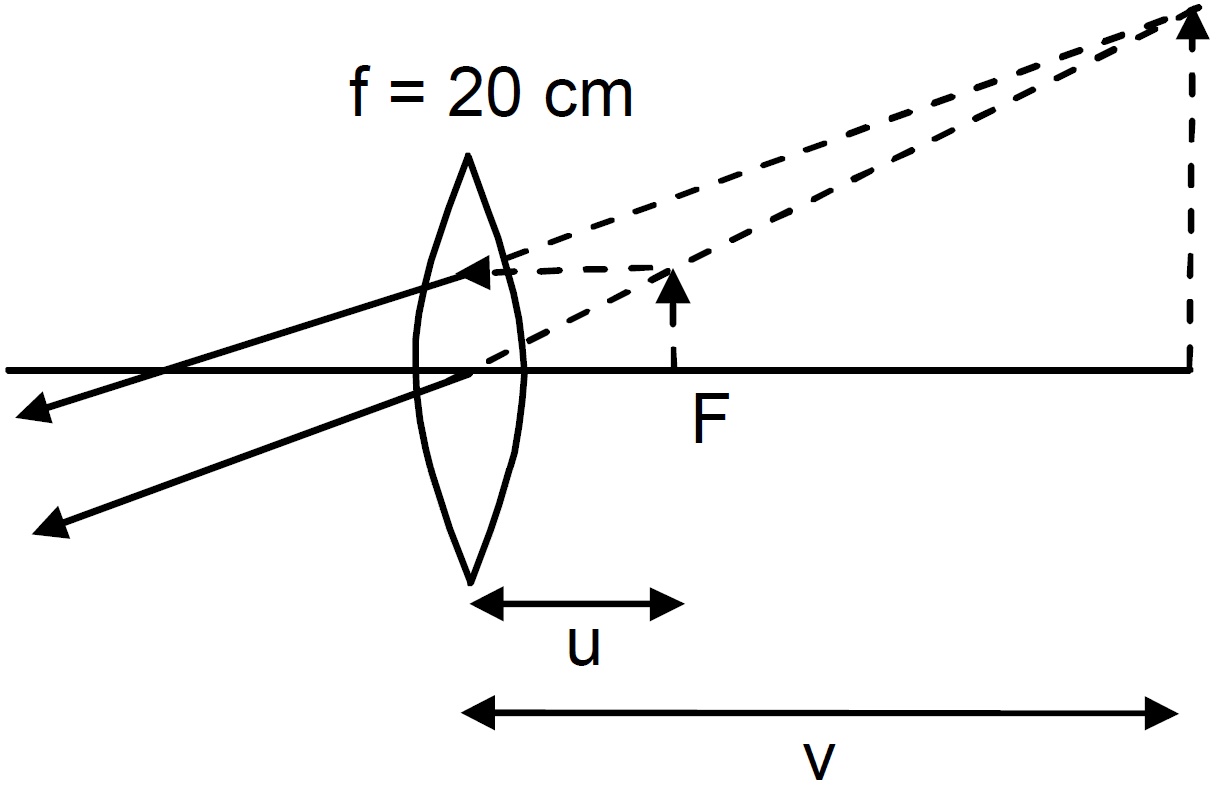
A 5.0 diopter lens forms a virtual image which is 4 times the object placed perpendicularly on the principal axis of the lens. Find the distance of the object from the lens.
Answer

Given, P = 5 diopter (convex lens)

$\Rightarrow\text{f}=\frac{1}{5}\text{m}=20\text{cm}$

Since, a virtual image is formed, u and v both are negative.Given, $\frac{\text{v}}{\text{u}}=4$

$\Rightarrow\text{v}=4\text{u} \ ...(1)$

From lens formula, $\frac{1}{\text{v}}-\frac{1}{\text{u}}=\frac{1}{\text{f}}$

$​​\Rightarrow\frac{1}{\text{f}}=\frac{1}{4\text{u}}-\frac{1}{\text{u}}​​\Rightarrow\frac{1}{20}=\frac{1-4}{4\text{u}}=-\frac{3}{4\text{u}}$

$\Rightarrow\text{u}=-15\text{cm}$

$\therefore$ Object is placed 15cm away from the lens.

Need a full question paper?

Generate a complete, print-ready paper with questions like this in minutes — across 16+ boards, with answer keys.
Start Generating Free

Similar questions

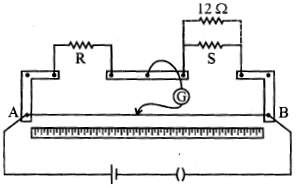
In a meter bridge, the null point is found at a distance of 40 cm from A. If a resistance of 12 Ω is connected in parallel with S, the null point occurs at 50.0 cm from. Determine the values of R and S.

Deduce an expression for the electric potential due to an electric dipole at any point on its axis. Mention one contrasting feature of electric potential of a dipole at a point as compared to that due to a single charge.
When we heat an object, it expands. Is work done by the object in this process ? Is heat given to the object equal to the increase in its internal energy?
An object P is focused by a microscope M. A glass slab of thickness 2.1cm is introduced between P and M. If the refractive index of the slab is 1.5, by what distance should the microscope be shifted to focus the object again?
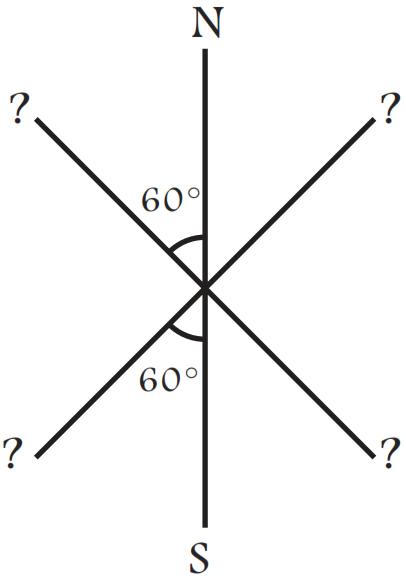
Three identical bar magnets are rivetted together at centre in the same plane as shown in Fig. This system is placed at rest in a slowly varying magnetic field. It is found that the system of magnets does not show any motion. The north-south poles of one magnet is shown in the Fig. Determine the poles of the remaining two.

Calculate the energy that can be obtained from 1kg of water through the fusion reaction
2H + 2H → 3H + p.
Assume that 1.5 × 10⁻²% of natural water is heavy water D2O (by number of molecules) and all the deuterium is used for fusion.
Red light however bright it is, cannot produce the emission of electrons from a clean zinc surface, but even weak ultraviolet radiation can do so; why?
What is reverse bias? Explain the change occuring in the junction under the effect of reverse bias.
An ideal gas is taken through a process in which the pressure and the volume are changed according to the equation p = kV. Show that the molar heat capacity of R the gas for the process is given by $\text{C}=\text{C}_\text{v}+\frac{\text{R}}{2}.$
A force $\overrightarrow{\text{F}}=\overrightarrow{\text{v}}\times\overrightarrow{\text{A}}$ is exerted on a particle in addition to the force of gravity, where v is the velocity of the particle and $\overrightarrow{\text{A}}$ is a constant vector in the horizontal direction. With what minimum speed a particle of mass m be projected so that it continues to move undeflected with a constant velocity?