Question
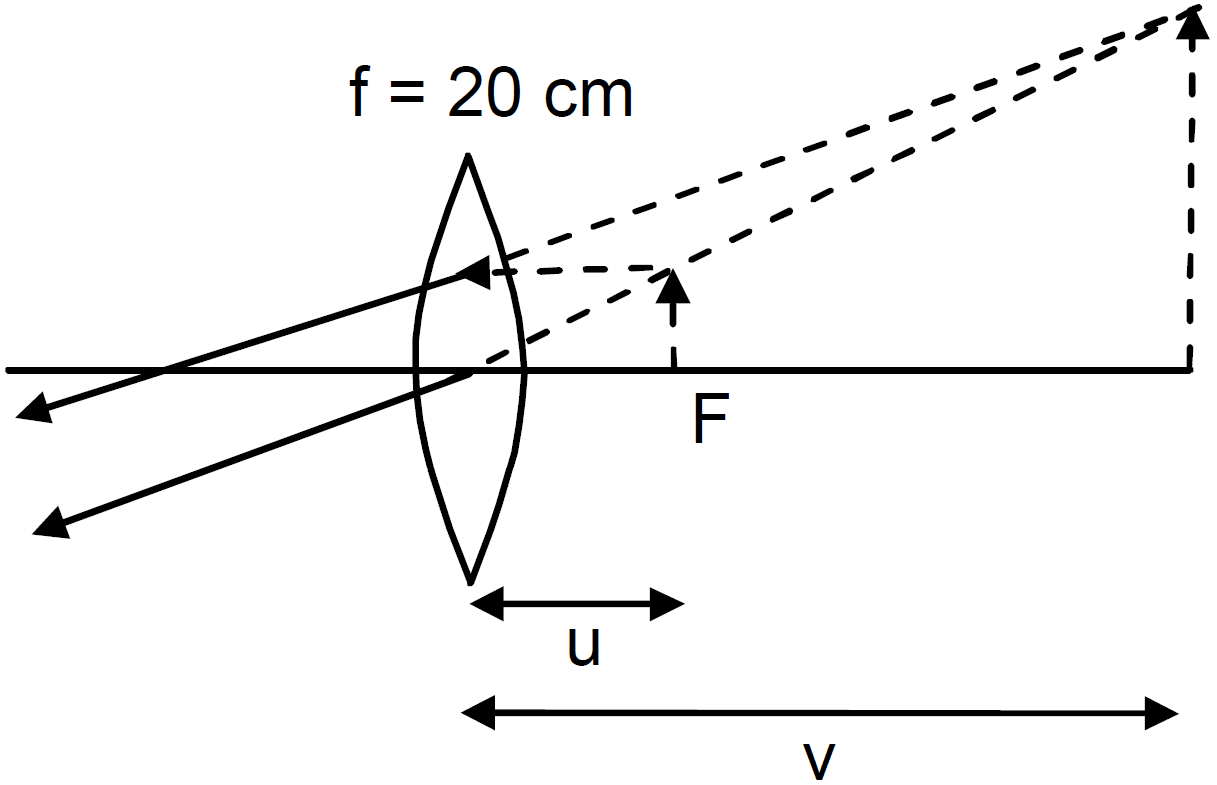
A 5.0 diopter lens forms a virtual image which is 4 times the object placed perpendicularly on the principal axis of the lens. Find the distance of the object from the lens.
Answer


Given, P = 5 diopter (convex lens)
$\Rightarrow\text{f}=\frac{1}{5}\text{m}=20\text{cm}$
Since, a virtual image is formed, u and v both are negative.Given, $\frac{\text{v}}{\text{u}}=4$
$\Rightarrow\text{v}=4\text{u} \ ...(1)$
From lens formula, $\frac{1}{\text{v}}-\frac{1}{\text{u}}=\frac{1}{\text{f}}$
$​​\Rightarrow\frac{1}{\text{f}}=\frac{1}{4\text{u}}-\frac{1}{\text{u}}​​\Rightarrow\frac{1}{20}=\frac{1-4}{4\text{u}}=-\frac{3}{4\text{u}}$
$\Rightarrow\text{u}=-15\text{cm}$
$\therefore$ Object is placed 15cm away from the lens.

Need a full question paper?

Generate a complete, print-ready paper with questions like this in minutes — across 16+ boards, with answer keys.
Start Generating Free

Similar questions

Write two important considerations used while fabricating a Zener diode. Explain, with the help of a circuit diagram, the principle and working of a Zener diode as voltage regulator.
A small piece of wood is floating on the surface of a 2.5m deep lake. Where does the shadow form on the bottom when the sun is just setting? Refractive index of water $=\frac{4}{3}.$
Light in certain cases may be considered as a stream of particles called photons. Each photon has a linear momentum $\frac{\text{h}}{\lambda}$ where h is the Planck's constant and $\lambda$ is the wavelength of the light. A beam of light of wavelength $\lambda$ is incident on a plane mirror at an angle of incidence $\theta.$ Calculate the change in the linear momentum of a photon as the beam is reflected by the mirror.
Show that it is not possible for a photon to be completely absorbed by a free electron.
Explain polarisation of light.
A cubical block of mass m and edge a slides down a rough inclined plane of inclination $\theta$ with a uniform speed. Find the torque of the normal force acting on the block about its centre.
A thin but long, hollow, cylindrical tube of radius r carries a current i along its length. Find the magnitude of the magnetic field at a distance $\frac{\text{r}}{2}$ from the surface (a) inside the tube (b) outside the tube.
The index of refraction of fused quartz is 1.472 for light of wavelength 400nm and is 1.452 for light of wavelength 760nm. Find the speeds of light of these wavelengths in fused quartz.
228Th emits an alpha particle to reduce to 224Ra. Calculate the kinetic energy of the alpha particle emitted in the following decay:
$\text{ }^{228}\text{Th}\rightarrow\text{ }^{224}\text{Ra}^*+\alpha$
$\text{ }^{224}\text{Ra}^*\rightarrow\text{ }^{224}\text{Ra}+\gamma(217\text{kev}).$
Atomic mass of 228Th is 228.028726u, that of 224Ra is 224.020196u and that of $\text{ }^4_2\text{He}$ is 4.00260u.
An $\alpha$-particle and a proton moving with the same speed enter the same magnetic field region at right angles to the direction of the field. Show the trajectories followed by the two particles in the region of the magnetic field. Find the ratio of the radii of the circular paths which the two particles may describe.