MCQ
A $5\,^oC$ rise in temperature is observed in a conductor by passing a current. When the current is doubled the rise in temperature will be approximately ........... $^oC$
  • A
    $16$
  • B
    $10$
  • $20$
  • D
    $12$

Answer

Correct option: C.
$20$
c
Since $H \propto {i^2},$ so on doubling the current, the heat produced and hence the rise in temperature becomes four times.

Need a full question paper?

Generate a complete, print-ready paper with questions like this in minutes — across 16+ boards, with answer keys.
Start Generating Free

Similar questions

To deposit one litre of hydrogen at 22.4 atmosphere from acidulaled water, the quantity of electricity that must pass through is
A step-up transformer operates on a $230\, V$ line and supplies a load of $2$ $ampere$. The ratio of the primary and secondary windings is $1 : 25$. The current in the primary is....$A$
The natural frequency of an $LC -$ circuit is $1,25,000$ cycles per second. Then the capacitor $C$ is replaced by another capacitor with a dielectric medium of dielectric constant $k$. In this case, the frequency decreases by $25kHz$. The value of $k$ is:
A $500\, W$ heating unit is designed to operate from a $115\, volt$ line. If the line voltage drops to $110\, volt$, the percentage drop in heat output will be ............... $\%$
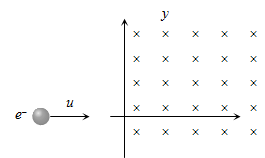
An electron moving with a speed u along the positive x-axis at y = 0 enters a region of uniform magnetic field $\vec{B}=B_0 \vec{k}$ which exists to the right of y-axis. The electron exits from the region after some time with the speed v at co-ordinate y, then
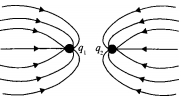
The given figure gives electric lines of force due to two charges $q_1$ and $q_2$. What are the signs of the two charges?
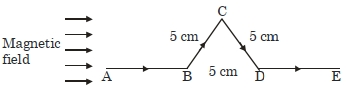
A triangular shaped wire carrying $10 A$ current is placed in a uniform magnetic field of $0.5\,T$, as shown in figure. The magnetic force on segment $CD$ is $....N$ $($ Given $BC = CD = BD =5\,cm )$.
For measuring voltage of any circuit, potentiometer is preferred to voltmeter because:
The ionisation energy of hydrogen atom is $13.6\; eV$, the ionisation energy of a singly ionised helium atom would be  ....... $eV$
What amount of heat will be generated in a coil of resistance $R$ due to a charge $q$ passing through it if the current in the coil decreases to zero uniformly during a time interval $\Delta t$