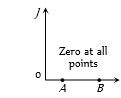
MCQ 11 Mark
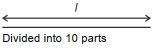
A wire of length ' $r$ ' and resistance $100 \Omega$ is divided into $10$ equal parts. The first $5$ parts are connected in series while the next $5$ parts are connected in parallel. The two combinations are again connected in series. The resistance of this final combination is:
- ✓
$52 \Omega$
- B
$55 \Omega$
- C
$60 \Omega$
- D
$26 \Omega$
AnswerCorrect option: A. $52 \Omega$
a
$R =\frac{\rho l}{A}$
$R^{\prime} =\frac{\rho l}{10 A}=\frac{R}{10}$
$R_S =5 \times \frac{R}{10} \quad \text { [series] }$
$R_S =50$
$R_p =\frac{K}{50} \quad \text { [parallel] }$
$R_{e q} =R_S+R_p$
$=52 \Omega$
View full question & answer→MCQ 21 Mark
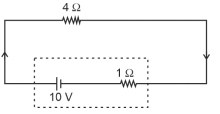
The terminal voltage of the battery, whose emf is $10 \mathrm{~V}$ and internal resistance $1 \Omega$, when connected through an external resistance of $4 \Omega$ as shown in the figure is:
- A
$6 \mathrm{~V}$
- ✓
$8 \mathrm{~V}$
- C
$10 \mathrm{~V}$
- D
$4 \mathrm{~V}$
AnswerCorrect option: B. $8 \mathrm{~V}$
b
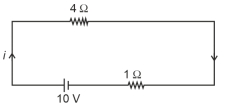
$\text { Current in circuit } i =\frac{10}{4+1}=2 \mathrm{~A}$
$\text { Terminal voltage } =E-i R$
$=10-2 \times 1=8 \mathrm{~V}$
View full question & answer→MCQ 31 Mark
Two heaters $A$ and $B$ have power rating of $1 \mathrm{~kW}$ and $2 \mathrm{~kW}$, respectively. Those two are first connected in series and then in parallel to a fixed power source. The ratio of power outputs for these two cases is:
- ✓
$2: 9$
- B
$1: 2$
- C
$2: 3$
- D
$1: 1$
AnswerCorrect option: A. $2: 9$
a
Power Consumed $=P=\frac{V^2}{R}$
$\frac{P_A}{P_B}=\frac{R_B}{R_A}$
$R_A=2 R_B$
For Series Combination
$P_S=\frac{V^2}{3 R_B}$
For Parallel Combination
$P_P=\frac{3 V^2}{2 R_B}$
$\frac{P_S}{P_P}=\frac{2}{9}$
View full question & answer→MCQ 41 Mark
The resistance of platinum wire at $0^{\circ}\,C$ is $2\,\Omega$ and $6.8\,\Omega$ at $80^{\circ} \,C$. The temperature coefficient of resistance of the wire is :
- A
$3 \times 10^{-1}{ }\;^{\circ}\,C ^{-1}$
- B
$3 \times 10^{-4}{ }\;^{\circ}C ^{-1}$
- C
$3 \times 10^{-3}{ }\;^{\circ}C ^{-1}$
- ✓
$3 \times 10^{-2}{ }\;^{\circ}C ^{-1}$
AnswerCorrect option: D. $3 \times 10^{-2}{ }\;^{\circ}C ^{-1}$
d
$R _{ T }= R _0\left[1+\alpha\left( T - T _0\right)\right]$
$6.8=2[1+\alpha(80-0)]$
$\alpha=\frac{2.4}{80}=0.03 /{ }^{\circ}\,C =3 \times 10^{-2} /{ }^{\circ}\,C$
View full question & answer→MCQ 51 Mark
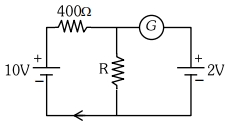
If the galvanometer $G$ does not show any deflection in the circuit shown, the value of $R$ is given by $............\Omega$
Answerd
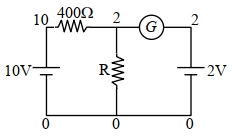
Since galvanometer does not show any deflection $\Rightarrow i_g=0$
$\frac{10-2}{400}=\frac{2}{R} \Rightarrow R=\frac{2 \times 400}{8}=100\,\Omega$
View full question & answer→MCQ 61 Mark
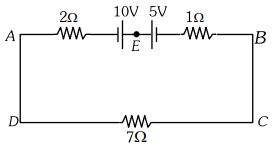
The magnitude and direction of the current in the following circuit is :-
- A
$1.5\,A$ from $B$ to $A$ through $E$
- B
$0.2\,A$ from $B$ to $A$ through $E$
- ✓
$0.5\,A$ from $A$ to $B$ through $E$
- D
$\frac{5}{9}\,A$ from $A$ to $B$ through $E$
AnswerCorrect option: C. $0.5\,A$ from $A$ to $B$ through $E$
c
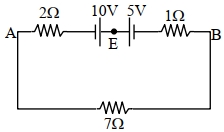
$i =\frac{10-5}{10}=\frac{5}{10}\,A$
$=0.5\,A$
from $A$ to $B$ through $E$.
View full question & answer→MCQ 71 Mark
$10$ resistors, each of resistance $R$ are connected in series to a battery of $emf$ $E$ and negligible internal resistance. Then those are connected in parallel to the same battery, the current is increased $n$ times. The value of $n$ is :
Answerc
$I_S=\frac{E}{10 R}$
$I_P=\frac{E}{R / 10}=\frac{10 E}{R}$
$n=\frac{I_P}{I_S}=100 \Rightarrow n=100$
View full question & answer→MCQ 81 Mark
Resistance of a carbon resistor determined from colour codes is $(22000 \pm 5 \%) \Omega$. The colour of third band must be :
Answerd
$R =\left[22 \times 10^3 \pm 5 \%\right] \Omega$
Acc. to color code Third Band
$\rightarrow$ Orange (color code for digit $3$ is orange)
View full question & answer→MCQ 91 Mark
A copper wire of length $10\,m$ and radius $\left(10^{-2} / \sqrt{\pi}\right) m$ has electrical resistance of $10 \,\Omega$. The current density in the wire for an electric field strength of $10( V / m )$ is :
- A
$10^{6} A / m ^{2}$
- B
$10^{-5} A / m ^{2}$
- ✓
$10^{5} A / m ^{2}$
- D
$10^{4} A / m ^{2}$
AnswerCorrect option: C. $10^{5} A / m ^{2}$
c
Radius of wire $=\frac{10^{-2}}{\sqrt{\pi}}$
Cross sectional area $A =\pi r ^{2}=10^{-4} m ^{2}$ $j =\frac{ i }{ A }=\left(\frac{ V }{ R }\right) \cdot \frac{1}{ A }=\frac{ E \ell}{ RA } \quad R =\frac{\rho \ell}{ A }$ $j =\frac{10 \times 10}{10 \times 10^{-4}}=10^{5} A / m ^{2}$
$J=\sigma E \Rightarrow \frac{ E }{\rho}=\frac{ E \ell}{ RA }=\frac{10 \times 10 \times \pi}{10 \times 10^{-4} \times \pi}$
$\Rightarrow 10^{5} A / m ^{2}$
View full question & answer→MCQ 101 Mark
A wheatstone bridge is used to determine the value of unknown resistance $X$ by adjusting the variable resistance $Y$ as shown in the figure. For the most precise measurement of $X$, the resistances $P$ and $Q$:
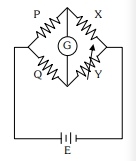
AnswerCorrect option: A. should be approximately equal and are small
a
Resistance of $P \& Q$ should be approx. equal as it decreases error in experiment.
View full question & answer→MCQ 111 Mark
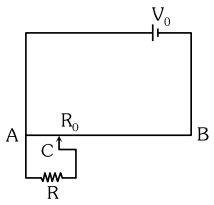
The sliding contact $C$ is at one fourth of the length of the potentiometer wire $( AB )$ from $A$ as shown in the circuit diagram. If the resistance of the wire $AB$ is $R _0$, then the potential drop $( V )$ across the resistor $R$ is
- ✓
$\frac{4 V _0 R }{3 R _0+16 R }$
- B
$\frac{4 V _0 R }{3 R _0+ R }$
- C
$\frac{2 V _0 R }{4 R _0+ R }$
- D
$\frac{2 V _0 R }{2 R _0+3 R }$
AnswerCorrect option: A. $\frac{4 V _0 R }{3 R _0+16 R }$
a
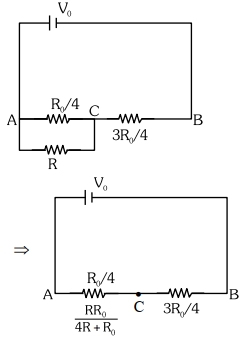
In series, potential divides in direct ratio of resistance,
So, $V_{A C}=\frac{R_{A C}}{R_{A C}+R_{C B}} V_0$
$=\frac{\frac{ RR _0}{4 R + R _0}}{\frac{ RR _0}{4 R + R _0}+\frac{3 R _0}{4}} \times V _0=\frac{4 RV _0}{16 R +3 R _0}$
View full question & answer→MCQ 121 Mark
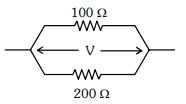
Two resistors of resistance, $100\,\Omega$ and $200\,\Omega$ are connected in parallel in an electrical circuit. The ratio of the thermal energy developed in $100\,\Omega$ to that in $200\,\Omega$ in a given time is:
- ✓
$2: 1$
- B
$1: 4$
- C
$4: 1$
- D
$1: 2$
AnswerCorrect option: A. $2: 1$
a
As both resistors are in parallel combination so potential drop $( V )$ across both are same.
$P =\frac{ V ^{2}}{ R } \Rightarrow P \propto \frac{1}{ R }$
$\frac{ P _{1}}{ P _{2}}=\frac{ R _{2}}{ R _{1}}=\frac{200}{100}=\frac{2}{1}$
$=2: 1$
View full question & answer→MCQ 131 Mark
The reciprocal of resistance is
Answerd
Conductance $=\frac{1}{\text { Resistance }}$
View full question & answer→MCQ 141 Mark
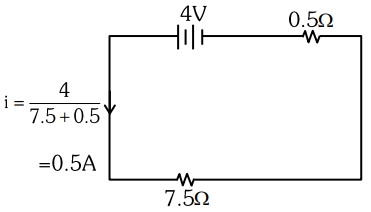
A cell of $emf\;4\,V$ and internal resistance $0.5\,\Omega$ is connected to a $7.5\,\Omega$ external resistance. The terminal potential difference of the cell is $.....\,V$.
- ✓
$3.75$
- B
$4.25$
- C
$4$
- D
$0.375$
AnswerCorrect option: A. $3.75$
a
TPD $=4-0.5 \times 0.5$
$\qquad =4-0.25$
TPD $=3.75 \text { volt }$
View full question & answer→MCQ 151 Mark
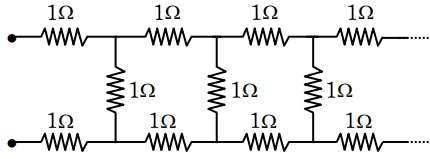
The equivalent resistance of the infinite network given below is :
- A
$2\,\Omega$
- B
$(1+\sqrt{2})\,\Omega$
- ✓
$(1+\sqrt{3})\,\Omega$
- D
$(1+\sqrt{5})\,\Omega$
AnswerCorrect option: C. $(1+\sqrt{3})\,\Omega$
c
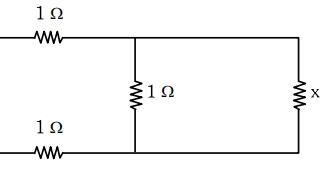
If effective resistance is $x$,
$\Rightarrow x=1+\frac{x \times 1}{x+1}+1$
$\Rightarrow(x-2)=\frac{x}{x+1}$
$\Rightarrow x^2-x-2=x$
$\Rightarrow x^2-2 x-2=0$
$\text { So, } x=\frac{2 \pm \sqrt{12}}{2}$
$=1 \pm \sqrt{3}\,\Omega$
neglecting negative value, $x =1+\sqrt{3}\,\Omega$
View full question & answer→MCQ 161 Mark
Column $- I$ gives certain physical terms associated with flow of current through a metallic conductor. Column $- II$ gives some mathematical relations involving electrical quantities. Match Column $- I$ and Column $- II$ with appropriate relations.
| Column $- I$ |
Column $- II$ |
| $(A)$ Drift Velocity |
$(P)$ $\frac{m}{n e^{2} \rho}$ |
| $(B)$ Electrical Resistivity |
$(Q)$ $\mathrm{ne} v_{\mathrm{d}}$ |
| $(C)$ Relaxation Period |
$(R)$ $\frac{\mathrm{eE}}{\mathrm{m}} \tau$ |
| $(D)$ Current Density |
$(S)$ $\frac{E}{J}$ |
- ✓
$(A)- (\mathrm{R}),(\mathrm{B})-(\mathrm{S}),(\mathrm{C})-(\mathrm{P}),(\mathrm{D})-(\mathrm{Q})$
- B
$(A)-(R), (B)-(S), (C)-(Q), (D)-(P)$
- C
$(A)-(R), (B)-(P), (C)-(S), (D)-(Q)$
- D
$(A)-(R), (B)-(Q), (C)-(S), (D)-(P)$
AnswerCorrect option: A. $(A)- (\mathrm{R}),(\mathrm{B})-(\mathrm{S}),(\mathrm{C})-(\mathrm{P}),(\mathrm{D})-(\mathrm{Q})$
a
$J=\frac{I}{A}=n e v_{d}=\frac{n e^{2} \tau}{m} E=\sigma E=\frac{E}{\rho}$
$V_{d}=\frac{e E}{m} I ; \rho=\frac{m}{n e^{2} \tau}$ or $\rho=\frac{E}{J}, J=n e v_{d}$
$A \rightarrow R \quad B \rightarrow S \quad D \rightarrow Q$
$\tau=\frac{m}{n e^{2} \rho}$
$C \rightarrow P$
View full question & answer→MCQ 171 Mark
In a potentiometer circuit a cell of $EMF$ $1.5\, {V}$ gives balance point at $36\, {cm}$ length of wire. If another cell of $EMF$ $2.5\, {V}$ replaces the first cell, then at what length of the wire, the balance point occurs ? (in $cm$)
Answera
$\phi=$ constant
$E_{\text {unknown }}=\phi I_{b} \Rightarrow E_{\text {unknown }} \propto I_{b}$
$\frac{E_{1}}{E_{2}}=\frac{I_{1}}{I_{2}} \Rightarrow \frac{1.5}{2.5}=\frac{36}{x}$
$x=\frac{36 \times 5}{3}=60\, \mathrm{~cm}$
View full question & answer→MCQ 181 Mark
The effective resistance of a parallel connection that consists of four wires of equal length, equal area of cross-section and same material is $0.25\, \Omega$. What will be the effective resistance if they are connected in series ? (In $\Omega$)
Answerd
$\frac{\mathrm{R}}{4}=.25$ parallel
$\mathrm{R}=1$
$\mathrm{R}_{\mathrm{s}}=4 \mathrm{R}=4\, \Omega$
View full question & answer→MCQ 191 Mark
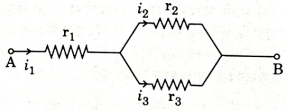
Three resistors having resistances $\mathrm{r}_{1}, \mathrm{r}_{2}$ and $\mathrm{r}_{3}$ are connected as shown in the given circuit. The ratio $\frac{i_{3}}{i_{1}}$ of currents in terms of resistances used in the circuit is :
- A
$\frac{r_{1}}{r_{2}+r_{3}}$
- ✓
$\frac{r_{2}}{r_{2}+r_{3}}$
- C
$\frac{r_{1}}{r_{1}+r_{2}}$
- D
$\frac{r_{2}}{r_{1}+r_{3}}$
AnswerCorrect option: B. $\frac{r_{2}}{r_{2}+r_{3}}$
b
$I_{3}=\frac{I_{1} r_{2}}{r_{2}+r_{3}}$
$\frac{I_{3}}{I_{1}}=\frac{I_{1} r_{2}}{\left(r_{2}+r_{3}\right) I_{1}}=\frac{r_{2}}{r_{2}+r_{3}}$
View full question & answer→MCQ 201 Mark
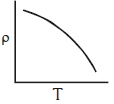
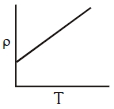
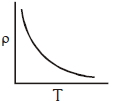
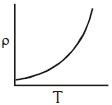
Which of the following graph represents the variation of resistivity ( $\rho$ ) with temperature $(T)$ for copper $?$
Answerd
For some metals like copper, resistivity is nearly proportional to temperature although a non linear region always exists at very low temperature.
View full question & answer→MCQ 211 Mark
The color code of a resistance is given below
The values of resistance and tolerance, respectively, are :
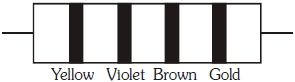
- ✓
$470\; \Omega, \,5 \%$
- B
$470\; k \Omega,\,5 \%$
- C
$47 \;k \Omega,\, 10 \%$
- D
$4.7 \;k \Omega,\, 5 \%$
AnswerCorrect option: A. $470\; \Omega, \,5 \%$
a
$R =47 \times 10^{1} \pm 5 \%$
$R =470 \Omega, 5 \%$
View full question & answer→MCQ 221 Mark
The equivalent resistance between $A$ and $B$ for the mesh shown in the figure is ......... $\Omega$
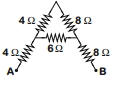
Answerc
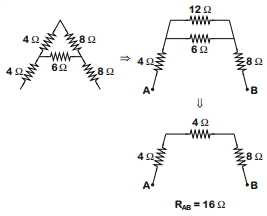
View full question & answer→MCQ 231 Mark
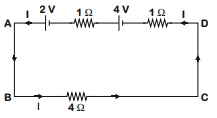
For the circuit shown in the figure, the current $I$ will be .......$A$
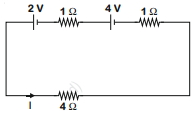
Answerc
By KVL in a closed loop ABCDA,
$V_{A}-1 \times 4-1 \times 1+4-1 \times 1+2=V_{A}$
$-61+6=0$
$1=1 A$
View full question & answer→MCQ 241 Mark
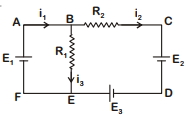
For the circuit given below, the Kirchoff's loop rule for the loop $BCDEB$ is given by the equation
- A
$- i _{2} R _{2}+ E _{2}+ E _{3}+ i _{3} R _{1}=0$
- B
$- i _{2} R _{2}+ E _{2}- E _{3}+ i _{3} R _{1}=0$
- ✓
$i _{2} R _{2}+ E _{2}- E _{3}- i _{3} R _{1}=0$
- D
$i _{2} R _{2}+ E _{2}+ E _{3}+ i _{3} R _{1}=0$
AnswerCorrect option: C. $i _{2} R _{2}+ E _{2}- E _{3}- i _{3} R _{1}=0$
c
In a loop BCDEB by KVL
$v _{ a }- i _{2} R _{2}- E _{2}+ E _{3}+ i _{3} R _{1}= v _{ B }$
$i _{2} R _{2}+ E _{2}- E _{3}- i _{3} R _{1}=0$
View full question & answer→MCQ 251 Mark
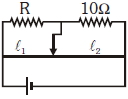
A resistance wire connected in the left gap of a meter bridge balances a $10\, \Omega$ resistance in the right gap at a point which divides the bridge wire in the ratio $3: 2 .$ If the length of the resistance wire is $1.5 m ,$ then the length of $1\, \Omega$ of the resistance wire is $....... \times 10^{-2}\;m$
Answerc
$\frac{ R }{10}=\frac{\ell_{1}}{\ell_{2}}$
$\frac{ R }{10}=\frac{3}{2}$
$R=15 \Omega$
Length of $15 \Omega$ resistance wire is $1.5 m$
length of $1 \Omega$ resistance wire $=\frac{1.5}{15}=0.1$
$=1.0 \times 10^{-1} m$
View full question & answer→MCQ 261 Mark
A charged particle having drift velocity of $7.5 \times 10^{-4}\, ms ^{-1}$ is an electric field of $3 \times 10^{-10}\, Vm ^{-1}$ has a mobility in $m ^{2} V ^{-1} s ^{-1}$ of
- A
$2.25 \times 10^{-15}$
- B
$2.25 \times 10^{15}$
- ✓
$2.5 \times 10^{6}$
- D
$2.5 \times 10^{-6}$
AnswerCorrect option: C. $2.5 \times 10^{6}$
c
$\mu=\frac{v_{d}}{E}=\frac{7.5 \times 10^{-4}}{3 \times 10^{-10}}$
$=2.5 \times 10^{6}$
View full question & answer→MCQ 271 Mark
Two solid conductors are made up of same material, have same length and same resistance. One of them has a circular cross section of area $A_{1}$ and the other one has a square cross section of area $A_{2}$. The ratio $\frac{A _{1}}{A _{2}}$ is
Answerc
Resistance of conductor is given as
$R=\frac{\rho l}{A}$
$\therefore \quad A=\frac{\rho l}{R}$
$\Rightarrow \frac{A_{1}}{A_{2}}=\frac{\rho_{1}}{\rho_{2}} \times \frac{L_{1}}{I_{2}}\left(\frac{R_{2}}{R_{1}}\right)$
$\Rightarrow \frac{A_{1}}{A_{2}}=1 \quad\left[\because R_{1}=R_{2}, I_{1}=l_{2}\right.$ and for same
material $\left.\rho_{1}=\rho_{2}\right]$
View full question & answer→MCQ 281 Mark
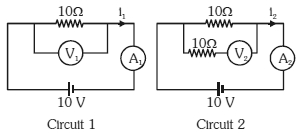
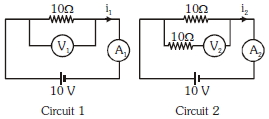
In the circuits shown below, the readings of the voltmeters and the ammeters will be
- A
$\mathrm{V}_{2}>\mathrm{V}_{1}$ and $\mathrm{I}_{1}=\mathrm{I}_{2}$
- B
$\mathrm{V}_{1}=\mathrm{V}_{2}$ and $\mathrm{I}_{1}>\mathrm{I}_{2}$
- ✓
$\mathrm{V}_{1}=\mathrm{V}_{2}$ and $\mathrm{I}_{1}=\mathrm{I}_{2}$
- D
$\mathrm{V}_{2}>\mathrm{V}_{1}$ and $\mathrm{I}_{1}>\mathrm{I}_{2}$
AnswerCorrect option: C. $\mathrm{V}_{1}=\mathrm{V}_{2}$ and $\mathrm{I}_{1}=\mathrm{I}_{2}$
c
$10 \Omega$ is in series with ideal voltmeter. Therefore it will not affect the circuit
$\mathrm{I}_{1}=\frac{10}{10}=1 \;\mathrm{A}$
$\mathrm{I}_{2}=\frac{10}{10}=1\; \mathrm{A}$
$V_1=10\;V$
$V_{2}=10\;V$
View full question & answer→MCQ 291 Mark
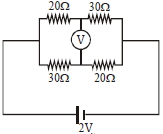
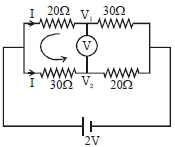
The reading of an ideal voltmer in the circuit shown is.....$V$
Answerd
$\left(\mathrm{V}_{1}-\mathrm{V}_{2}\right)=\frac{30}{25}-\frac{20}{25}=\frac{10}{25}=\frac{2}{5}=0.4 \mathrm{V}$
View full question & answer→MCQ 301 Mark
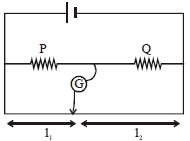
The meter bridge shown is in balanced position with $\frac{\mathrm{P}}{\mathrm{Q}}=\frac{\mathrm{l}_{1}}{\mathrm{l}_{2}}$. If we now litterchange the positions of gavanometer and cell, will the bridge work? If yes, what will be balance condition?
- A
yes, $\frac{\mathrm{P}}{\mathrm{Q}}=\frac{\mathrm{l}_{2}-\mathrm{l}_{1}}{\mathrm{l}_{2}+\mathrm{l}_{1}}$
- B
- C
yes, $\frac{P}{Q}=\frac{l_{2}}{l_{1}}$
- ✓
yes, $\frac{P}{Q}=\frac{l_{1}}{l_{2}}$
AnswerCorrect option: D. yes, $\frac{P}{Q}=\frac{l_{1}}{l_{2}}$
d
Interchanging cell and galvanometer do not effect balance condition.
View full question & answer→MCQ 311 Mark
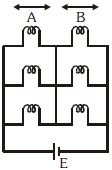
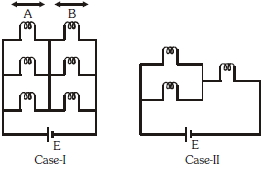
Six similar bulbs are connected as shown in the figure with a $DC$ source of $emf\; E$, and zero internal resistance. The ratio of power consumption by the bulbs when $(i)$ all are glowing and $(ii)$ in the situation when two from section $A$ and one from section $B$ are glowing, will be
- A
$4:9$
- ✓
$9:4$
- C
$1:2$
- D
$2: 1$
Answerb
$\mathrm{R}_{\mathrm{eq}_{1}}=2 \mathrm{R} / 3$
$\mathrm{R}_{\mathrm{eq}_{2}}=\mathrm{R} / 2+\mathrm{R}=\frac{3 \mathrm{R}}{2}$
$\mathrm{P}_{\mathrm{eq}_1}=\frac{\mathrm{E}^{2}}{2 \mathrm{R} / 3}=\frac{3 \mathrm{P}}{2}$
$\mathrm{P}_{\mathrm{eq}_1}=\frac{\mathrm{E}^{2}}{3 \mathrm{R} / 2}=\frac{2 \mathrm{P}}{3}$
$P_{eq_{1}}: P_{eq_{2}}=9: 4$
View full question & answer→MCQ 321 Mark
A set of $n$ equal resistors, of value $R$ each, are connected in series to a battery of emf $E$ and internal resistance $R.$ The current drawn is $I.$ Now, the $n$ resistors are connected in parallel to the same battery. Then the current drawn from battery becomes $10\,I.$ The value of $n$ is
Answera
Current drawn from a battery when $n$ resistors are connected in series is
$I=\frac{E}{n R+R}$ .....$(i)$
Current drawn from same battery when $n$ resistors are connected in parallel is
$10 I=\frac{E}{R / n+R}$ ......$(ii)$
On dividing eqn. $(ii)$ by $(i),$ $10=\frac{(n+1) R}{(1 / n+1) R}$
After solving the equation, $n=10$.
View full question & answer→MCQ 331 Mark
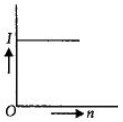
A battery consists of a variable number $n$ of identical cells (having internal resistance reach) which are connected in series. The terminals of the battery are short-circuited and the current $I$ is measured. Which of the graphs shows the correct relationship between $I$ and $n \,?$
Answera
Curtent drawn from the
cell is
$I=\frac{n \varepsilon}{n r}=\frac{\varepsilon}{r}$
$\mathrm{So}, I$ is independent of $n$ and $I$ is constant.
View full question & answer→MCQ 341 Mark
A carbon resistor of $(47 \pm 4.7) \;k\Omega$ is to be marked with rings of different colours for its identification. The colour code sequence will b
- A
Violet - Yellow - Orange - Silver
- B
Green - Orange - Violet - Gold
- ✓
Yellow - Violet - Orange - Silver
- D
Yellow - Green - Violet - Gold
AnswerCorrect option: C. Yellow - Violet - Orange - Silver
c
$(47 \pm 4.7) \;k \Omega=47 \times 10^3 \pm 10 \%$
Yellow - Violet - Orange - Silver
View full question & answer→MCQ 351 Mark
The resistance of a wire is $R\; ohm$. If it is melted and stretched to $'n'$ times its original length, its new resistance will be
AnswerCorrect option: B. $n^2R$
b
The resistance of a wire of length $l$ and area
$A$ and resistivity $\rho$ is given as
$R=\frac{\rho l}{A}$
Given, $l'=n l$
As the volume of the wire remains constant
$\therefore A^{\prime} l^{\prime}=A l$
$A^{\prime}=\frac{A l}{l^{\prime}}=\frac{A l}{n l} \text { or } A^{\prime}=\frac{A}{n}$
$ \therefore \quad R^{\prime} =\frac{\rho l^{\prime}}{A^{\prime}} $
$ R^{\prime} =\frac{\rho n l}{\frac{A}{n}}=\frac{n^{2} \rho l}{A}=n^{2} R $
View full question & answer→MCQ 361 Mark
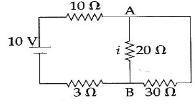
In the electrical circuit shown in the figure, the current $i$ through the side $AB$ is
- A
$\frac{{10}}{{33}}A$
- B
$\;\frac{1}{5}A$
- C
$\;\frac{{10}}{{63}}A$
- ✓
$\;\frac{6}{{25}}A$
AnswerCorrect option: D. $\;\frac{6}{{25}}A$
d
$R_{eq}=25 \Omega$
$I=\frac{10}{25}$
$I=0.4$
$I_{(20\;\Omega)}=\frac{30 \times \frac{4}{10}}{20+30}=\frac{12}{50}=\frac{6}{25} A$
View full question & answer→MCQ 371 Mark
A potentiometer is an accurate and versatile device to make electrical measurements of $EMF$ because the method involves
- A
- ✓
a condition of no current flow through the galvanometer
- C
- D
a combination of cells, galvanometer and resistances
AnswerCorrect option: B. a condition of no current flow through the galvanometer
b
A potentiometer is an accurate and versatile device to make electrical measurements of emf because the method involves a condition of no current flow through the galvanometer, the device can be used to measure potential difference, internal resistance of a cell and compare emf's of two sources.
View full question & answer→MCQ 381 Mark
A potentiometer wire is $100\,\, cm$ long and a constant potential difference is maintained across it. Two cells are connected in series first to support one another and then in opposite direction. The balance points are obtained at $50\,\, cm$ and $10\,\, cm$ from the positive end of the wire in the two cases. The ratio of emf's is
Answerc
Suppose two cells have emfs $\varepsilon_{1}$ and $\varepsilon_{2}$
$\left(\text { also } \varepsilon_{1}>\varepsilon_{2}\right)$
Potential difference per unit length of the potentiometer wire $=k$ (say)
When $\varepsilon_{1}$ and $\varepsilon_{2}$ are in series and supporteach other then
$\varepsilon_{1}+\varepsilon_{2}=50\, \times k$ .....$(i)$
When $\varepsilon_{1}$ and $\varepsilon_{2}$ are in opposite direction
$\varepsilon_{1}-\varepsilon_{2}=10 \times k$ ....$(ii)$
On adding eqn. $(i)$ and eqn. $(ii)$
$2 \varepsilon_{1}=60\, k \Rightarrow \varepsilon_{1}=30 \,k$ and $\varepsilon_{2}=50\, k-30 \,k=20\, k$
$\therefore \quad \frac{\varepsilon_{1}}{\varepsilon_{2}}=\frac{30 \,k}{20 \,k}=\frac{3}{2}$
View full question & answer→MCQ 391 Mark
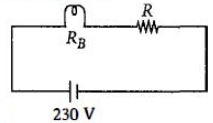
A filament bulb $(500 \,W,\,\, 100 \,V)$ is to be used in a $230\, V$ main supply. When a resistance $R$ is connected in series, it works perfectly and the bulb consumes $500\,W.$ The value of $R$ is .................. $\Omega$
Answera
Resistance of bulb, $R_{B}=\frac{V^{2}}{P}=\frac{(100)^{2}}{500}=20\, \Omega$
Power of the bulb in the circuit,
$P =V I $
$I =\frac{P}{V_{B}} $
$=\frac{500}{100}=5\, \mathrm{A}$
$V_{R} =I R \Rightarrow(230-100)=5 \times R $
$\therefore \quad R =26 \,\Omega$
View full question & answer→MCQ 401 Mark
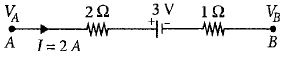
The potential difference $(V_A - V_B)$ between the points $A$ and $B$ in the given figure is ............ $V$
Answerb
$V_{A B}=V_{A}-V_{B}=2 \times 2+3+1 \times 2=9\, \mathrm{V}$

View full question & answer→MCQ 411 Mark
The charge flowing through a resistance $R$ varies with time $t$ as $ Q=at-bt^2 $ where $a$ and $b$ are positive constants . The total heat produced in $R$ is
AnswerCorrect option: D. $\;\frac{{{a^3}R}}{{6b}}$
d
$\text { Given, } Q=a t-b t^{2}$
$\therefore \quad I=\frac{d Q}{d t}=a-2 b t$
At $t=0, Q=0 \Rightarrow I=0$
Also, $I=0$ at $t=a / 2 b$
$\therefore \quad$ Total heat produced in resistance $R$
$H = \int\limits_0^{a/2b} {{I^2}Rdt = R\int\limits_0^{a/2b} {{{(a - 2bt)}^2}dt} } $
${ = R\int\limits_0^{a/2b} {\left( {{a^2} + 4{b^2}{t^2} - 4abt} \right)dt} }$
$=R\left[a^{2} t+4 b^{2} \frac{t^{3}}{3}-4 a b \frac{t^{2}}{2}\right]_{0}^{a / 2 b} $
$=R\left[a^{2} \times \frac{a}{2 b}+\frac{4 b^{2}}{3} \times \frac{a^{3}}{8 b^{3}}-\frac{4 a b}{2} \times \frac{a^{2}}{4 b^{2}}\right]$
$=\frac{a^{3} R}{b}\left[\frac{1}{2}+\frac{1}{6}-\frac{1}{2}\right]=\frac{a^{3} R}{6}$
View full question & answer→MCQ 421 Mark
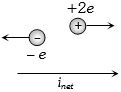
In an electrolyte $3.2 \times {10^{18}}$ bivalent positive ions drift to the right per second while $3.6 \times {10^{18}}$ monovalent negative ions drift to the left per second. Then the current is
- A
$1.6\,amp$ to the left
- ✓
$1.6\,amp$ to the right
- C
$0.45\,amp$ to the right
- D
$0.45\,amp$ to the left
AnswerCorrect option: B. $1.6\,amp$ to the right
b
Net current ${i_{net}} = {i_{( + )}} + {i_{( - )}}$
$ = \frac{{{n_{( + )}}{q_{( + )}}}}{t} + \frac{{{n_{( - )}}{q_{( - )}}}}{t}$
$ = \frac{{{n_{( + )}}}}{t} \times 2e + \frac{{{n_{( - )}}}}{t} \times e$
$= 3.2 \times {10^{18}} \times 2 \times 1.6 \times 10^{-19} + 3.6 \times {10^{18}} \times 1.6 \times 10^{-19}$
$= 1.6\, A$ (towards right)
View full question & answer→MCQ 431 Mark
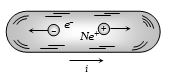
In a neon discharge tube $2.9 \times {10^{18}}\,N{e^ + }$ ions move to the right each second while $1.2 \times {10^{18}}$ electrons move to the left per second. Electron charge is $1.6 \times {10^{ - 19}}\,C$. The current in the discharge tube
- A
$1\, A$ towards right
- ✓
$0.66\, A$ towards right
- C
$0.66\, A$ towards left
- D
AnswerCorrect option: B. $0.66\, A$ towards right
b
Net current $i = {i_ + } + {i_ - } = \frac{{({n_ + })\,({q_ + })}}{t} + \frac{{({n_ - })\,({q_ - })}}{t}$
$ \Rightarrow $ $i = \frac{{({n_ + })}}{t} \times e + \frac{{({n_ - })}}{t} \times e$
$ = 2.9 \times {10^{18}} \times 1.6 \times {10^{ - 19}} + 1.2 \times {10^{18}} \times 1.6 \times {10^{ - 19}}$
$ \Rightarrow $ $i = \,0.66\,A$
View full question & answer→MCQ 441 Mark
A current $I$ is passing through a wire having two sections $P$ and $Q$ of uniform diameters $d$ and $d/2$ respectively. If the mean drift velocity of electrons in sections $P$ and $Q$ is denoted by $v_P$ and $v_Q$ respectively, then
- A
$v_P = v_Q$
- B
$v_P = \frac{1}{2}v_Q$
- ✓
$v_P = \frac{1}{4}v_Q$
- D
$v_P = 2 v_Q$
AnswerCorrect option: C. $v_P = \frac{1}{4}v_Q$
c
(c) Drift velocity ${v_d} = \frac{i}{{neA}} \Rightarrow {v_d} \propto \frac{1}{A}{\rm{ or}}\,{v_d} \propto \frac{1}{{{d^2}}}$
$ \Rightarrow \,\frac{{{v_P}}}{{{v_Q}}} = {\left( {\frac{{{d_Q}}}{{{d_P}}}} \right)^2} = {\left( {\frac{{d/2}}{d}} \right)^2} = \frac{1}{4} \Rightarrow {v_P} = \frac{1}{4}{v_Q}$.
View full question & answer→MCQ 451 Mark
A source of $e.m.f.$ $E = 15\,V$ and having negligible internal resistance is connected to a variable resistance so that the current in the circuit increases with time as $i = 1.2 t + 3$. Then, the total charge that will flow in first five second will be ............... $C$
Answerc
$i = \frac{{dQ}}{{dt}}$ $ \Rightarrow $ $dQ = idt$ $ \Rightarrow $ $Q = \int_{\,{t_1}}^{\,{t_2}} i \,dt = \int_0^5 {(1.2t + 3)\,} dt$
$ = \left[ {\frac{{1.2{t^2}}}{2} + 3t} \right]_0^5 = 30\,C$
View full question & answer→MCQ 461 Mark
The current in a conductor varies with time t as $I = 2t + 3{t^2}$ where $I$ is in ampere and $t$ in seconds. Electric charge flowing through a section of the conductor during $t = 2\,\sec$ to $t = 3\,\sec$ is ............. $C$
Answerb
$dQ = Idt$
$\Rightarrow $ $Q = \int_{t = 2}^{t = 3} {\,Idt} = $ $\left[ {2\int\limits_2^3 {tdt} + 3\int\limits_2^3 {{t^2}dt} } \right]$
$= \left[ {{t^2}} \right]_2^3 + \left[ {{t^3}} \right]_2^3= (9 -4) + (27 -8) = 5 + 19 = 24\,C$.
View full question & answer→MCQ 471 Mark
A beam contains $2 \times 10^8$ doubly charged positive ions per cubic centimeter, all of which are moving with a speed of $10^5 \,m/s$. The current density is ............. $A/m^2$
Answera
$J = nqv = n(ze)v = \frac{{2 \times {{10}^8} \times 2 \times 1.6 \times {{10}^{ - 19}} \times {{10}^5}}}{{{{({{10}^{ - 2}})}^3}}}$ $= 6.4\,A/m^2$
View full question & answer→MCQ 481 Mark
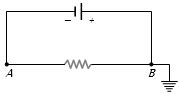
A battery is connected to a uniform resistance wire $AB$ and $B$ is earthed. Which one of the graphs below shows how the current density $J$ varies along $AB$
Answerd
(d) Wire $AB$ is uniform so current through wire $AB$ at every across section will be same. Hence current density $J\left( { = i/A} \right)$ at every point of the wire will be same.
View full question & answer→MCQ 491 Mark
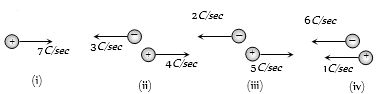
Following figure shows four situations in which positive and negative charges moves horizontally through a region and gives the rate at which each charge moves. Rank the situations according to the effective current through the region greatest first
- A
$i = ii = iii = iv$
- B
$i > ii > iii > iv$
- ✓
$i = ii = iii > iv$
- D
$i = ii = iii < iv$
AnswerCorrect option: C. $i = ii = iii > iv$
c
(c) For figure $(i)$ ${i_1} = 7A$
For figure $(ii)$ ${i_2} = 4 + 3 = 7A$
For figure $(iii)$ ${i_3} = 5 + 2 = 7A$
For figure $(iv)$ ${i_4} = 6 - 1 = 5A$
View full question & answer→MCQ 501 Mark
Two wires each of radius of cross section $r$ but of different materials are connected together end to end (in series). If the densities of charge carriers in the two wires are in the ratio $1 : 4$, the drift velocity of electrons in the two wires will be in the ratio:
- A
$1 : 2$
- B
$2 : 1$
- ✓
$4 : 1$
- D
$1 : 4$
AnswerCorrect option: C. $4 : 1$
c
Let $n_{1}$ and $n_{2}$ be the densities of charge carriers in the two wires, $V_{d_{1}}$ and $V_{d_{2}}$ be the drift velocities of charge carriers in the two wires,
$A$ be the area of cross section,
$e$ is the charge on electron and
$I$ is the current flowing through both the wires
Hence, $I=n_{1} e A V_{d_{1}}=n_{1} e A V_{d_{2}}$
$\therefore n_{1} V_{d_{1}}=n_{2} V_{d_{2}}$
$\therefore \frac{V_{d 1}}{V_{d_{2}}}=\frac{n_{2}}{n_{1}}$
$\therefore \frac{V_{d 1}}{V_{d_{2}}}=\frac{4}{1}$
View full question & answer→