Question
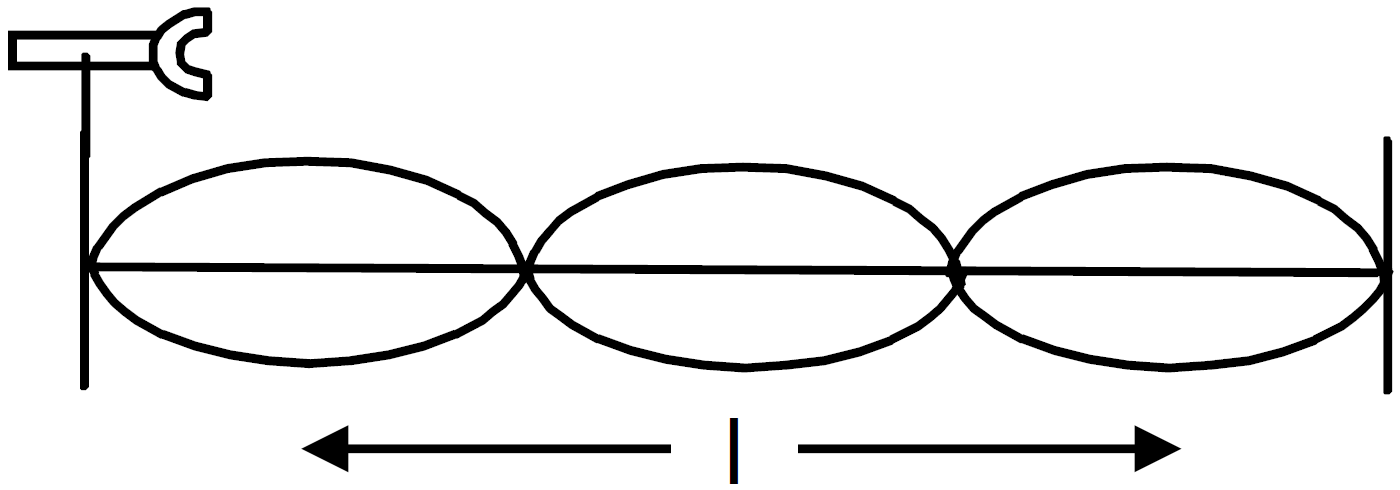
A $660Hz$ tuning fork sets up vibration in a string clamped at both ends. The wave speed for a transverse wave on this string is $220m/s$ and the string vibrates in three loops.
  1. Find the length of the string.
  2. If the maximum amplitude of a particle is $0.5\ cm,$ write a suitable equation describing the motion.
Answer

Frequency of the tuning fork, $\text{f}=660\text{Hz}$ Wave speed, $\text{v}=220\text{ms}$
$\Rightarrow\lambda=\frac{\text{v}}{\text{f}}=\frac{1}{3}\text{m}$
No.of loops $= 3$
  1. So, $\text{f}=\Big(\frac{3}{2\text{l}}\Big)\text{v}$
$\Rightarrow\text{l}=50\text{cm}$
  1. The equation of resultant stationary wave is given by
$\text{y}=2\text{A}\cos\Big(\frac{2\pi\text{x}}{\text{Ql}}\Big)\sin\Big(\frac{2\pi\text{vt}}{\lambda}\Big)$
$\Rightarrow\text{y}(0.5\text{cm})\cos(0.06\pi\text{cm}^{-1})\sin(1320\pi\text{s}^{-1})$

Need a full question paper?

Generate a complete, print-ready paper with questions like this in minutes — across 16+ boards, with answer keys.

Start Generating Free

Similar questions

One mole of an ideal gas is taken in a Carnot engine working between $27°C$ and $227°C$. The useful work done in one cycle is $600J$. Calculate the ratio of the volume of the gas at the end and beginning of the isothermal expansion. Given $R = 8.31J mole^{-1} K^{-1}$.
Two soap bubbles of different diameters are in contact with a certain portion common to both the bubbles. What will be the shape of the common boundary as seen from inside the smaller bubble? Support your answer with a neat diagram. Give reason for your answer.
The velocities of ten particles in $ms^{-1}$ are $0, 2, 3, 4, 4, 4, 5, 5, 6, 9.$ Calculate $(i)$ Average speed and $(ii) \text{r.m.s}.$ speed.
 A source and an observer are approaching one another with velocity $4 m / s$. If the true frequency is $1200 Hz$ , deduce the observed frequency under the following conditions:
i. All velocity is in the source alone.
ii. All velocity is in the observer alone.
Take the velocity of sound waves in air to be $340 ms^{-1}$.
State the principle of homogeneity of dimensions. Test the dimensional homogeneity of the following equation: $\text{h}=\text{h}_0+\text{v}_0\text{t}+\frac{1}{2}\text{gt}^2.$
To simulate car accidents, auto manufacturers study the collisions of moving cars with mounted springs of different spring constants. Consider a typical simulation with a car of mass $1000 \ kg$ moving with a speed $18.0 \ km / h$ on a smooth road and colliding with a horizontally mounted spring of spring constant $5.25 \times 10^3 N m ^{-1}$. What is the maximum compression of the spring?
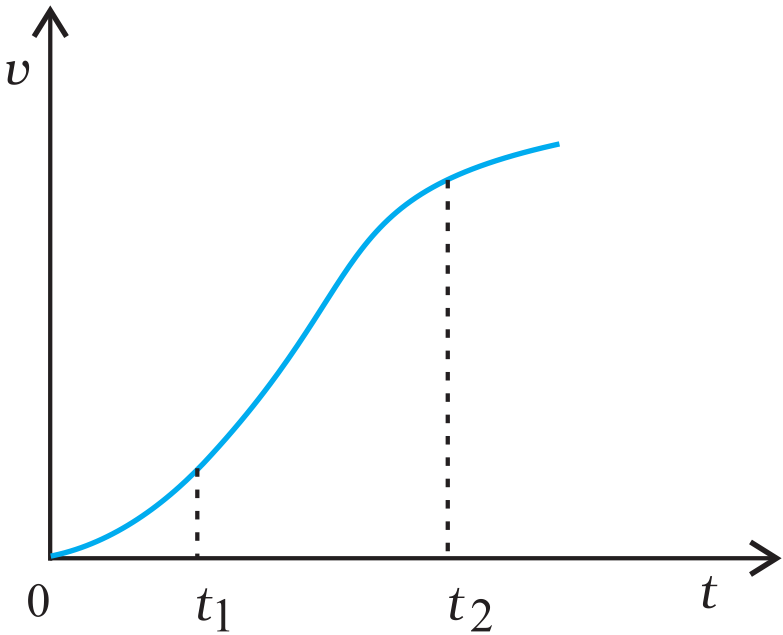
The velocity-time graph of a particle in one-dimensional motion is shown in:

Which of the following formulae are correct for describing the motion of the particle over the time-interval $t_1$ to $t_2$:
a. $x\left(t_2\right)=x\left(t_1\right)+v\left(t_1\right)\left(t_2-t_1\right)+(1 / 2) a\left(t_2-t_1\right)^2$
b. $v\left(t_2\right)=v\left(t_1\right)+a\left(t_2-t_1\right)$
c. $v_{\text {average }}=\left(x\left(t_2\right)-x\left(t_1\right)\right) /\left(t_2-t_1\right)$
d. $a_{\text {average }}=\left(v\left(t_2\right)-v\left(t_1\right)\right) /\left(\mathrm{t}_2-\mathrm{t}_1\right)$
e. $x\left(t_2\right)=x\left(t_1\right)+v_{\text {average }}\left(t_2-t_1\right)+(1 / 2) a_{\text {average }}\left(t_2-t_1\right)^2$
f. $x\left(t_2\right)-x\left(t_1\right)=$ area under the $v$-t curve bounded by the $t$-axis and the dotted line shown.
In a HCl molecule, we may treat Cl to be of infinite mass and H alone be oscillating. If the oscillation of HCl molecule shows a frequency of $9 \times 10^{13}s^{-1}$, deduce the force constant. [Given: Avogadro's number = $6 \times 10^{26}$ per kg mole.)
Calculate the Q-value of the fusion reaction
${ }^4 \mathrm{He}+{ }^4 \mathrm{He}={ }^8 \mathrm{Be} .$
The period of oscillation of the pendulum of a steel clock at $20^{\circ} C$ is 2 seconds. If the temperature of the clock increases by $30^{\circ} C$, what will be the gain or loss in measuring time every day? The coefficient of linear expansion of steel is $1.2 \times$ $10^{-5}{ }^{\circ} C ^{-1}$.