Question
The period of oscillation of the pendulum of a steel clock at $20^{\circ} C$ is 2 seconds. If the temperature of the clock increases by $30^{\circ} C$, what will be the gain or loss in measuring time every day? The coefficient of linear expansion of steel is $1.2 \times$ $10^{-5}{ }^{\circ} C ^{-1}$.
Answer

Given :
$\begin{aligned}\alpha & =1.2 \times 10^{-5}{ }^{\circ} C^{-1} \\\Delta T & =30-20=10^{\circ} C\end{aligned}$
Period of oscillation $=2 sec$
Using the relation $\Delta l=l a \Delta T$
$\begin{array}{l}\frac{\Delta l}{l}=\alpha \Delta T \\\frac{\Delta l}{l}=1.2 \times 10^{-5} \times 10=1.2 \times 10^{-4}\ldots\ldots (1)\end{array}$
Time period $\quad T =2 \pi \sqrt{\frac{l}{g}}\text {let}\ldots\ldots (2)$
When $\Delta l$ increased by $l$ then the period of oscillation is $T ^1$.
$\begin{aligned}T^1 & =2 \pi \sqrt{\frac{l+\Delta l}{g}} \\T^1 & =2 \pi \sqrt{\frac{l}{g}\left(1+\frac{\Delta l}{l}\right)}\ldots\ldots (3)\end{aligned}$
On dividing equation (3) by (2)
$\frac{T^1}{T}=\sqrt{1+\frac{\Delta l}{l}}=\sqrt{1+1.2 \times 10^{-4}}$
$\therefore$ Time loss in one oscillation $= T ^1- T$
Therefore, the daily loss in time
$\begin{array}{l}=\frac{T^1-T}{T} \times 24 \times 3600 \text { second } \\=\left(\frac{T^1}{T}-1\right) \times 24 \times 3600 \\=\left(\sqrt{1+1.2 \times 10^{-4}}-1\right) \times 24 \times 3600 \text { second } \\=\left(\left(1+1.2 \times 10^{-4}\right)^{\frac{1}{2}}-1\right) \times 24 \times 36000\end{array}$
On using binomial theorem, neglecting high order terms
$\begin{array}{l}\left(1+\frac{1}{2} \times 1.2 \times 10^{-4}-1\right) \times 24 \times 36000 \\=\frac{1.2 \times 10^{-4} \times 24 \times 3600}{2} \text { second } \\=5.18 \text { second }\end{array}$

Need a full question paper?

Generate a complete, print-ready paper with questions like this in minutes — across 16+ boards, with answer keys.

Start Generating Free

Similar questions

 A person in an elevator accelerating upwards with an acceleration of $2 m s ^{-2}$, tosses a coin vertically upwards with a speed of 20 m $s ^1$. After how much time will the coin fall back into his hand? $\left( g =10 m s ^{-2}\right)$
Explain the difference between M.K.S. and S.I. unit system.
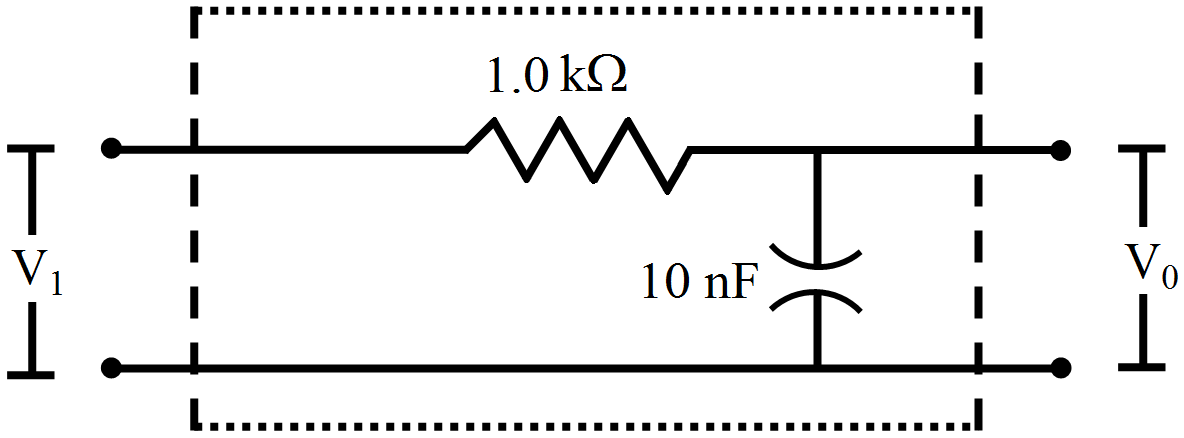
Figure shows a typical circuit for a low$-$pass filter. An $A C$ input $V_i=10 \mathrm{mV}$ is applied at the left end and the output $V_0$ is received at the right end. Find the output voltage for $v=10 \mathrm{kHz}, 1.0 \mathrm{MHz}$ and $10.0 MHz$ . Note that as the frequency is increased the output decreases and, hence, the name low$-$pass filter.
Find the magnetic field B due to a semicircular wire of radius 10.0cm carrying a current of 5.0A at its centre of curvature.
Theory of relativity reveals that mass can be converted into energy. The energy E so obtained is proportional to certain powers of mass m and the speed c of light. Guess a relation among the quantities using the method of dimensions.
If a number of little droplets of water, each of radius $r$, coalesce to form a single drop of radius $R$, show that the rise in temperature will be given by $\Delta \theta=\frac{3 \sigma}{J}\left(\frac{1}{r}-\frac{1}{R}\right)$ where $\sigma$ is the surface tension of water and J is the mechanical equivalent of heat.
A metal sphere of radius $R$ is charged to a potential $V:$
  1. Find the electrostatic energy stored in the electric field within a concentric sphere of radius $2R.$
  2. Show that the electrostatic field energy stored outside the sphere of radius $2R$ equals that stored within it.
A car moving with a speed of $50km/ h^{-1}$​​​​​​​ can be stopped by brakes after at least 6m. What will be the minimum stopping distance, if the same car is moving at a speed of $100km/ h^{-1}​​​​​​​$?
The displacement $($in metre$)$ of a particle moving along $x-$axis is given by $x = 18t + 5r^2$. Calculate:
  1. The instantaneous velocity at $t = 2s$.
  2. Average velocity between $t = 2s$ and $t = 3s$.
  3. Instantaneous acceleration.
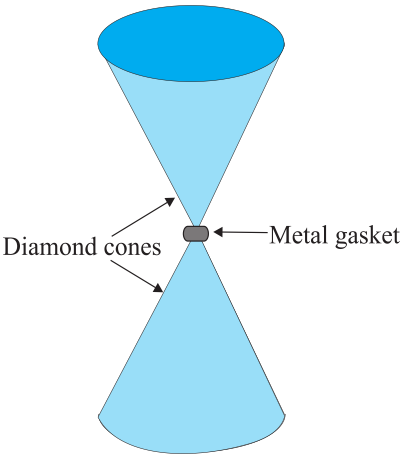
Anvils made of single crystals of diamond, with the shape as shown in Fig., are used to investigate behaviour of materials under very high pressures. Flat faces at the narrow end of the anvil have a diameter of $0.50mm$, and the wide ends are subjected to a compressional force of $50,000N$. What is the pressure at the tip of the anvil?