A $6\,\mu F$ capacitor is charged from $10\;volts$ to $20\;volts$. Increase in energy will be
Easy


Download our appand get started for free
Experience the future of education. Simply download our apps or reach out to us for more information. Let's shape the future of learning together!No signup needed.*
Similar Questions
- 1A parallel plate capacitor has plate area $100\, m ^{2}$ and plate separation of $10\, m$. The space between the plates is filled up to a thickness $5\, m$ with a material of dielectric constant of $10 .$ The resultant capacitance of the system is $'x'$ $pF$. The value of $\varepsilon_{0}=8.85 \times 10^{-12} F \cdot m ^{-1}$ The value of $'x'$ to the nearest integer is............View Solution
- 2Two identical capacitors are joined in parallel, charged to potential $V$, separated and then, connected in series, $i.e.$, the positive plate of one is connected to the negative plate of the other. ThenView Solution
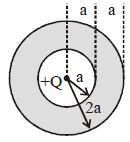
- 3A solid spherical conducting shell has inner radius a and outer radius $2a$. At the center of the shell is located a point charge $+Q$. What must the excess charge of the shell be in order for the charge density on the inner and outer surfaces of the shell to be exactly equal ?View Solution
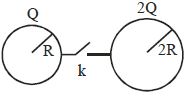
- 4Two spheres of radius $R$ and $2R$ having charge $Q$ and $2Q$ respectively are placed far away from each other. How much charge will flow when key $'k'$ is pressed ?View Solution
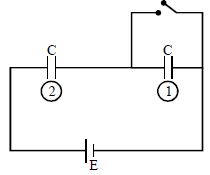
- 5View SolutionCalculate the charge on the second capacitor before and after switch in the circuit is closed
- 6A capacitor $C$ is fully charged with voltage $V _{0}$ After disconnecting the voltage source, it is connected in parallel with another uncharged capacitor of capacitance $\frac{ C }{2} .$ The energy loss in the process after the charge is distributed between the two capacitors is$.........$$CV _{0}^{2}$View Solution
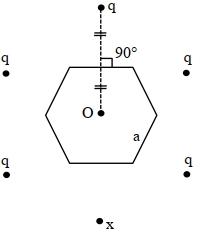
- 7Six charges are placed around a regular hexagon of side length a as shown in the figure. Five of them have charge $q$, and the remaining one has charge $x$. The perpendicular from each charge to the nearest hexagon side passes through the center $O$ of the hexagon and is bisected by the side.View Solution
Which of the following statement($s$) is(are) correct in SI units?
$(A)$ When $x=q$, the magnitude of the electric field at $O$ is zero.
$(B)$ When $x=-q$, the magnitude of the electric field at $O$ is $\frac{q}{6 \pi \epsilon_0 a^2}$.
$(C)$ When $x=2 q$, the potential at $O$ is $\frac{7 q}{4 \sqrt{3} \pi \epsilon_0 a}$.
$(D)$ When $x=-3 q$, the potential at $O$ is $\frac{3 q}{4 \sqrt{3} \pi \epsilon_0 a}$.
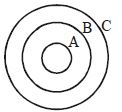
- 8Charges $Q, 2Q$ and $-Q$ are given to three concentric conducting shells $A, B$ and $C$ respectively as shown the ratio of charges on inner and outer surfaces of shell $C$ will beView Solution
- 9Condenser $A$ has a capacity of $15\,\mu F$ when it is filled with a medium of dielectric constant $15$. Another condenser $B$ has a capacity of $1\,\mu F$ with air between the plates. Both are charged separately by a battery of $100\;V$. After charging, both are connected in parallel without the battery and the dielectric medium being removed. The common potential now is.....$V$View Solution
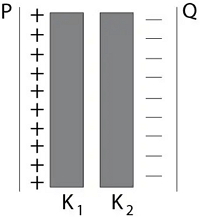
- 10Two thin dielectric slabs of dielectric constants $K_1$ and $K_2$ $(K_1 < K_2)$ are inserted between plates of a parallel plate capacitor, as shown in the figure. The variation of electric field $E$ between the plates with distance $d$ as measured from plate $P$ is correctly shown byView Solution