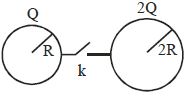
Two spheres of radius $R$ and $2R$ having charge $Q$ and $2Q$ respectively are placed far away from each other. How much charge will flow when key $'k'$ is pressed ?
Easy


Download our appand get started for free
Experience the future of education. Simply download our apps or reach out to us for more information. Let's shape the future of learning together!No signup needed.*
Similar Questions
- 1Four equal charges $Q$ are placed at the four corners of a square of each side is $'a'$. Work done in removing a charge $-Q$ from its centre to infinity isView Solution
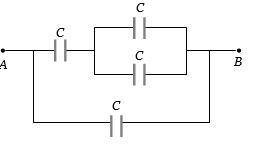
- 2Four equal capacitors, each of capacity $C$, are arranged as shown. The effective capacitance between $A$ and $B$ isView Solution
- 3Assertion : If three capacitors of capacitances $C_1 < C_2 < C_3$ are connected in parallel then their equivalent capacitance $C_P > C_S$.View Solution
Reason : $\frac{1}{{{C_p}}} = \frac{1}{{{C_1}}} + \frac{1}{{{C_2}}} + \frac{1}{{{C_3}}}$
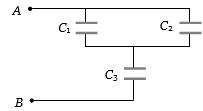
- 4In the given network capacitance, ${C_1} = 10\,\mu \,F,\,{C_2} = 5\,\mu \,F$ and ${C_3} = 4\,\mu \,F$. What is the resultant capacitance between $A$ and $B$.......$\mu \,F$View Solution
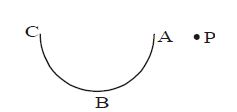
- 5An electric dipole of moment $\vec p$ is lying along a uniform electric field $\vec E.$ The work done in rotating the dipole by $90^o $ isView Solution
- 6A particle of charge $Q$ and mass $M$ moves in a circular path of radius $R$ in a uniform magnetic field of magnitude $B$. The same particle now moves with the same speed in a circular path of same radius $R$ in the space between the cylindrical electrodes of the cylindrical capacitor. The radius of the inner electrode is $R/2$ while that of the outer electrode is $ 3R/2.$ Then the potential difference between the capacitor electrodes must beView Solution
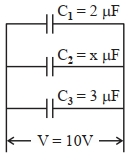
- 7In the given figure the total charge stored in the combination of capacitors is $100\,\mu C$. The value of ' $x$ ' is $............$.View Solution
- 8Two spherical conductors $A$ and $B$ of radii $1\ mm$ and $2\ mm$ are separated by a distance of $5\ cm$ and are uniformly charged. If the spheres are connected by a conducting wire then in equilibrium condition, the ratio of the magnitude of the electric fields at the surfaces of spheres $A$ and $B$ isView Solution
- 9The equivalent capacitance of three capacitors of capacitance ${C_1},{C_2}$ and ${C_3}$ are connected in parallel is $12$ units and product ${C_1}.{C_2}.{C_3} = 48$. When the capacitors ${C_1}$ and ${C_2}$ are connected in parallel, the equivalent capacitance is $6$ units. Then the capacitance areView Solution
- 10In the following diagram the work done in moving a point charge from point $P$ to point $A, B$ and $C$ is respectively as $W_A,\, W_B$ and $W_C$, then (there is no charge nearby)View Solution