MCQ
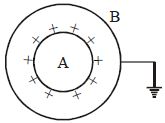
$A$ and $B$ are two concentric spheres. If $A$ is given a charge $Q$ while $B$ is earthed as shown
  • A
    The charge density of $A$ and $B$ are same
  • B
    The field inside and outside $A$ is zero
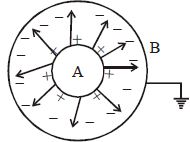
  • The field between $A$ and $B$ is not zero
  • D
    The field inside and outside $B$ is zero
Answer

Correct option: C.
The field between $A$ and $B$ is not zero
c

Need a full question paper?

Generate a complete, print-ready paper with questions like this in minutes — across 16+ boards, with answer keys.

Start Generating Free

Similar questions

A block of mass $2\,kg$ moving on a horizontal surface with speed of $4\,ms ^{-1}$ enters a rough surface ranging from $x =0.5\,m$ to $x =1.5\,m$. The retarding force in this range of rough surface is related to distance by $F =- kx$ where $k =12\,Nm ^{-1}$. The speed of the block as it just crosses the rough surface will be ........... $\,ms ^{-1}$
At distance of $5$ $cm$ and $10$ $cm $ outwards from the surface of a uniformly charged solid sphere, the potentials are $100$ $V$ and $75$ $V$ respectively . Then
The maximum illumination on a screen at a distance of $2\, m$ from a lamp is $25\, lux.$ The value of total luminous flux emitted by the lamp is
A bulb and a capacitor are connected in series to a source of alternating current. If its frequency is increased, while keeping the voltage of the source constant, then
Choose $CORRECT$ variation of $\mu $ (permeability of material) with magnetising field intensity $(H)$ for a ferromagnetic material
According to Kepler, the period of revolution of a planet $(T)$ and its mean distance from the sun $(r)$ are related by the equation
Select the incorrect statement$(s)$
The frequency of $1^{st}$ line of Balmer series in ${H_2}$ atom is ${\nu _0}$. The frequency of line emitted by singly ionised He atom is
A wooden cube just floats inside water with a $200 \,gm$ mass placed on it. When the mass is removed, the cube floats with its top surface $2 \,cm$ above the water level. the side of the cube is ......... $cm$
Two forces of magnitude $3\;N$ and $4\;N $ respectively are acting on a body. Calculate the resultant force if the angle between them is $0^o$