A wooden cube just floats inside water with a $200 \,gm$ mass placed on it. When the mass is removed, the cube floats with its top surface $2 \,cm$ above the water level. the side of the cube is ......... $cm$
Medium
Download our app for free and get started
(c)
Mass $\times g=$ Volume of part of cube $\times \rho \times g$
$\Rightarrow 200 \times g=L^2\left(2 \times \rho_w \times g\right)$
$\Rightarrow 100=L^2 \quad\left\{\because \rho_w=1\right\}$
$\Rightarrow 10 \,cm =L$
From the two figures we can see that the $200 \,gm$ block is provided with required buoyant force but a part of cube which is afloat in $2^{\text {nd }}$ figure.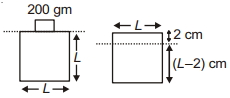

Download our appand get started for free
Experience the future of education. Simply download our apps or reach out to us for more information. Let's shape the future of learning together!No signup needed.*
Similar Questions
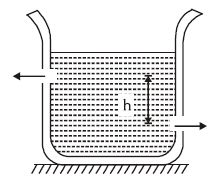
- 1There are two identical small holes of area of cross-section a on the opposite sides of a tank containing a liquid of density $\rho$. The difference in height between the holes is $h$. Tank is resting on a smooth horizontal surface. Horizontal force which will have to be applied on the tank to keep it in equilibrium isView Solution
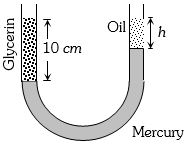
- 2A vertical $U-$ tube of uniform inner cross section contains mercury in both sides of its arms. A glycerin (density = $1.3 g/cm^3$) column of length $10 $ $cm $ is introduced into one of its arms. Oil of density $0.8 gm/cm^3$ is poured into the other arm until the upper surfaces of the oil and glycerin are in the same horizontal level. Find the length of the oil column ........ $cm$. Density of mercury = $13.6 g/cm^3$View Solution
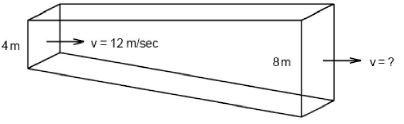
- 3A river gradually deepens, from a depth of $4 \ m$ to a depth of $8\ m$ as shown. The width, $W$, of the river does not change. At the depth of $4 \ m$, the river's speed is $12\ m/sec.$ Its elocity at the $8\ m$ depth is ......... $m/sec$View Solution
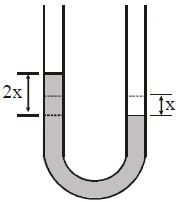
- 4$9\ kg$ of mercury is poured into a glass $U-tube$ with inner diameter of $1.2 \ cm$. The mercury can flow without friction within the tube. the oscillation period ......... $\sec$. Density of mercury = $13.6 × 10^3\ kg/m^3$.View Solution
- 5A long cylindrical vessel is half filled with a liquid. When the vessel is rotated about its own vertical axis, the liquid rises up near the wall. If the radius of vessel is $5\,cm$ and its rotational speed is $2$ rotations per second, then the difference in the heights between the centre and the sides, in $cm,$ will beView Solution
- 6Blood velocity: The flow of blood in a large artery of an anesthetised dog is diverted through a Venturi meter. The wider part of the meter has a crosssectional area equal to that of the artery. $A = 8\; mm^2$. The narrower part has an area $a = 4 \;mm^2$. The pressure drop in the artery is $24\; Pa$. What is the speed (in $m/s$) of the blood in the artery?View Solution
- 7A concrete sphere of radius $R$ has a cavity of radius $ r$ which is packed with sawdust. The specific gravities of concrete and sawdust are respectively $2.4$ and $0.3$ for this sphere to float with its entire volume submerged under water. Ratio of mass of concrete to mass of sawdust will beView Solution
- 8View SolutionA beaker containing a liquid is kept inside a big closed jar. If the air inside the jar is continuously pumped out, the pressure in the liquid near the bottom of the liquid will
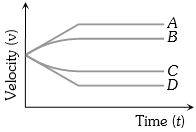
- 9Eight equal drops of water are falling through air with a steady speed of $10\,cm / s$. If the drops coalesce, the new velocity is $.........\,cm/s$View Solution
- 10View SolutionA small spherical solid ball is dropped from a great height in a viscous liquid. Its journey in the liquid is best described in the diagram given below by the