MCQ
$A$ and $B$ are
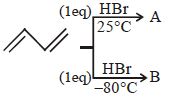
- AChain isomer
- ✓Position isomer
- CIdentical
- DGeometrical isomers
Generate a complete, print-ready paper with questions like this in minutes — across 16+ boards, with answer keys.
Reason : Grignard reagents react with hydroxyl group
$\begin{array}{*{20}{c}}
{C{H_3}\,\,\,\,\,\,\,\,\,\,\,\,\,\,\,\,\,\,\,\,\,\,\,\,\,\,\,\,\,\,\,\,C{H_3}\,\,\,\,\,\,\,} \\
{|\,\,\,\,\,\,\,\,\,\,\,\,\,\,\,\,\,\,\,\,\,\,\,\,\,\,\,\,\,\,\,\,\,\,\,\,\,\,\,\,\,|\,\,\,\,\,\,\,\,\,\,\,\,} \\
{\mathop C\limits_7 {H_3} - \mathop C\limits_6 - \mathop C\limits_5 H = \mathop C\limits_4 H - \mathop C\limits_3 H - \mathop C\limits_2 \equiv \mathop C\limits_1 H} \\
{|\,\,\,\,\,\,\,\,\,\,\,\,\,\,\,\,\,\,\,\,\,\,\,\,\,\,\,\,\,\,\,\,\,\,\,\,\,\,\,\,\,\,\,\,\,\,\,\,\,\,\,\,\,\,} \\
{C{H_3}\,\,\,\,\,\,\,\,\,\,\,\,\,\,\,\,\,\,\,\,\,\,\,\,\,\,\,\,\,\,\,\,\,\,\,\,\,\,\,\,\,\,\,\,\,\,\,}
\end{array}$
is in the following sequence
| Metal | $Li$ | $Na$ | $K$ | $Mg$ | $Cu$ | $Ag$ | $Fe$ | $Pt$ | $W$ |
| $\phi( eV )$ | $2.4$ | $2.3$ | $2.2$ | $3.7$ | $4.8$ | $4.3$ | $4.7$ | $6.3$ | $4.75$ |
$Q\,\left( {1{s^2},\,\,2{s^2}\,2{p^6},\,\,3{s^1}} \right);\,\,R\,\left( {1{s^2},\,\,2{s^2}\,2{p^2}} \right)$The element that would most readily form a diatomic molecule is