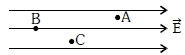
$A, B$ and $C$ are three points in a uniform electric field. The electric potential is
Easy
Download our app for free and get started
Electric potential decreases in the direction of electric field.

Download our appand get started for free
Experience the future of education. Simply download our apps or reach out to us for more information. Let's shape the future of learning together!No signup needed.*
Similar Questions
- 1Equivalent capacitance between $A$ and $B$ is......$\mu \,F$View Solution
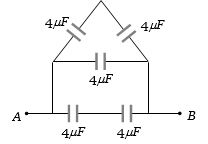
- 2View SolutionThe equivalent capacitance of the combination shown in the figure is :
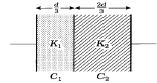
- 3A parallel plate capacitor with air between the plates has capacitance of $9\ pF$. The separation between its plates is '$d$'. The space between the plates is now filled with two dielectrics. One of the dielectrics has dielectric constant $k_1 = 3$ and thickness $\frac{d}{3}$ while the other one has dielectric constant $k_2 = 6$ and thickness $\frac{2d}{3}$ . Capacitance of the capacitor is now.......$pF$View Solution
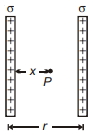
- 4For two infinitely long charged parallel sheets, the electric field at $P$ will beView Solution
- 5Two charged spherical conductors of radius $R_{1}$ and $\mathrm{R}_{2}$ are connected by a wire. Then the ratio of surface charge densities of the spheres $\left(\sigma_{1} / \sigma_{2}\right)$ is :View Solution
- 6The electrostatic potential inside a charged spherical ball is given by : $V = b -ar^2$, where $r$ is the distance from the centre ; $a$ and $b$ are constants. Then, the charge density inside the ball is :View Solution
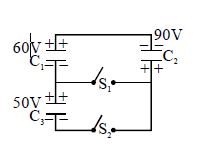
- 7Three charged capacitors, $C_1$ = $17\ μF$, $C_2$ = $34\ μF$, $C_3$ = $41\ μF$and two open switches, $S_1$ and $S_2$ are assembled into a network with initial voltages and polarities, as shown. Final status of the network is attained when the two switches, $S_1$ and $S_2$ are closed. In the figure, the final charge on capacitor $C_3$ in $mC$, is closet to:View Solution
- 8A parallel plate capacitor has capacitance $C$. If it is equally filled with parallel layers of materials of dielectric constants $K_1$ and $K_2$ its capacity becomes $C_1$. The ratio of $C_1$ to $C$ isView Solution
- 9Electric potential in a region is varying according to the relation $V=\frac{3 x^2}{2}-\frac{y^2}{4}$, where $x$ and $y$ are in metre and $V$ is in volt. Electric field intensity (in $N/C$) at a point $(1 \,m , 2 \,m$ ) is ......View Solution
- 10The electric potential at the centre of two concentric half rings of radii $R_1$ and $R_2$, having same linear charge density $\lambda$ isView Solution