MCQ
$A$ bal $A$ collides elastically with another identical ball $B$ initially at rest $A$ is moving with velocity of $10m/ s$ at an angle of $60^o$ from the line joining their centres. Select correct alternative :
  • A
    velocity of ball $A$ after collision is $5\, m/s$
  • B
    velocity of ball $B$ after collision is $5m/s$
  • C
    velocity of ball $A$ after collision is $7.5 m/s$
  • velocity of ball $B$ after collision is $5 m/s.$
Answer

Correct option: D.
velocity of ball $B$ after collision is $5 m/s.$
d

Need a full question paper?

Generate a complete, print-ready paper with questions like this in minutes — across 16+ boards, with answer keys.

Start Generating Free

Similar questions

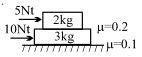
The system shown in figure is released then $a_1$ and $a_2$ is
A particle has an initial velocity of ($3\hat i + 4\hat j)\;ms^{-1}$ and an acceleration of $(0.4\hat i + 0.3\hat j)\;ms^{-1}$ Its speed after $10\;s$ is:
A particle is moving in a straight line such that its velocity is increasing at $5\,ms ^{-1}$ per meter. The acceleration of the particle is $ms ^{-2}$ at a point where its velocity is $20\,ms ^{-1}$.
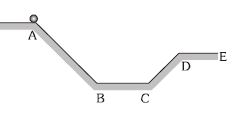
In the picture shown, a ball standing from rest rolls down a ramp $AB$, goes along at the horizontal bottom $BC$, and then backs up a smaller ramp $CD$, thereafter rolls on horizontal plane $DE$. Ignore friction and air resistance.Which of the following figure shows variation in speed with time ?
$A$ paritcle falls freely near the surface of the earth. Consider $a$ fixed point $O$ (not vertically below the particle) on the ground.
One mole of a monoatomic ideal gas is mixed with one mole of a diatomic ideal gas. The molar specific heat of the mixture at constant volume is
When an engine passes near to a stationary observer then its apparent frequencies occurs in the ratio $5/3$. If the velocity sound is $340 m/s$, than the velocity of engine is .... $m/s$
The angular speed of a fly wheel making $120$ revolutions/minute is
A spherically symmetric gravitational system of particles has a mass density $\rho=\left\{\begin{array}{ll}\rho_0 & \text { for } r \leq R \\ 0 & \text { for } r>R\end{array}\right.$ where $\rho_0$ is a constant. A test mass can undergo circular motion under the influence of the gravitational field of particles. Its speed V as a function of distance $r(0 < r < \infty)$ from the centre of the system is represented by
Where will it be profitable to purchase $1$ kilogram sugar