MCQ
A ball hits a floor and rebounds after an inelastic collision. In this case:
  1. The momentum of the ball just after the collision is same as that just before the collision.
  2. The mechanical energy of the ball remains the same during the collision.
  3. The total momentum of the ball and the earth is conserved.
  4. The total energy of the ball and the earth remains the same.
  • A
    $A$ and $B$
  • B
    $B$ and $C$
  • C
    $B$ and $D$
  • $C$ and $D$

Answer

Correct option: D.
$C$ and $D$
As the ball rebounds after hitting the floor, its velocity changes.
i.e. Velocity of ball before collision $\neq$ Velocity of ball after collision
Therefore, the momentum of the ball just after the collision is not same as that just before the collision.
The mechanical energy of the ball also changes during the collision.
However, the total momentum of the system $($earth plus ball$)$ and the total energy of the system remain conserved.

Need a full question paper?

Generate a complete, print-ready paper with questions like this in minutes — across 16+ boards, with answer keys.

Start Generating Free

Similar questions

In a seconds pendulum, mass of bob is $30\, g$. If it is replaced by $90\, g$ mass. Then its time period will be ... $\sec$
The change in frequency due to Doppler effect does not depend on:
Let a wire be suspended from the ceiling (rigid support) and stretched by a weight $W$ attached at its free end. The longitudinal stress at any point of cross-sectional area $A$ of the wire is :
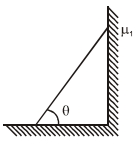
In the figure, a ladder of mass $m$ is shown leaning against a wall. It is in static equilibrium making an angle $\theta$ with the horizontal floor. The coefficient of friction between the wall and the ladder is $\mu_1$ and that between the floor and the ladder is $\mu_2$. The normal reaction of the wall on the ladder is $N_1$ and that of the floor is $N_2$. If the ladder is about to slip, then

$Image$

$(A)$ $\mu_1=0 \mu_2 \neq 0$ and $N _2 \tan \theta=\frac{ mg }{2}$

$(B)$ $\mu_1 \neq 0 \mu_2=0$ and $N_1 \tan \theta=\frac{m g}{2}$

$(C)$ $\mu_1 \neq 0 \mu_2 \neq 0$ and $N _2 \tan \theta=\frac{ mg }{1+\mu_1 \mu_2}$

$(D)$ $\mu_1=0 \mu_2 \neq 0$ and $N _1 \tan \theta=\frac{ mg }{2}$

Two vessels of different materials are similar in size in every respect. The same quantity of ice filled in them gets melted in $20$ minutes and $40$ minutes respectively. The ratio of thermal conductivities of the materials is 
If momentum $(P)$, area $(A)$ and time $(T)$ are taken to be fundamental quantities then energy has dimensional formula
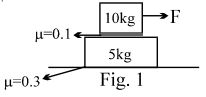
When $F = 2N$, the frictional force between $5 kg$ block and ground is ...... $N$
$A$ system of $N$ particles is free from any external forces. Which of the following is true for the magnitude of the total momentum of the system?
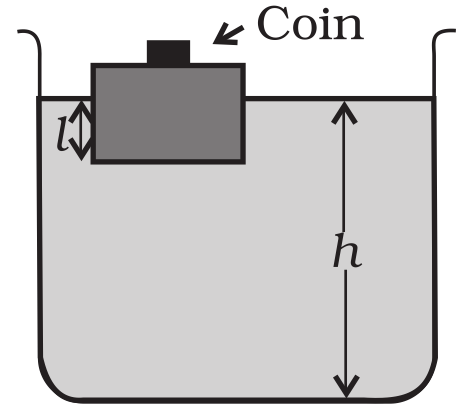
A wooden block with a coin placed on its top, floats in water as shown in the distance $l$ and $h$ are shown in the figure. After some time the coin falls into the water. Then:
  1. l decreases.
  2. h decreases.
  3. l increases.
  4. h increase.
Ship $A$ is sailing towards north -east with velocity $\vec v = 30\,\hat i + 50\hat j\,km/hr$ where $\hat i$ points east and $\hat j$ , north. Ship $B$ is at a distance of $80\, km$ east and $150\, km$ north of Ship $A$ and is sailing towards west at $10\, km/hr$. $A$ will be at minimum distance from $B$ is.........$hrs$