MCQ
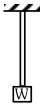
Let a wire be suspended from the ceiling (rigid support) and stretched by a weight $W$ attached at its free end. The longitudinal stress at any point of cross-sectional area $A$ of the wire is :
  • A
    Zero
  • B
    $2 W / A$
  • $W / A$
  • D
    $W / 2 A$

Answer

Correct option: C.
$W / A$
c
Stress $=\frac{ IRF }{ A }$

Stress $=\frac{ W }{ A }$

(Here $A$ Cross-sectional Area)
Need a full question paper?

Generate a complete, print-ready paper with questions like this in minutes — across 16+ boards, with answer keys.
Start Generating Free

Similar questions

A communications Earth satellite
Two vectors $\overrightarrow{{X}}$ and $\overrightarrow{{Y}}$ have equal magnitude. The magnitude of $(\overrightarrow{{X}}-\overrightarrow{{Y}})$ is ${n}$ times the magnitude of $(\overrightarrow{{X}}+\overrightarrow{{Y}})$. The angle between $\overrightarrow{{X}}$ and $\overrightarrow{{Y}}$ is -
Which of the following statements can be suitable?
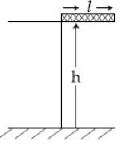
A rectangles solid box of length $0.3\, m$ is held horizontally, with one of its sides on the edge of a platform of height $5\,m$. When released, it slips off the table in a very short time $= 0.01\, s$, remaining essentially horizontal. The angle by which it would rotate when it hits the ground will be (in radians) close to:
A man standing on a road hold his umbrella at $30^° $ with the vertical to keep the rain away. He throws the umbrella and starts running at $10\, km/hr$. He finds that raindrops are hitting his head vertically, the speed of raindrops w.r.t. the moving man, will be
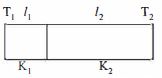
One end of a thermally insulated rod is kept at a temperature $T_1$ and the other at $T_2$ . The rod is composed of two sections of length $l_1$ and $l_2$ and thermal conductivities $K_1$ and $K_2$ respectively. The temperature at the interface of the two section is
A car accelerates on a horizontal road due to the forces exerted by
A particle moves such that its position vector $\overrightarrow{\mathrm{r}}(\mathrm{t})=\cos \omega \mathrm{t} \hat{\mathrm{i}}+\sin \omega \mathrm{t} \hat{\mathrm{j}}$ where $\omega$ is a constant and $t$ is time. Then which of the following statements is true for the velocity $\overrightarrow{\mathrm{v}}(\mathrm{t})$ and acceleration $\overrightarrow{\mathrm{a}}(\mathrm{t})$ of the particle
A satellite of mass $m$ is in circular orbit of radius $3 R_E$ about earth (mass of earth $M_{E}$, radius of earth $R_{E}$). How much additional energy is required to transfer the satellite to an orbit of radius $9 R_{E}$?
The two nearest harmonics of a tube closed at one end and open at other end are $220\,\, Hz$ and $260\,\, Hz.$ What is the fundamental frequency of the system .... $Hz$ ?