MCQ
A ball hits a floor and rebounds after an inelastic collision. In this case:
  • A
    The total energy of the ball and the earth remains the same.
  • B
    The total momentum of the ball and the earth is conserved.
  • C
    The momentum of the ball just after the collision is same as that just before the collision.
  • A and B both

Answer

Correct option: D.
A and B both
Explanation:
As the collision is inelastic, body losses some energy, so that KE of ball does not remain the same. However, total energy and total momentum of ball and earth remain the same.

Need a full question paper?

Generate a complete, print-ready paper with questions like this in minutes — across 16+ boards, with answer keys.

Start Generating Free

Similar questions

A resonance tube is old and has jagged end. It is still used in the laboratory to determine velocity of sound in air. A tuning fork of frequency $512\,Hz$ produces first resonance when the tube is filled with water to a mark $11\,cm$ below a reference mark, near the open end of the tube. The experiment is repeated with another fork of frequency $256\,Hz$ which produces first resonance when water reaches a mark $27\,cm$ below the reference mark. The velocity of sound in air, obtained in the experiment, is close to .... $ms^{-1}$
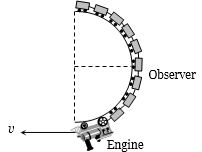
A train has just complicated a $U-$curve in a track which is a semicircle. The engine is at the forward end of the semi circular part of the track while the last carriage is at the rear end of the semicircular track. The driver blows a whistle of frequency $200 Hz.$ Velocity of sound is $340 m/sec$. Then the apparent frequency as observed by a passenger in the middle of a train when the speed of the train is $30 m/sec$ is  ... $Hz$
In rear$-$wheel drive cars, the engine rotates the rear wheels and the front wheels rotate only because the car moves. If such a car accelerates on a horizontal road, the friction:
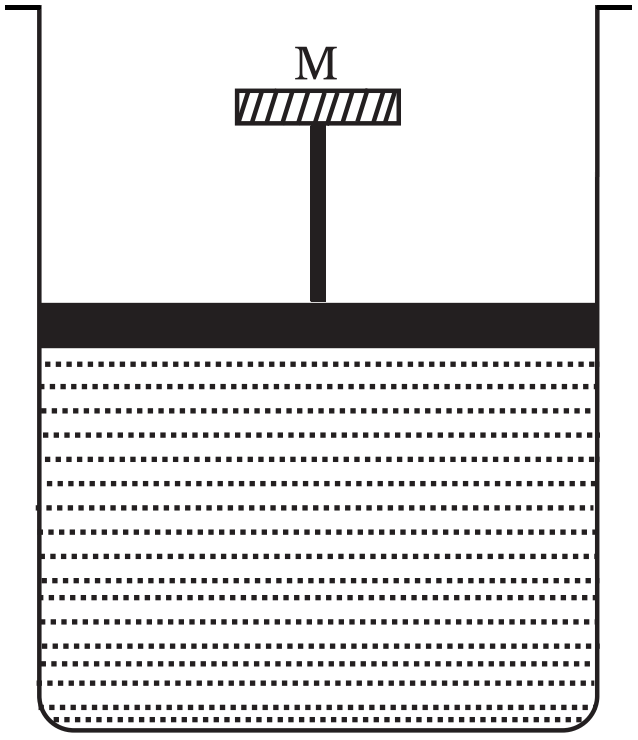
A cylinder containing an ideal gas is in vertical position and has a piston of mass $M$ that is able to move up or down without friction $($ figure$)$. If the temperature is increased.
For silver, Young's modulus is $7.25 \times {10^{10}}\,N/{m^2}$ and Bulk modulus is $11 \times {10^{10}}\,N/{m^2}$. Its Poisson's ratio will be
On colliding in a closed container the gas molecules
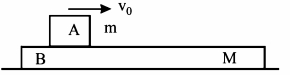
The masses of blocks A and B are $m$ and $M$ respectively. Between $A$ and $B$, there is a constant frictional force $F$ and $B$ can slide on a smooth horizontal surface. A is set in motion with velocity while $B$ is at rest. What is the distance moved by A relative to $B$ before they move with the same velocity?
Choose the correct match

List I 

List II

 $(i)$ Curie

 $(A)$ $ML{T^{ - 2}}$

 $(ii)$ Light year 

 $(B)$ $M$

 $(iii)$ Dielectric strength

 $(C)$ Dimensionless

 $(iv)$ Atomic weight

 $(D)$ $T$

 $(v)$ Decibel

 $(E)$ $M{L^2}{T^{ - 2}}$


 $(F)$ $M{T^{ - 3}}$


 $(G)$ ${T^{ - 1}}$


 $(H)$ $L$


 $(I)$ $ML{T^{ - 3}}{I^{ - 1}}$


 $(J)$ $L{T^{ - 1}}$

A uniform cube of side $a$ and mass $m $ rests on a rough horizontal table. $A$ horizontal force $F $ is applied normal to one of the faces at a point that is directly above the centre of the face, at a height $\frac{{3a}}{4}$ above the base. The minimum value of $F$ for which the cube begins to tilt about the edge is (assume that the cube does not slide)
In terms of basic units of mass $(M)$, length $(L)$, time $(T)$ and charge $(Q)$, the dimensions of magnetic permeability of vacuum $\left(\mu_0\right)$ would be