MCQ 11 Mark
A body of mass $m$ is rotating in a vertical circle of radius $'r\ '$ with critical speed. The difference in its $K.E.$ at the top and the bottom is $.............$
- ✓
$\text{2mgr}$
- B
$\text{4mgr}$
- C
$\text{6mgr}$
- D
$\text{3mgr}$
AnswerCorrect option: A. $\text{2mgr}$
The change of kinetic energy will be equet to the change in potential energy.
$\triangle\text{KE}=\triangle\text{PE}=\text{mg}(\text{h}_1-\text{h}_2)$
Since radious $r,$
$h_1- h_2= r$
View full question & answer→MCQ 21 Mark
A small sphere is attached to a cord and rotates in a vertical circle about a point Or. If the average speed of the sphere is increased, the cord is most likely to break at the orientation when the mass is at:
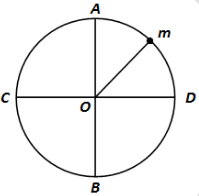
- ✓
Bottom point $B$
- B
Top point $A$
- C
Point $D$
- D
Point $C$
AnswerCorrect option: A. Bottom point $B$
Tension in the cord is maximum $($for a given average speed of rotation$)$ when the mass, $m,$ is at the bottom points $B,$ as the gravitational force is in the downward direction and tension of the cord is directly opposing it.
View full question & answer→MCQ 31 Mark
A stationary particle explodes into two particles of masses $m_1$ and $m_2$, which move in opposite directions with velocities $v_1$ and $v_2$. The ratio of their kinetic energies $\frac{\text{E}_1}{\text{E}_2}$ is:
- ✓
$\frac{\text{m}_2}{\text{m}_1}$
- B
$\frac{\text{m}_1}{\text{m}_2}$
- C
$1$
- D
$\frac{\text{m}_1\text{v}_2}{\text{m}_2\text{v}_1}$
AnswerCorrect option: A. $\frac{\text{m}_2}{\text{m}_1}$
According to the principle of conservation of linear momentum,
$\text{m}_1\text{v}_1-\text{m}_2\text{v}_2=0$
$\therefore\frac{\text{m}_1}{\text{m}_2}=\frac{\text{v}_2}{\text{v}_1}$
$\frac{\text{E}_1}{\text{E}_2}=\frac{\frac{1}{2}\text{m}_1\text{v}_1^2}{\frac{1}{2}\text{m}_2\text{v}_2^2}$
$=\frac{\text{m}_1}{\text{m}_1}\Big(\frac{\text{v}_1}{\text{v}_2}\Big)^2$
$=\frac{\text{m}_1}{\text{m}_2}\Big(\frac{\text{m}_2}{\text{m}_1}\Big)^2$
$=\frac{\text{E}_1}{\text{E}_2}=\frac{\text{m}_2}{\text{m}_1}$
View full question & answer→MCQ 41 Mark
The work done by all the forces $($external and internal$)$ on a system equals the change in:
View full question & answer→MCQ 51 Mark
The water stored in a reservoir possesses:
AnswerPotential energy is the energy possessed due to the relative position of one body with respect to other.
Kinetic energy is the energy possessed due to the motion of the body.
Water stored in the reservoir is at rest, so no kinetic energy but it is at some height with respect to some level below the water surface, so it contains potential energy.
View full question & answer→MCQ 61 Mark
An electron and a proton are moving under the influence of mutual forces. In calculating the change in the kinetic energy of the system during motion, one ignores the magnetic force of one on another. This is because:
- A
The two magnetic forces are equal and opposite, so they produce no net effect.
- ✓
The magnetic forces do no work on each particle.
- C
The magnetic forces do equal and opposite (but non-zero) work on each particle.
- D
The magenetic forces are necessarily negligible.
AnswerCorrect option: B. The magnetic forces do no work on each particle.
Key concept: To calculate the change in kinetic energy of the system during motion we have to apply work energy, theorem. According to this theorem, Net work done $=$ Final kinetic energy $-$ Initial kinetic energy of the object The above statement shows the connection between work and kinetic energy as:
“The work done by the net force acting on an object is equal to the change in the kinetic energy of that object”.
Net work done $(IF)$ on a particle equals change in kinetic energy of the particle.
$\sum\text{W}=\text{K}_2-\text{K}_1$
According to the problem as the electron and proton are moving under the influence of mutual forces, the magnetic forces will be perpendicular to their motion, hence, it acts as a centripetal force for the particle. In this way the particle performs the uniform circular morion, this implies speed will remain constant.
So, there is no change in kinetic energy of the particle.
Hence no work is done by these forces.
$\vec{\text{F}_\text{m}}=\text{q}(\vec{\text{v}}\times\vec{\text{B}})\cdot\text{F}_\text{m}$
$($magnetic force$)$ will be perpendicular to both $B$ and $v,$ where $B$ is the external magnetic field and $v$ is the velocity of particle.
That is why one ignores the magnetic force of one particle on another.
View full question & answer→MCQ 71 Mark
In a hydroelectric power station, the water is flowing at $2\ ms^{-1}$ in the river which is $100m$ wide and $5m$ deep. The maximum power output from the river is:
- A
$1.5MW.$
- ✓
$2MW.$
- C
$2.5MW.$
- D
$3MW.$
AnswerCorrect option: B. $2MW.$
View full question & answer→MCQ 81 Mark
What is the ratio of kinetic energy of a particle at the bottom to the kinetic energy at the top when it just loops a vertical loop of radius $r?$
- ✓
$5 : 1$
- B
$2 : 3$
- C
$5 : 2$
- D
$7 : 2$
AnswerCorrect option: A. $5 : 1$
View full question & answer→MCQ 91 Mark
In the elastic collision of heavy vehicle moving with a velocity $10\ ms^{-1}$ and a small stone at rest, the stone will fly away with a velocity equal to:
- A
$40\ ms^{-1}$
- ✓
$20\ ms^{-1}$
- C
$10\ ms^{-1}$
- D
$5\ ms^{-1}$
AnswerCorrect option: B. $20\ ms^{-1}$
In the elastic collision between a heavy object and a very light object at rest, the velocity of particles after collision is.
for heavy particle, in$_1 =$ in the$_1 />$ for light particle, in $= 2$ in the$_1$−in the$_2/>$
since, in the$_2 = 0$ hence,
in$_2 = 2$ in the$_1$
Therefore, the stone will fly away with a velocity equal to
in$_1= 2$ in the$_1= 2(10) = 20\ ms^{-1}$
View full question & answer→MCQ 101 Mark
A particle of mass $1g$ moving with a velocity $\text{v}_1=3\hat{\text{i}}-2\hat{\text{j}}\text{ms}^{-1}$ experiences a perfectly elastic collision with another particle of mass $2g$ and velocity $\text{v}_2=4\hat{\text{j}}-6\hat{\text{k}}\text{ms}^{-1}$. The velocity of the particle is:
- A
$23\ ms ^{-1}$
- ✓
$4.6\ ms^{-1}$
- C
$9.2\ ms^{-1}$
- D
$6\ ms^{-1}$
AnswerCorrect option: B. $4.6\ ms^{-1}$
View full question & answer→MCQ 111 Mark
A force of $16N$ is distributed uniformly on one surface of a cube of edge $8\ cm.$ The pressure on this surface is:
- A
$3500Pa$
- ✓
$2500Pa$
- C
$4500Pa$
- D
$5500Pa$
AnswerCorrect option: B. $2500Pa$
$F = 16N$
$A =8 \times 8 \times 10^{-4}m^2$
$\text{P}=\frac{\text{F}}{\text{A}}$
$=\frac{16}{64 \times10^{-4}}$
$=\frac{1000}{4}$
$=2500\text{Pa}$
View full question & answer→MCQ 121 Mark
In which case does the potential energy decrease?
- A
On compressing the spring.
- B
- C
On moving a body against gravitational pull.
- ✓
On the raising of an air bubble in water.
AnswerCorrect option: D. On the raising of an air bubble in water.
$P.E.$ decreases when an air bubble rises in water. Because work is done by upthrust.
View full question & answer→MCQ 131 Mark
A bulled of mass $a$ and velocity $b$ is fired into a large block of mass $c$. The final velocity of the system is:
- A
$\frac{\text{c}}{\text{a}+\text{b}}.\text{b}$
- ✓
$\frac{\text{ab}}{\text{a}+\text{c}}$
- C
$\frac{(\text{a}+\text{b})}{\text{c}}.\text{a}$
- D
$\frac{(\text{a}+\text{c})}{\text{a}}.\text{b}$
AnswerCorrect option: B. $\frac{\text{ab}}{\text{a}+\text{c}}$
View full question & answer→MCQ 141 Mark
A man does a given amount of work in $10s.$ Another man does the same amount of work in $20s.$ The ratio of the output power of the first man to that of second man is
- A
$1$
- B
$1 : 2$
- ✓
$2 : 1$
- D
$3 : 1$
AnswerCorrect option: C. $2 : 1$
Since, $\text{P}=\frac{\text{W}}{\text{t}}$
So, if $W$ is constant, than $\text{P}\propto\frac{1}{\text{t}}$
i.e. $\frac{\text{P}_1}{\text{P}_2}=\frac{\text{t}_2}{\text{t}_1}=\frac{20}{10}$
$\Rightarrow\frac{\text{P}_1}{\text{P}_2}=\frac{2}{1}$
$P_1 : P_2$
$= 2 : 1$
View full question & answer→MCQ 151 Mark
A ball of mass $m$ moving with a velocity $v$ collides with an identical ball at rest. After collision, the first ball comes to rest. The speed of the other ball is:
- A
$\frac{\text{v}}{2}$
- B
$2v$
- ✓
$v$
- D
AnswerAs the masses of two balls are equal, their velocities are exchanged.
As first ball comes to rest, speed of other ball $= v.$
View full question & answer→MCQ 161 Mark
Two bodies of masses $m$ and $4m$ are moving with equal kinetic energy. The ratio of their linear momenta is:
- A
$1 : 4$
- B
$4 : 1$
- ✓
$1 : 2$
- D
$1 : 1$
AnswerCorrect option: C. $1 : 2$
View full question & answer→MCQ 171 Mark
Two bodies of masses $m$ and $4m$ are moving with equal linear momentum. The ratio of their kinetic energies is:
- A
$1 : 4$
- ✓
$4 : 1$
- C
$1 : 1$
- D
$1 : 2$
AnswerCorrect option: B. $4 : 1$
View full question & answer→MCQ 181 Mark
Two weights of $5\ kg$ and $10\ kg$ are placed on a horizontal table of height $1.5m.$ Which will have more potential energy?
- A
$5\ kg$
- ✓
$10\ kg$
- C
Both will have equal energy
- D
AnswerCorrect option: B. $10\ kg$
We know that, $\text{P.E = mgh}$
So, It is directly proportional to height and mass.
Since both the weights are at the same height,
so the weight with a larger mass will have more potential energy.
Since $10\ kg$ object has a larger mass than a $5$ medical history
So, the potential energy of a $10\ kg$ mass will be greater.
View full question & answer→MCQ 191 Mark
A boy is swinging in a swing. If he stands the time period will
- A
First decreases, then increase.
- ✓
- C
- D
AnswerAs the child stand up the effective length of pendulum decreases due to the reason that center of gravity rises up.
According to $\text{T}=2\text{s}\sqrt{\Big(\frac{1}{\text{g}}}\Big)$
View full question & answer→MCQ 201 Mark
A raised hammer possesses:
AnswerCorrect option: B. $P.E.$
A raised hammer possesses $P.E$ Energy possessed by a body by virtue of its position is called as potential energy.
Similarly is the case when a hammer is raised. A raised hammer possesses potential energy by virtue of its height above ground level.
View full question & answer→MCQ 211 Mark
You lift a suitcase from the floor and keep it on the table. The work done by you on the suitcase depends on:
- A
The path taken by the suitcase.
- B
- ✓
The weight of the suitcase.
- D
The time taken by you in doing so.
AnswerCorrect option: C. The weight of the suitcase.
The work done by a person in lifting an object is stored as its potential energy mgh.
Hence, work done depends on the weight of the object mg.
View full question & answer→MCQ 221 Mark
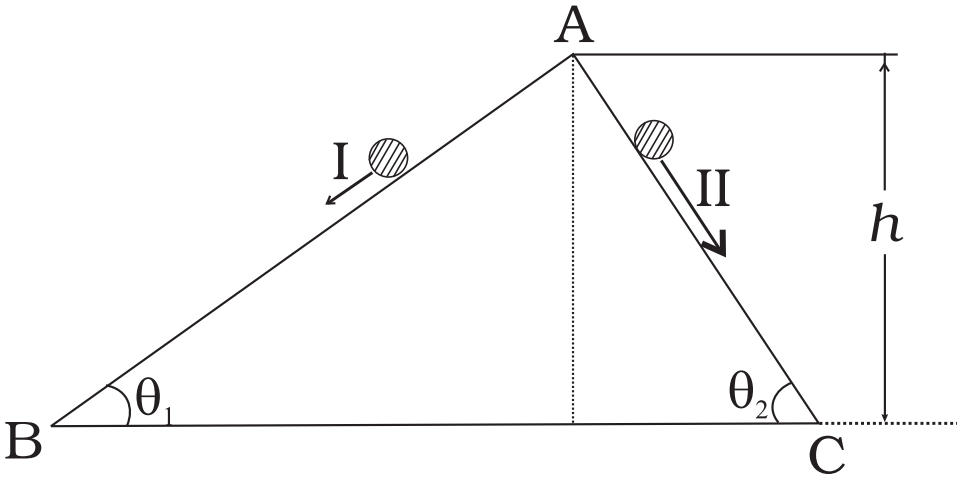
Two inclined frictionless tracks, one gradual and the other steep meet at A from where two stones are allowed to slide down from rest, one on each track as shown in which of the following statement is correct?
- A
Both the stones reach the bottom at the same time but not with the same speed.
- B
Both the stones reach the bottom with the same speed and stone $I$ reaches the bottom earlier than stone $II.$
- ✓
Both the stones reach the bottom with the same speed and stone $II$ reaches the bottom earlier than stone $I.$
- D
Both the stones reach the bottom at different times and with different speeds.
AnswerCorrect option: C. Both the stones reach the bottom with the same speed and stone $II$ reaches the bottom earlier than stone $I.$
As shown in diagram $AB$ and $AC$ are two smooth planes inclined to the angle $\theta_1$ and $\theta_2$ respectively. As friction is absent here,
hence, mechanical energy will be conserved.
As both the tracks having common height $h,$ From conservation of mechanical energy,
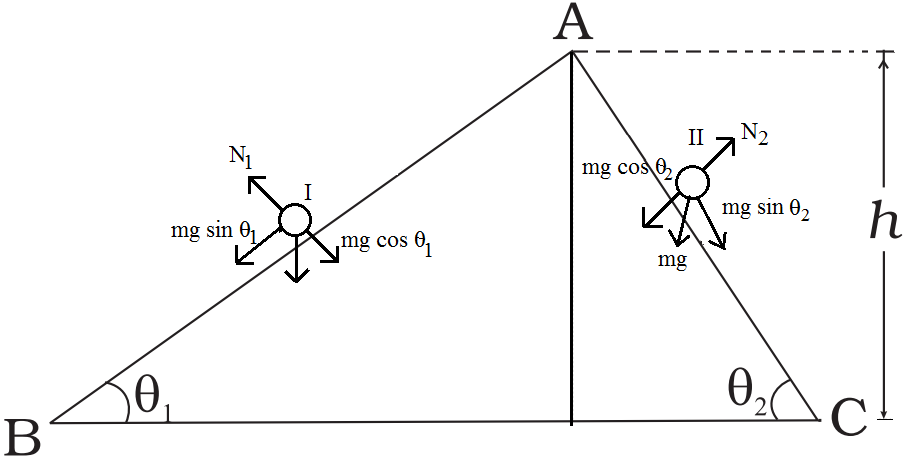
$\frac{1}{2}\text{mv}^2=\text{mgh} ($for both tracks $I$ and $II)$
$\text{v}=\sqrt{2\text{gh}}$
Hence, speed is same for both stones. For stone $I\, a_1 =$ acceleration along inclines plane $=\text{g}\sin\theta_1$
Similarly, for stone $II,\ \text{a}_2=\text{g}\sin\theta_2$ as $\theta_2>\theta_1$
hence, $\text{a}_2>\text{a}_1$
And both length for track $II$ is also less,
hence stone $II$ reaches earkier than stone $I.$ View full question & answer→MCQ 231 Mark
Consider two observers moving with respect to each other at a speed $v$ along a straight line. They observe a bock of mass $m$ moving a distancel on a rough surface. The following quantities will be same as observed by the two observers.
- A
Kinetic energy of the block at time t.
- B
- C
Total work done on the block.
- ✓
Acceleration of the block.
AnswerCorrect option: D. Acceleration of the block.
Acceleration of the block will be the same to both the observers. The respective kinetic energies of the observers are different, because the block appears to be moving with different velocities to both the observers. Work done by the friction and the total work done on the block are also different to the observers.
View full question & answer→MCQ 241 Mark
In which form, the energy is stored in a fuel?
AnswerChemical energy is energy stored in the bonds of atoms and molecules. Batteries, biomass, petroleum, natural gas, and coal are examples of chemical energy. Chemical energy is converted to thermal energy when people burn wood in a fireplace or burn gasoline in a car's engine.
View full question & answer→MCQ 251 Mark
A ball of mass $3\ kg$ collides with a wall with velocity $10m/ \sec$ at an angle of $30^\circ$ with the wall and after collision reflects at the same angle with the same speed. The change in momentum of ball in $\text{MKS}$ unit is:
Answer$\triangle\text{p=2mvcos}60^\circ=\text{min}$
$=2\times 3\times 10\times 21$
$=30\frac{\text{kgm}}{\text{s}}$
View full question & answer→MCQ 261 Mark
Equal masses $($meach$)$ are attached at the two ends of a string passing over two pulleys. Another mass is attached at the centre of the string. In order that there is no sag in the string, this mass should be:
- A
$m$
- B
$\frac{\text{m}}{2}$
- C
$2m$
- ✓
View full question & answer→MCQ 271 Mark
A block of mass $m$ slides down a smooth vertical circular track. During the motion, the block is in:
AnswerThe net force on the block is not zero, therefore the block will not be in any given equilibrium.
View full question & answer→MCQ 281 Mark
A boy is whirling a stone tied at one end such that the stone is in uniform circular motion. Which of the following statement is correct?
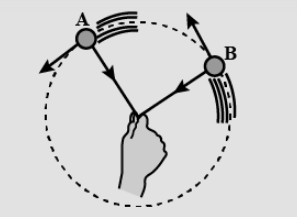
AnswerCorrect option: B. The speed of stone at $A$ is equal to the speed of stone at $B.$
In uniform circular motion speed is constant while velocity being a vector quantity is constantly changing as its direction keeps changing. Centripetal force acts inwards towards the center to counterbalance the centrifugal force acting outwards from the center.
View full question & answer→MCQ 291 Mark
One end of a light spring constant k is fixed to a wall and the other end is tied to a block placed on a smooth horizontal surface. In a displacement, the work done by the spring $\frac{1}{2\text{kx}^2}.$
The possible cases are:
- A
The spring was initially compressed by a distance X and was finally in its natural length.
- B
It was initially in its natural length and finally in a compressed position.
- C
It was initially stretched by a distance x and finally was in its natural length.
- ✓
AnswerExplanation:
As work is done by the spring, therefore, there are only two possibilities: the spring was initially compressed by a distance x and has come to its natural length or the spring was initially stretched by distance x and finally comes to its natural length.
View full question & answer→MCQ 301 Mark
A proton is kept at rest. A positively charged particle is released from rest at a distance $d$ in its field. Consider two experiments one in which the charged particle is also a proton and in another, a positron. In the same time $t,$ the work done on the two moving charged particles is:
- A
Same as the same force law is involved in the two experiments.
- B
Less for the case of a positron, as the positron moves away more rapidly and the force on it weakens.
- ✓
More for the case of a positron, as the positron moves away a larger distance.
- D
Same as the work done by charged particle on the stationary proton.
AnswerCorrect option: C. More for the case of a positron, as the positron moves away a larger distance.
Positron because their charges are same.
As the mass of positron is much lesser than proton,
$(1/1840$ times$)$ it moves away through much larger distance compared to proton.
Change in their momentum will be same.
So, velocity of lighter particle will be greater than that of a heavier particle.
So, positron is moved through a larger distance.
As work done $=$ force $\times$ distance.
As forces are same in case of proton and positron but distance moved by positron is larger,
hence, work done will be more.
View full question & answer→MCQ 311 Mark
The potential energy function for a particle executing linear $\text{SHM}$ is given by $\text{v(x)}=\frac{1}{2}\text{kx}^2$ where $k$ is the force constant of the oscillator. For $k = 0.5N/ m,$ the graph of $V(x)$ versus $x$ is shown in the figure. A particle of total energy $E$ turns back when it reaches $\text{x}=\pm\text{x}_\text{m}.$ If $V$ and $K$ indicate the $P.E$. and $K.E.,$ respectively of the particle at $x = +xm,$ then which of the following is correct?
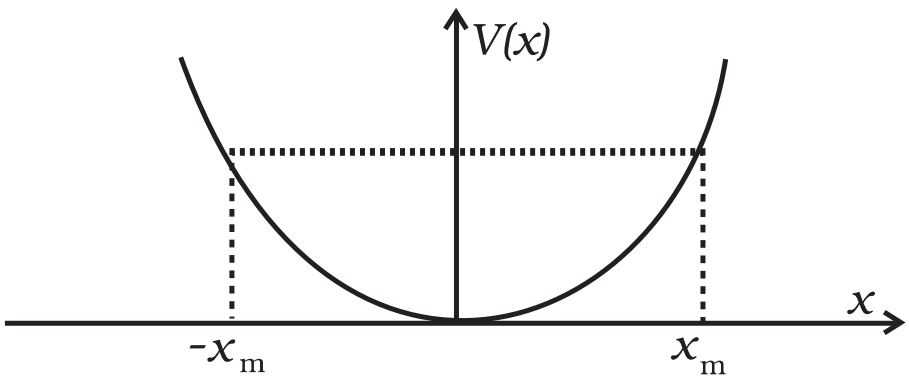
- A
$V = 0, K = E$
- ✓
$V = E, K = 0$
- C
$V < E, K = 0$
- D
$V = 0, K < E$
AnswerCorrect option: B. $V = E, K = 0$
Key concept: Energy Graph for a Spring: If the mass attached with spring performs simple harmonic motion about its mean position then its potential energy at any position $(x)$ can be given by,
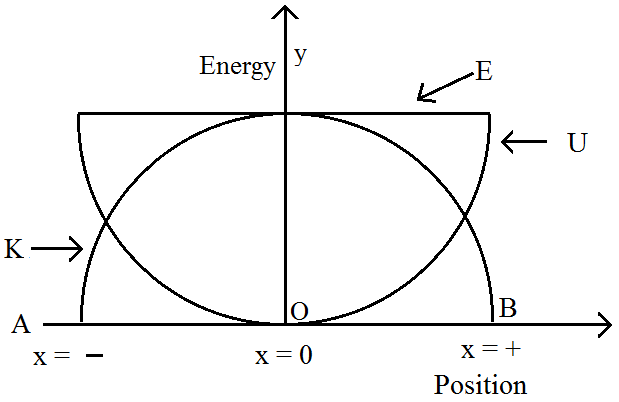
Now kinetic energy at any position $\text{K}=\text{E}-\text{U}=\frac{1}{2}\text{Ka}^2-\frac{1}{2}\text{Kx}^2$
$\text{K}=\frac{1}{2}(\text{a}^2-\text{x}^2)\ ....(\text{i})$
From the above formula, we can cheak that
$\text{U}_\text{max}=\frac{1}{2}\text{Ka}^2$
At extreme $x=\pm\text{a}\big]$ and $U_{min} = 0 [$At mean $x = 0]$
$\text{K}_\text{max}=\frac{1}{2}\text{Ka}^2 [$At mean $x = 0]$ and $K_{min} = 0 \big[$ At extreme $x=\pm\text{a}\big]$
$\text{E}=\frac{1}{2}\text{ka}^2=$ constant$($at all positions$)$
Because velocity of mass $= 0 [$at extreme position$]$
$\therefore\ \text{K}=\frac{1}{2}\text{mv}^2=0$
It means kinetic energy changes parabolically w.r.t. position but total energy remain always constant irrespective to the position of mass.
Total energy is $\text{E = PE + KE,}$ which remains constant.
According to the question, when paraticle is at $x = xm,$
i.e., at extreme position $\ce{x = xm \Rightarrow KE = 0}$
Hence, total energy will be
$\text{E}=\text{PE}+0=\text{PE}$
$\Rightarrow\text{V}\text{(x}_\text{m})=\frac{1}{2}\text{kx}^2_\text{m}$
Hence option $(b)$ is correct.
$\text{V = E, K = 0}$ View full question & answer→MCQ 321 Mark
Which of the following statements is true?
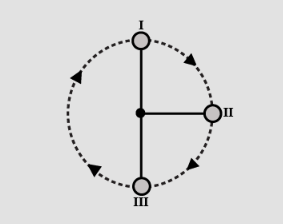
- ✓
The tension in the string is greater at points $III$ than at point $I$
- B
The tension in the string is greater at points $I$ than at point $III$
- C
The tension at point $I$ is equal to the tension at point $III$
- D
The tension in the string is greatest at point $II$
AnswerCorrect option: A. The tension in the string is greater at points $III$ than at point $I$
When the bob is swinging in vertical circle the centripetal force and the pseudo force varies.
Centripetal force causes the tension in the string.
Let centripetal force be $C,$ pseudo force be $P$ and weight of bob be In.
At position $1, C = P − In$
At position $2, C = In$
At position $3, C = P + In$
As $C$ at position $3$ is greatest, the tension in the string is greatest at this position.
View full question & answer→MCQ 331 Mark
Which one of the following types of energy is possessed by a body when placed at a certain height?
AnswerWhen a body is placed at a certain height, the body possesses potential energy.
$P.$ And, $\text{uh. = mgH}$
$m;$ the mass of the object
$g;$ acceleration due to gravity
$H;$ height gained by object
View full question & answer→MCQ 341 Mark
Force shown acts for $2$ seconds. Find out work done by force $F$ on $10\ kg$ in $3$ seconds.
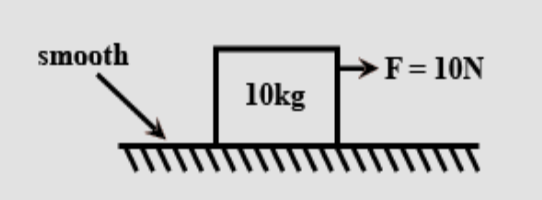
AnswerWork done,
$In = Fd$
Displacement d is given by,
$\text{d}=\frac{1}{2}\text{at}^2$
$F = ma$
$10 = 10a, a = 1\ m/ s^2$
$\text{d}=\frac{1}{2}(1)(2)^2=2\text{m}$
$In = 10 \times 2 = 20D$
View full question & answer→MCQ 351 Mark
The total work done on a particle is equal to the change in its kinetic energy:
- ✓
- B
Only if the forces acting on it are conservative.
- C
Only if gravitational force alone acts on it.
- D
Only if elastic force alone acts on it.
AnswerAccording to the work$-$energy theorem, the total work done on a particle is equal to the change in kinetic energy of the particle.
View full question & answer→MCQ 361 Mark
When a massive body suffers an elastic collision with a stationary light body, then massive body approximately comes to rest and light body-
- ✓
Acquires velocity greater than initial velocity of massive body.
- B
Sticks to the massive body and remains at rest.
- C
Acquires half the initial velocity of the massive body
- D
Remains at rest but does not stick to the massive body.
AnswerCorrect option: A. Acquires velocity greater than initial velocity of massive body.
View full question & answer→MCQ 371 Mark
A long spring is stretched by $2\ cm.$ Its potential energy is $V.$ If the spring is stretched by $10\ cm,$ its potential energy would be:
- A
$\frac{\text{v}}{25}$
- B
$\frac{\text{v}}{5}$
- C
$5V$
- ✓
$25V$
AnswerPotential energy $\propto\text{x}^2$ When $\times$ becomes $5$ times, $P.E.$ becomes $25$ times.
View full question & answer→MCQ 381 Mark
Two bodies $P$ and $Q$ of equal masses are kept at heights $x$ and $4x$ respectively. What will be the ratio of their potential energies?
- A
$1 : 8$
- B
$4 : 1$
- ✓
$1 : 4$
- D
$8 : 1$
AnswerCorrect option: C. $1 : 4$
Potential energy $P = mgh$
Given, $h_1= x ; h_2 = 4x$
Since, the masses are same,
then$\frac{\text{P}_1}{\text{P}_2}=\frac{\text{h}_1}{\text{h}_2}=\frac{\text{x}}{4\text{x}}=1:4$
View full question & answer→MCQ 391 Mark
The $K.E.$ of a body becomes $4$ times its initial value. The new linear momentum will be:
- A
- B
Four times the initial value.
- ✓
- D
Eight times the initial value.
Answer$\text{K.E}=\frac{\text{p}^2}{2\text{m}}$
When $K.E.$ becomes $4$ times, $\text{p}^2$ is $4$ times.
Therefore, $p$ becomes $2$ times.
View full question & answer→MCQ 401 Mark
If the linear momentum is increased by $50\%,$ then $K.E.$ will be increased by:
- A
$50\%$
- B
$100\%$
- ✓
$125\%$
- D
$25\%$
AnswerCorrect option: C. $125\%$
View full question & answer→MCQ 411 Mark
A sphere, a cube and a thin circular plate; all are of the same material and same mass and all of them are initially heated to same high temperature. Then:
- A
Plate will cool fastest and cube the slowest.
- B
Sphere will cool fastest and cube the slowest.
- ✓
Plate will cool fastest and sphere the slowest.
- D
Cube will cool fastest and plate the slowest.
AnswerCorrect option: C. Plate will cool fastest and sphere the slowest.
The surface area of sphere $ < $ surface area of the cube for the given same mass and same density.
The rate of cooling $\alpha$ area of contact with surroundings.
The plate will cool faster than the sphere.
View full question & answer→MCQ 421 Mark
The kinetic energy of a particle continuously increases with time:
- A
The resultant force on the particle must be parallel to the velocity at all instants.
- B
The resultant force on the particle must be at an angle less than 90° all the time.
- C
The magnitude of its linear momentum is increasing continuously.
- ✓
AnswerExplanation:
As K.E. of particle is increasing continuously with time magnitude of its linear momentum must be increasing continuously $\big(\therefore\text{E}=\frac{\text{p}^2}{2\text{m}}\big).$ For this resultant force on the particle must be at an angle less than 90° all the time.
View full question & answer→MCQ 431 Mark
A mass is performing vertical circular motion $($see figure$)$. If the average velocity of the particle is increased, then at which point is the maximum breaking possibility of the string:
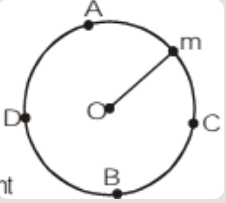
AnswerTension at any point in vertical motion is given by:
$\text{T}=\frac{\text{min}^2}{1}+\text{mgcos}\theta$
where $I =$ angular displacement from lowest point,
$l =$ length of string
$m =$ mass of string
It is clear that tension at the lowest point $(B)$ is greatest than at other points $(A, C, D).$ If we increase average velocity, tension will increase at lowest point, therefore at point $B,$ string has maximum possibility of break.
View full question & answer→MCQ 441 Mark
The kinetic energy force on the particle continuously increases with time.
AnswerCorrect option: D. The magnitude of its linear momentum is increasing continuously.
Kinetic energy of a particle is directly proportional to the square of its velocity. The resultant force on the particle must be at an angle less than $90^\circ$ with the velocity all the time so that the velocity or kinetic energy of the particle keeps on increasing.
The kinetic energy is also directly proportional to the square of its momentum, therefore it continuously increases with the increase in momentum of the particle.
View full question & answer→MCQ 451 Mark
A body is falling freely under the action of gravity alone in vacuum. Which of the following quantities remain constant during the fall?
AnswerAs the body is falling freely under gravity, the potential energy decreases continuously and kinetic energy increases continuously as all the conservative forces are doing work.
So, total mechanical energy $\text{(PE + KE)}$ of the body will be constant.
Let us discuss this in detail:
In the given diagram an object is dropped from$-$a height $H$ from ground.
At point $A$ total mechanical energy will be $\text{EA = K.E + P.E}$
$\text{E}_\text{A}=\frac{1}{2}\text{mv}^2+\text{mgH}$
As velocity will be zero at $A$, so its kinetic energy will be zero.
$\text{E}_\text{A}=\text{mgH}$
Velocity at point $B$ will be, $\text{v}_\text{B}=\sqrt{2\text{gh}}$
So, energy at point $B$ will be $\text{E}_\text{B}=\text{KE}+\text{PE}$
$\text{E}_\text{B}=\frac{1}{2}\text{m}(2\text{gh})+\text{mg}(\text{H}-\text{h})$
$\text{E}_\text{B}=\text{mgh}+\text{mgH}-\text{mgh}$
$\text{E}_\text{B}=\text{mgH}$
Now, velocity at point $C$ will be $\text{v}_\text{c}=\sqrt{2\text{gh}}$
So, energy at point will be $\text{E}_\text{c}=\text{KE}+\text{PE}$
$\text{E}_\text{c}=\frac{1}{2}\text{m}(2\text{gH})+\text{mg}(0)$
$\text{E}_\text{c}=\text{mgH}$
So, total mechanical energy will remain same $($if we neglect the air friction$).$
View full question & answer→MCQ 461 Mark
Which of the following does not have potential energy ?
- A
- ✓
Water in a flowing river.
- C
- D
AnswerCorrect option: B. Water in a flowing river.
Potential energy is the energy that is stored in an object due to its position above the ground surface and when the object is in motion then it has kinetic energy. Water in a flowing river has kinetic energy.
View full question & answer→MCQ 471 Mark
No work is done by a force on an object if:
- A
The object is stationary but the point of application of the force moves on the object.
- B
The object moves in such a way that the point of application of the force remains fixed.
- C
The force is always perpendicular to its velocity.
- ✓
Answer$\text{W}=\text{Fs}=\cos\theta=0$, when either $s = 0$ or $\theta=90^\circ$
i.e., when object is stationary but the point of application of the force moves on the object or object moves in such a way that point of application of force remains fixed; or force is at $90^\circ$ to the acceleration.
View full question & answer→MCQ 481 Mark
A particle is acted upon by a force of constant magnitude which is always perpendicular to the velocity of the particle. The motion of the particle takes place in a plane. It follows that:
- A
Its velocity is constant.
- B
Its acceleration is constant.
- C
Its kinetic energy is constant.
- ✓
It moves in a circular path.
AnswerCorrect option: D. It moves in a circular path.
When the force on a particle is always perpendicular to its velocity,
the work done by the force on the particle is zero,
as the angle between the force and velocity is $90^\circ .$
So, kinetic energy of the particle will remain constant.
The force acting perpendicular to the velocity of the particle provides centripetal acceleration that causes the particle to move in a circular path.
View full question & answer→MCQ 491 Mark
A body is moving unidirectionally under the influence of a source of constant power. Its displacement in time $t$ is proportional to:
- A
$\text{t}^{\frac{1}{2}}$
- B
$\text{t}$
- ✓
$\text{t}^\frac{3}{2}$
- D
$\text{t}^2$
AnswerCorrect option: C. $\text{t}^\frac{3}{2}$
As power, $P =$ force $\times$ veclocity
$\text{P}=\big[\text{MLT}^{-2}\big]\big[\text{LT}^{-1}\big]=\big[\text{ML}^2\text{T}^{-3}\big]$
As, $\text{P}=\big[\text{ML}^2\text{T}^{-3}\big]$
$=$ Constant
$\therefore\text{ L}^2\text{T}^3=\text{Constant}$
Or, $\frac{\text{L}^2}{\text{T}^3}=\text{Constant}$
$\therefore\text{ L}^2\propto\text{T}^3$
Or, $\text{L}\propto \text{T}^{\frac{3}{2}}$
Hence, right choice is $(iii) \text{t}^{\frac{3}{2}}$
View full question & answer→MCQ 501 Mark
A body of mass $'M'$ collides against a wall with a velocity $v$ and retraces its path with the same speed. the change in momentum is $............. ($take initial direction of velocity as positive$)$
AnswerTaking $+ x$ direction to be positive, and assuming ball was travelling in $+ x$ direction initially.
$\text{Pi = Mv}$
After collision ball will move in $- x$ direction
$\text{Pf = − Mv}$
Change in momentum:
$\triangle \text{P = Pi − Pf}$
$\triangle \text{P = Mv + Mv = 2Mv}$
View full question & answer→MCQ 511 Mark
A mass of $5\ kg$ is moving along a circular path of radius $1m.$ If the mass moves with $300$ revolutions per minute, its kinetic energy would be:
- ✓
$250\pi^2$
- B
$100\pi^2$
- C
$5\pi^2$
- D
$0$
AnswerCorrect option: A. $250\pi^2$
According to the problem, Radius $= 1m,$ mass $= m = 5\ kg$
$\text{f}=\frac{300}{60}$
Angular velocity will be
$=2\pi\text{f}=(300\times2\pi)\text{rad/ min}$
$=(300\times3.14)\text{rad/ 60s}$
$=\frac{300\times2\times3.14}{60}\text{rad/ s}$
$=10\pi\text{rad/ s}$
And relation between linear velocity and angular velocity is $\text{v}=\omega\text{R}$
$=\Big(\frac{300\times2\pi}{60}\Big)(1\text{m})$
$=10\pi\text{m/ s}$
And kinetic energy $=\frac{1}{2}\text{mv}^2$
$=\frac{1}{2}\times5\times(10\pi^2)$
$=100\pi^2\times5\times\frac{1}{2}$
$=250\pi^2\text{J}$
View full question & answer→MCQ 521 Mark
In a shotput event an athlete throws the shotput of mass $10\ kg$ with an initial speed of $1\ m s^{-1}$ at $45^\circ$ from a height $1.5m$ above ground. Assuming air resistance to be negligible and acceleration due to gravity to be $10\ m s^{-2}$, the kinetic energy of the shotput when it just reaches the ground will be:
- A
$20.5J$
- B
$5.0J$
- C
$52.5J$
- ✓
$155.0J$
AnswerCorrect option: D. $155.0J$
If air resistance is negligible, total mechanical energy of the system will remain constant.
And let us take ground as a reference where potential energy will be zero.
According to the problem, $h = 1.5 m, v = 1\ m/ s, m = 10 \ kg, g = 10\ m s^{-2}$
Initial energy of the shotput $=(\text{PE})_\text{i}+(\text{KE})_\text{i}$
$=\text{mgh}+\frac{1}{2}\text{mv}^2$
$=10\times10\times1.5+\frac{1}{2}\times10\times(1)^2$
$=150+5$
$=155.0\text{J}$
From conservation of mechanical energy,
$\text{(PE)}_\text{i}+\text{(KE)}_\text{i}=\text{(PE)}_\text{f}+\text{(KE)}_\text{f}$
So, final kinetic energy of the shotput is $155J$
View full question & answer→MCQ 531 Mark
A sphere of mass $m,$ moving with a speed $v,$ strikes a wall elastically at an angle of incidence $I$. If the speed of the sphere before and after collision is the same and the angle of incidence and velocity normally towards the wall the angle of rebound is equal to the angle of incidence and velocity normally towards the wall is taken as negative then, the change in the momentum parallel to wall is:
- A
$mv \cos I$
- B
$2mv \cos I$
- C
$-2mv \cos I$
- ✓
AnswerSince the sphere collided elastically and there was no friction there was no impulse on the sphere along the wall. The only contact force acted was normal and that obviously was perpendicular to surface. NO change in momentum parallel to wall.
View full question & answer→MCQ 541 Mark
In the phenomenon of work done by variable forces, the forces:
AnswerThe variable forces are the non-constant forces that changes with maybe time, distance or any other variable.
View full question & answer→MCQ 551 Mark
A ball kept in a closed box moves in the box making collisions with the walls. The box is kept on a smooth surface. The velocity of the centre of mass:
- A
Of the box remains constant.
- ✓
Of the box plus the ball system remains constant.
- C
Of the ball remains constant.
- D
Of the ball relative to the box remains constant.
AnswerCorrect option: B. Of the box plus the ball system remains constant.
Consider the box and the ball a system. As no external force acts on this system, the velocity of the centre of mass of the system remains constant.
View full question & answer→MCQ 561 Mark
A particle of mass, $m,$ is tied to a light string and rotated with a speed, $v,$ along a circular path of radius, $r.$ If $T =$ tension in the string and $mg =$ gravitational force on the particle, then the actual forces acting on the particle are:
- ✓
$Mg$ and $T$ only.
- B
$\ce{Mg, T}$ and an additional force of $\ce{mv2/ r}$ directed inwards.
- C
$\ce{Mg, T}$ and an additional force of $\ce{mv2/ r}$ directed outwards.
- D
Only a force $\ce{mv2/ r}$ directed outwards.
AnswerCorrect option: A. $Mg$ and $T$ only.
The force $\ce{mv2/ r}$ directed outwards, called centrifugal force, is not a real force.
At $\ce{A, mv12/ l = T_1 + mg}$
View full question & answer→MCQ 571 Mark
Name the type of energy $($kinetic energy $K$ or potential energy $U)$ possessed in a compressed spring:
- ✓
$U$
- B
$K$
- C
Both $U$ and $K$
- D
AnswerWhen you compress a spring, it possess potential energy. The force of compression is proportional to the compression, according to Hooke's Law. Releasing the spring turns the potential energy into kinetic energy. The spring can be then used to propel some object.
View full question & answer→MCQ 581 Mark
A particle is rotated in a vertical circle by connecting it to a string of length $l$ and keeping the other end of the string fixed. The minimum speed of the particle when the string is horizontal for which the particle will complete the circle is:
- A
$\sqrt{\text{gl}}$
- B
$\sqrt{2\text{gl}}$
- ✓
$\sqrt{3\text{gl}}$
- D
$\sqrt{5\text{gl}}$
AnswerCorrect option: C. $\sqrt{3\text{gl}}$
Suppose that one end of an extensible string is attached to a mass $m,$ while the other end is fixed. The mass moves with a velocity $v$ in a vertical circle of radius $R.$ At some instant, the string makes an angle $\theta$ with the vertical as shown in the figure.
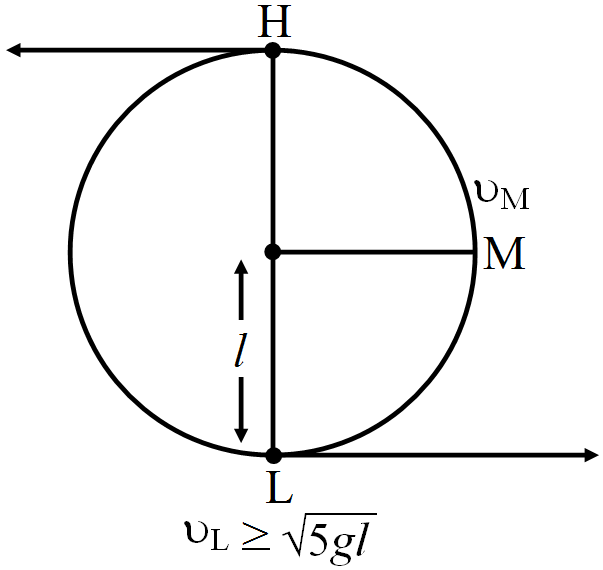
For a complete circle, the minimum velocity at $L$ must be $\nu_\text{L}=\sqrt{5\text{gl}}.$
Applying the law of conservation of energy, we have:
Total energy at $M =$ total energy at $L$
i.e., $\frac{1}{2}\text{m}\nu_{\text{M}^2}+\text{mgl}=\frac{1}{2}\text{m}\nu_{\text{L}^2}$
$\Rightarrow\frac{1}{2}\text{m}\nu_{\text{M}^2}=\frac{1}{2}\text{m}\nu_{\text{L}^2}-\text{mgl}$
Using $\nu_\text{L}\geq\sqrt{5\text{gl}},$ we have:
$\frac{1}{2}\text{m}\nu_{\text{M}^2}\geq\frac{1}{2}\text{m}(5\text{gl})-\text{mgl}$
$\therefore\ \nu_\text{M}=\sqrt{3\text{gl}}$ View full question & answer→MCQ 591 Mark
Which of the following is not conserved in inelastic collision?
- A
- ✓
- C
Both momentum and kinetic energy.
- D
Neither momentum nor kinetic energy
AnswerKinetic energy is not conserved in an inelastic collision.
View full question & answer→MCQ 601 Mark
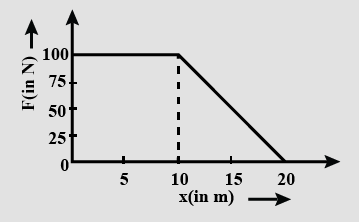
A force $F$ acting on an object varies with distance $x$ as shown in the figure. The work done by the force in moving the object from $x = 0$ and $x = 20m$ is:
- A
$500J$
- B
$1000D$
- ✓
$1500J$
- D
$2000D$
AnswerCorrect option: C. $1500J$
Area under force displacement curve is the work done in that interval
Area under the given figure Area of surface Area of triangle. $= +$
Work done $= 10\times 100+\frac{1}{2}\times 10\times 100$
$= 1000 + 500$
$= 1500J$
View full question & answer→MCQ 611 Mark
A body of mass $1\ kg$ is rotating in a vertical circle of radius $1m.$ What will be the difference in its kinetic energy at the top and bottom of the circle?
Take $g = 10\ m/ s^2$
AnswerAccording to work energy theorem, $\triangle K.$ And, $\ce{uh.= In}$ and
here work is done by the gravitational force.
$\Rightarrow \triangle K.$ And, $\ce{uh. = In = mg(2r) = 1 \times 10 \times 2(1) = 20D}$
View full question & answer→MCQ 621 Mark
Consider two observers moving with respect to each other at a speed $v$ along a straight line. They observe a block of mass $m$ moving a distance $l$ on a rough surface. The following quantities will be same as observed by the two observers.
AnswerCorrect option: D. Total work done on the block.
When two observers are moving with respect to each other at a speed $v$ along a straight line, acceleration of block, if any, will be same. Distance moved may be different. Therefore, work done/$K.E$. of the block may appear different.
View full question & answer→MCQ 631 Mark
A molecule in a gas container hits a horizontal wall with speed $200\ ms^{-2}$ and angle ${30}^\circ$ with the normal and rebounds with the same speed. Which statement is true?
- A
- B
- C
- ✓
Both $(a)$ and $(b).$
AnswerCorrect option: D. Both $(a)$ and $(b).$
View full question & answer→MCQ 641 Mark
If the force and displacement of particle in the direction of force are doubled, then work done would be:
AnswerCorrect option: B. $4$ times.
$\because$ Work $=$ Force $\times$ Displacement $…(i)$
View full question & answer→MCQ 651 Mark
A body is moving along a circular path. How much work is done by the centripetal force?
AnswerFor a body moving along a circular path, the centripetal force acts along the radius while the displacement is tangential, i.e. $\theta=90^\circ$,
therefore, $\text{W}=\text{Fs}\cos90^\circ=0$.
View full question & answer→MCQ 661 Mark
In an inelastic collision:
- A
The initial kinetic energy is equal to the final kinetic energy.
- ✓
The final kinetic energy is less than the initial kinetic energy.
- C
The kinetic energy remains constant.
- D
The kinetic energy first increases then decreases.
AnswerCorrect option: B. The final kinetic energy is less than the initial kinetic energy.
As some energy is loss into heat in an inelastic collision, the final kinetic energy is less than the initial kinetic energy.
View full question & answer→MCQ 671 Mark
Two masses of $1g$ and $4g$ are moving with equal kinetic energy. The ratio of the magnitudes of their momentum is:
- A
$4 : 1$
- B
$2 : 1$
- ✓
$1 : 2$
- D
$1 : 1$
AnswerCorrect option: C. $1 : 2$
As we know that linear momentum
$=\sqrt{2\text{mk}}$
$\Big(\therefore\text{K}=\frac{\text{P}^2}{2\text{m}}\Big)$
For same Kinetic energy, $\text{P}\propto\sqrt{\text{m}}$
$\frac{\text{P}_1}{\text{P}_2}=\sqrt{\frac{\text{m}_1}{\text{m}_2}}=\sqrt{\frac{1}{4}}=\frac{1}{2}=1:2$
View full question & answer→MCQ 681 Mark
Two springs $A$ and $B(k_A = 2k_B)$ are stretched by applying forces of equal magnitudes at the four ends. If the energy stored in $A$ is $E,$ that in $B$ is:
- A
$\frac{\text{E}}{2}$
- ✓
$2\text{E}$
- C
$\text{E}$
- D
$\frac{\text{E}}{4}$
AnswerCorrect option: B. $2\text{E}$
Let $x_A$ and $x_B$ be the extensions produced in springs $A$ and $B,$ respectively.
Restoring force on spring $A, F = k_Ax_A ...(1)$
Restoring force on spring $B, F = k_Bx_B ...(2)$
From $(1)$ and $(2),$ we get:
$k_Ax_A = k_Bx_B$
It is given that $k_A = 2k_B$
$\therefore\ \text{x}_\text{B}=2\text{x}_\text{A}$
Energy stored in spring $A:$
$\text{E}=\frac{1}{2}\text{k}_\text{A}\text{x}_\text{A}^2\ \dots(3)$
Energy stored in spring $B:$
$\text{E}'=\frac{1}{2}\text{k}_\text{B}\text{x}_\text{B}^2=\frac{1}{2}\Big(\frac{\text{k}_\text{A}}{2}\Big)(2\text{x}_\text{A})^2$
$\therefore\ \text{E}'=2\times\Big(\frac{1}{2}\text{k}_\text{A}\text{x}_\text{A}^2\Big)=2\text{E} [$From $(3)]$
View full question & answer→MCQ 691 Mark
What is work done in holding a body of mass $20\ kg$ at a height of $2m$ above the ground? $(g = 10m/ s^2)$
AnswerA body of mass $20\ kg$ is held at a height of $2m$ above the ground means there is no displacement because of which there is no change in its potential energy.
View full question & answer→MCQ 701 Mark
A crane pulls up a car of mass $500\ kg$ to a vertical height of $4m.$ So, work done by the crane is:
- A
$19.6J$
- ✓
$19.6kJ$
- C
$19600kJ$
- D
$4900J$
AnswerCorrect option: B. $19.6kJ$
To raise the car, the crane has to do work against the force of gravity.
Therefore, the force required to lift the car, $F = mg = 500 \times 9. 8N = 4900N$
Displacement, $S =$ vertical height raised $= 4m.$
$\therefore$ Work done, In $= F. S = 4900 \times 4J = 19600J = 19.6kJ$
View full question & answer→MCQ 711 Mark
A body is initially at rest. It undergoes one$-$dimensional motion with constant acceleration. The power delivered to it at time $t$ is proportional to:
- A
$\text{t}^{\frac{1}{2}}$
- ✓
$\text{t}$
- C
$\text{t}^\frac{3}{2}$
- D
$\text{t}^2$
AnswerCorrect option: B. $\text{t}$
From,
$V = u + at$
$V = 0 + at = at$
As power, $P = F \times V$
$\therefore P = (ma) \times at = ma^2t$
As m and a are constants, therefore, $\text{P}\propto\text{t}$
Hence, right choice is $(ii)\ t.$
View full question & answer→MCQ 721 Mark
The velocity of a bus, moving on a smooth road, is increased from $8\ m/ s$ to $32\ m/ s$ in $120s.$ During this process, the potential energy of the bus:
- ✓
- B
Becomes twice that of initial potential energy.
- C
Becomes four times that of initial potential energy.
- D
Becomes sixteen times that of initial potential energy.
AnswerAs potential energy, $\ce{P = mgh}$
Since, there is no vertical displacement so, $h = 0.$
Hence, potential energy change $\ce{P = mgh = 0}$
The moving bus has only change in its Kinetic energy.
View full question & answer→MCQ 731 Mark
Does not vary from point to point in space Which pair of the following forces will never give resultant force of $2N?$
- A
$1N$ and $3N$
- B
$2N$ and $2N$
- C
$1N$ and $1N$
- ✓
$1N$ and $4N$
AnswerCorrect option: D. $1N$ and $4N$
$1N$ and $4N$ will never give $2N$
mind it, if the side lengths of a triangle is $a, b, c$
$a + b > = c$
$b + c > = a$
$c + a > = b$
View full question & answer→MCQ 741 Mark
A heavy object has $.......$ gravitational potential energy than a lighter one.
AnswerGravitational potential energy is given by
$\ce{EP = mgh}$
where m is mass so heavy object means more mass and more mass means more potential energy.
View full question & answer→MCQ 751 Mark
A car is accelerated on a leveled road and attains a velocity $4$ times its initial velocity. In this process, the potential energy of the car:
AnswerPotential energy depends on the height at which the object is situated. Where potential energy is measured by the product of the mass of the object, gravity, and height. In this case, there is no change in height of the object.
View full question & answer→MCQ 761 Mark
A uniform metal chain is placed on a rough table such that one end of it hangs down over the edge of the table. When one third of its length hangs over the edge, the chain starts sliding. Then the coefficient of static friction is:
- A
$\frac{3}{4}$
- B
$\frac{1}{4}$
- C
$\frac{2}{3}$
- ✓
$\frac{1}{2}$
AnswerCorrect option: D. $\frac{1}{2}$
The chain starts sliding, when applied force $=$ force of friction
$($due to hanging part$) ($between chain and table$)$
$\frac{1}{3}\text{mg}=\text{f}=\mu\text{R}=\mu\Big(\frac{2}{3}\text{mg}\Big)$
$\mu=\frac{1}{2}$
View full question & answer→MCQ 771 Mark
The energy directly related to the speed of a moving body and its mass is:
AnswerThe kinetic energy of a body is the energy by virtue of its motion $K.$
And $=\frac{1}{2}\text{min}^2$
where $m$ is mass and in is velocity.
View full question & answer→MCQ 781 Mark
If the linear momentum is increased by $50\%,$ then kinetic energy will be increased by:
- A
$50\%$
- B
$100\%$
- ✓
$125\%$
- D
$25\%$
AnswerCorrect option: C. $125\%$
View full question & answer→MCQ 791 Mark
What are conservative forces? Distinguish the conservative and non$-$conservative forces among the following:
AnswerConservative forces are those forces in which work done $(i)$ in a closed path is zero and $(ii)$ is independent of path.
Conservative forces: Gravitational and Electrostatic force.
Non-conservative forces: Frictional force and air resistance.
View full question & answer→MCQ 801 Mark
A one kilowatt motor is used to pump water from a well $10m$ deep. The quantity of water pumped out per second is nearly:
- A
$1\ kg.$
- ✓
$10\ kg.$
- C
$100\ kg.$
- D
$1000\ kg.$
AnswerCorrect option: B. $10\ kg.$
View full question & answer→MCQ 811 Mark
By stretching the rubber strings of a catapult we store $..........$ energy in it.
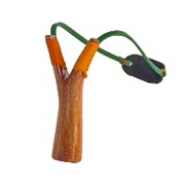
AnswerThe energy exerted or work done by our muscles on the rubber band is consumed in changing its shape. It gets stored in the stretched rubber band as its potential energy. It is this stored energy that is used by the rubber band to move to its original state, shape, and size. When the rubber band is released, this stored potential energy gets converted into kinetic energy.
If a pebble is placed in contact with the stretched rubber band, this kinetic energy is transferred to the pebble. This kinetic energy of the pebble is enough to do some destructive work, like breaking a glass window, injuring someone, etc.
View full question & answer→MCQ 821 Mark
- A
The kinetic energy remains constant.
- B
The final linear momentum is equal to the initial linear momentum.
- C
The final kinetic energy is equal to the initial kinetic energy.
- ✓
AnswerDuring an elastic collision, all of the above statements are valid.
View full question & answer→MCQ 831 Mark
The $K.E.$ of a body can be increased maximum by doubling its:
Answer$\text{K.E}=\frac{1}{2}\text{mv}^2$
$\text{K.E}\propto\text{m}\text{ &}\text{ K.E}\propto\text{v}^2$
So doubling mass will double the kinetic energy and doubling speed will make kinetic energy $4$ times.
View full question & answer→MCQ 841 Mark
During inelastic collision between two bodies, which of the following quantities always remain conserved
AnswerIf in a collision kinetic energy after collision is not equal to kinetic energy before collision, the collision is said to inelastic. Coefficient of restitution $0 < e < 1$ When we are considering the two bodies as system the total external force on the system will be zero.
Hence, total linear momentum of the system remain conserved.
Here kinetic energy appears in other forms,
i.e. energy may be lost in the form of heat and sound etc.
In some cases $\ce{(KE)_{final} < (KE)_{initial}}$such as when initial $KE$ is converted into intertial energy of the product $($as heat, elastic or excitation$)$ while in other cases $\ce{(KE)_{final} > (KE)_{initial}}$ such as when internal energy stored in the colliding particles is released.
Examples:
Collision between two billiard balls.
Collision between two automobiles on a road.
In fact all majority of collisions belong to this category.
View full question & answer→MCQ 851 Mark
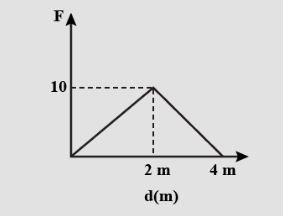
Work done from $d = 0m$ to $d = 4m$
- A
$12.5J$
- B
$15D$
- C
$17.5J$
- ✓
$20D$
View full question & answer→MCQ 861 Mark
$(i)$ What is the work done by the porter when he climbs up a height of $10m (g = 10\ ms^{-2})?$
- A
$5\ kJ^2$
- B
$50\ kJ$
- C
$100\ kJ^2$
- ✓
$5\ kJ$
AnswerCorrect option: D. $5\ kJ$
The work done by the potter is defined as the product of the force and the displacement.
Work done $=$ force $\times$ displacement
$= m \times g \times 10 ($ Since force $=$ mass $\times$ gravity$)$
$= 50 \times 10 \times 10$
$= 5KJ$
View full question & answer→MCQ 871 Mark
The speed of a motor increases from $1200$ rpm to $1800$ rpm in $20s.$ How many revolutions does it make during these second?
View full question & answer→MCQ 881 Mark
A fruit hanging from the top branch of a tree possesses:
- ✓
Gravitational potential energy.
- B
Elastic potential energy.
- C
- D
AnswerCorrect option: A. Gravitational potential energy.
A fruit, hanging from the top branch of a tree, is at rest at a certain height from the earth"s surface.
View full question & answer→MCQ 891 Mark
The first ball of mass $m$ moving with the velocity $v$ collides head on with the second ball of mass $m$ at rest. If the coefficient of restitution is $e$, then the ratio of the velocities of the first and the second ball after the collision is:
AnswerCorrect option: A. $\frac{1-\text{ e}}{1+\text{ e}}$
Here, $\text{m}_1=\text{m}_2=\text{m},\text{u}_1=\text{u},\text{u}_2=0$.
Let $\text{v}_1,\text{v}_2$ be their velocities after collision.
According to principle of conservation of linear momentum.
$\text{mu}+0=\text{m}(\text{v}_1+\text{v}_2)$ or $\text{ v}_1+\text{v}_2=\text{u}\dots\text{(i})$
By definition,
$\text{e}=\frac{\text{v}_2-\text{v}_1}{\text{u}-0}$ or $\text{ v}_2-\text{v}_1=\text{eu}\dots\text{(ii)}$
Add $(i)$ and $(ii),$
$\text{v}_2=\frac{\text{u(1+ e)}}{2}$
$\therefore\frac{\text{v}_1}{\text{v}_2}=\frac{1-\text{ e}}{1+\text{ e}}$
View full question & answer→MCQ 901 Mark
The hydroelectric plants do not produce electricity, if the water level in the dam is less than $34m.$
View full question & answer→MCQ 911 Mark
What is the dimensions of power:
- A
$\ce{[MLT^{-2}]}$
- B
$\ce{[ML^2T]}$
- C
$\ce{[ML^2T^2]}$
- ✓
$\ce{[MLT^{-3}]}$
AnswerCorrect option: D. $\ce{[MLT^{-3}]}$
View full question & answer→MCQ 921 Mark
A ball of mass $m$ moving with velocity in collides elastically with wall and rebounds. The change in momentum of the ball will be:
- A
$4\ce{min}$
- ✓
$2\ce{min}$
- C
$\ce{min}$
- D
$\ce{zero}$
AnswerCorrect option: B. $2\ce{min}$
Here, a ball of mass $m$ moving with velocity in collides elastically with wall hence, momentum is.
$\ce{pi = min}$
The ball rebounds from wall hence, final momentum is.
$\ce{pf = −min}$
Change in momentum is.
$\ce{\triangle p = pi − pf}$
$\ce{\triangle p = mv − (−min) = 2min}$
View full question & answer→MCQ 931 Mark
How many collision are possible between the blocks?
AnswerAs the distance keeps on decreasing and there will be a deceleration in the blocks.
In further results, collision increases frequently many times and slowly come in contact.
View full question & answer→MCQ 941 Mark
Name the type of energy $($kinetic energy $K$ or potential energy In the$)$ possessed in the following case.
A piece of stone placed on the roof.
AnswerWhen a stone is placed at the roof it is at a certain height that is given by In the $= m \times g \times h$
As we have a certain value for $h$ there would be some value for potential energy.
As the stone is at rest at the roof it will not have any kinetic energy as its velocity is zero, $\text{K}=\frac{1}{2}(\text{m}\times\text{in}^2)=0$
View full question & answer→MCQ 951 Mark
A body of mass $5\ kg$ is thrown vertically up with a kinetic energy of $490J.$ The height at which the kinetic energy of the body becomes half of the original value is:
- A
$12.5m$
- B
$10m$
- C
$2.5m$
- ✓
$5m$
AnswerAccording to the law of conservation of energy,
$\frac{1}{2}\text{Mv}^2=\frac{1}{2}\Big(\frac{1}{2}\text{mv}^2\Big)+\text{mgh}$
$\Rightarrow490+245+5\times9.8\times\text{h}$
$\text{h}=\frac{245}{49}=5\text{m}$
View full question & answer→MCQ 961 Mark
What is potential energy?
- ✓
Energy of an object due to its position or arrangement in a system.
- B
Energy of an object due to its nature or arrangement in a system.
- C
Energy of an object due to its shape or arrangement in a system.
- D
AnswerCorrect option: A. Energy of an object due to its position or arrangement in a system.
The potential energy is the stored energy of an object due to its position. some examples of potential energies are gravitational potential energy, Electrostatic potential energy and elastic energy etc.
A body placed at ground will have less gravitational potential energy than a body placed at some height. therefore, potential energy changes by changing the position of object.
View full question & answer→MCQ 971 Mark
A car is accelerated on a levelled road and attains a velocity $4$ times of its initial velocity. In this process, the potential energy of the car?
AnswerThe potential energy is the energy that an object has due to its position in a force field or that a system has due to the configuration of its parts. The potential energy of the car remains the same and will not change as the road is leveled and the height of the body remains the same, although its speed increases.
View full question & answer→MCQ 981 Mark
The energy stored in wound watch spring is:
AnswerCorrect option: B. $P.E.$
Energy stored in spring is potential energy, and it is defined as.
$\text{E}=\frac{1}{2}\text{Kx}^2$
where $k$ is spring constant, and $x$ is the extension/compression in spring.
View full question & answer→MCQ 991 Mark
A force $\text{F}=-\text{kx}^2(\text{x}\neq0)$ acts on a particle in $X-$direction. Find the work done by the force in displacing the particle from $x = -a$ to $x = 2a.$
- ✓
$\frac{3\text{k}}{2\text{a}}$
- B
$\frac{4\text{k}}{\text{a}^2}$
- C
$\frac{-3\text{k}}{2\text{a}^2}$
- D
$\frac{-9\text{k}}{\text{a}^2}$
AnswerCorrect option: A. $\frac{3\text{k}}{2\text{a}}$
View full question & answer→MCQ 1001 Mark
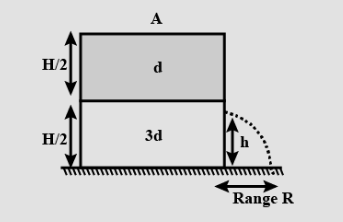
A block of mass $m$ is oscillating on smooth between two light springs of spring constant $K$ separated by a distance $I$ colliding elastically with the spring. If the velocity of the blocks is increased by an external impulse when it is not touching either of the spring then time period.
View full question & answer→MCQ 1011 Mark
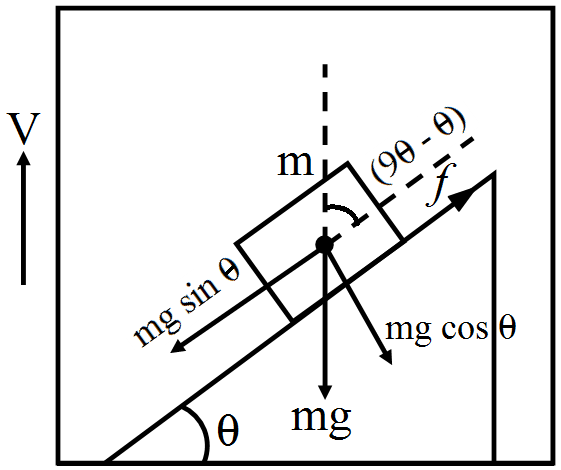
A small block of mass $m$ is kept on a rough inclined surface of inclination $\theta$ fixed in an elevator. The elevator goes up with a uniform velocity $v$ and the block does not slide on the wedge. The work done by the force of friction on the block in time $t$ will be:
AnswerCorrect option: C. $\text{mgvt}\sin^2\theta$
Distance $(d)$ travelled by the elevator in time $t = vt$
The block is not sliding on the wedge.
Then friction force $(\text{f})=\text{mg}\sin\theta$
Work done by the friction force on the block in time $t$ is given by,
$\text{W}=\text{Fd}\cos(90-\theta)$
$\Rightarrow\text{W}=\text{mg}\sin\theta\times\text{d}\times\cos(90-\theta)$
$\Rightarrow\text{W}=\text{mgd}\sin^2\theta$
$\therefore\ \text{W}=\text{mg}\nu\text{t}\sin^2\theta$
View full question & answer→MCQ 1021 Mark
A man raises a box of mass $50\ kg$ to a height of $2m$ in $2\ \text{min}$ , while another man raises the same box to the same height in $5$ minthes. What is the ratio of work done by them?
- ✓
$1 : 1$
- B
$2 : 1$
- C
$1 : 2$
- D
$4 : 1$
AnswerCorrect option: A. $1 : 1$
Work $= Fs \cos\theta$
Where, $F$ is the force applied, $s$ is the displacement, and $I$ is the angle between the force applied and displacement.
Hence, work done is independent of time taken.
In the given cases, $I = 0^{\circ}$ as the force applied are in the same direction.
Also, $F = mg$
So $\ce{In = Fs = mgs}$
In both the cases, mass and displacement are the same.
$In = 50 \times 10 \times 2 = 1000 D$
View full question & answer→MCQ 1031 Mark
- ✓
The initial kinetic energy is equal to the final kinetic energy.
- B
The final kinetic energy is less than the initial kinetic energy.
- C
The kinetic energy remains constant.
- D
The kinetic energy first increases then decreases.
AnswerCorrect option: A. The initial kinetic energy is equal to the final kinetic energy.
As no energy is lost into heat in an elastic collision,
the initial kinetic energy is equal to the final kinetic energy.
View full question & answer→MCQ 1041 Mark
A particle is pushed by forces $2\hat{\text{i}}+3\hat{\text{j}}-2\hat{\text{k}}$ and $5\hat{\text{i}}+\hat{\text{j}}-2\hat{\text{k}}$ simultaneously and it is displaced from point $\hat{\text{i}}+\hat{\text{j}}+\hat{\text{k}}$ to point $2\hat{\text{i}}-\hat{\text{j}}-2\hat{\text{k}}$. The work done is:
- A
$7$ units.
- ✓
$-7$ units.
- C
$10$ units.
- D
$-10$ units.
AnswerCorrect option: B. $-7$ units.
Net force, $=2\hat{\text{i}}+3\hat{\text{j}}-2\hat{\text{k}+}5\hat{\text{i}}-\hat{\text{j}}-3\hat{\text{k}}$
$=7\hat{\text{i}}+2\hat{\text{j}}-5\hat{\text{k}}$
Diolacement, $\text{d}=2\hat{\text{i}}-\hat{\text{j}}+3\hat{\text{k}-}\hat{\text{i}}-\hat{\text{j}}-\hat{\text{k}}$
$=\hat{\text{i}}-2\hat{\text{j}}+2\hat{\text{k}}$
Work done $=\text{F}.\text{d}=(7\hat{\text{i}}+2\hat{\text{j}}-5\hat{\text{k}}).(\hat{\text{i}}-2\hat{\text{j}}+2\hat{\text{k}})$
$=7-4-10$
$=-7\text{ units}$.
View full question & answer→MCQ 1051 Mark
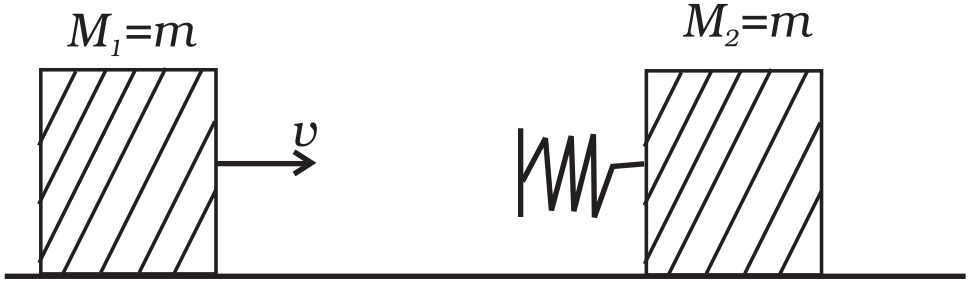
Two blocks $M_1$ and $M_2$ having equal mass are free to move on a horizontal frictionless surface. $M_2$ is attached to a massless spring as shown in. Iniially $M_2$ is at rest and $M_1$ is moving toward $M_2$ with speed v and collides head$-$on with $M_2$.
- A
While spring is fully compressed all the $KE$ of $M_1$ is stored as $PE$ of spring.
- B
While spring is fully compressed the system momentum is not conserved, though final momentum is equal to initial momentum.
- ✓
If spring is massless, the final state of the $M_1$ is state of rest.
- D
If the surface on which blocks are moving has friction, then collision cannot be elastic.
AnswerCorrect option: C. If spring is massless, the final state of the $M_1$ is state of rest.
If there is not specified we always consider the collision elastic. When two bodies of equal masse collides elastically, their velocities are interchanged in these types of collision.
Kinetic energy and linear momentum remain conserved. According to the above diagram when $m_1$ comes in contact with the spring, $m_1$ is retarded by the spring force and $m_2$ is accelerated by the spring force.
- The spring will continue $*$to compress until the two blocks acquire common velocity. So some of kinetic energy of block $M_X$ store into $P.E$ and some part of it stores into $K.E$ of block $M_2$. So option $(a)$ is incorrect.
- As surfaces are frictionalless momentum of the system will be conserved. So option $(b)$ is also incorrect.
- The two bodies of equal mass exchange their velocities in a head on elastic collision between them. So, if spring is massless, the final state of the $M_1$ is state of rest.
- Since there is a loss of $K.E$ when the blocks collides on the rough surface. Hence, the collision is inelastic.
View full question & answer→MCQ 1061 Mark
In which case, work done will be zero:
AnswerWork done by weight$-$lifter is zero because there is no displacement.
In a locomotive, work done is zero because force and displacement are mutually perpendicular to each other.
While a person holding a suitcase, work done is zero because there is no displacement.
View full question & answer→MCQ 1071 Mark
A massive ball moving with a speed in collide with a tiny ball having a very small mass, immediately after the impact the second ball will move at speed approximately equal to:
- A
$\infty$
- B
$\frac{\text{in}}{2}$
- C
$in$
- ✓
$2in$
AnswerIn an elastic collision where the projectile is much more massive than the target, the velocity of the target particle after the collision will be about twice that of the projectile and the projectile velocity will be essentially unchanged.
View full question & answer→MCQ 1081 Mark
Which of the following statements is incorrect?
- ✓
Kinetic energy may be zero, positive or negative.
- B
Power, energy and work are all scalars.
- C
Potential energy may be zero, positive or negative.
- D
Ballistic pendulum is a device for measuring the speed of bullets.
AnswerCorrect option: A. Kinetic energy may be zero, positive or negative.
The kinetic energy of a body of mass $mm$ which is moving with velocity $v$ is $\text{K}=\frac{1}{2}\text{min}^2$
Mass is always positive and if the velocity is either positive or negative, the kinetic energy is always positive due to the square of velocity.
View full question & answer→MCQ 1091 Mark
$...........$ of a two particle system depends only on the separation between the two particles. The most appropriate choice for the blank space in the above sentence is:
AnswerThe potential energy of a two particle system depends only on the separation between the particles.
View full question & answer→MCQ 1101 Mark
A particle is acted by a constant power. Then, which of the following physical quantity remains constant?
- A
- B
Rate of change of acceleration.
- C
- ✓
Rate of change of kinetic energy.
AnswerCorrect option: D. Rate of change of kinetic energy.
By definition, $\text{p}\frac{\text{dW}}{\text{dt}}$
$\because$ Work done $=$ Kinetic energy
$\Rightarrow\text{p}=\frac{\text{dW}}{\text{dt}}$
$=\frac{\text{d(KE)}}{\text{dt}}=\text{constant}$
View full question & answer→MCQ 1111 Mark
A mass of $0.5\ kg$ moving with a speed of $1.5\ ms^{-1}$ on a horizontal smooth surface, collides with a nearly weightless spring of spring constant $k = 50\ N/ m^{-1}$
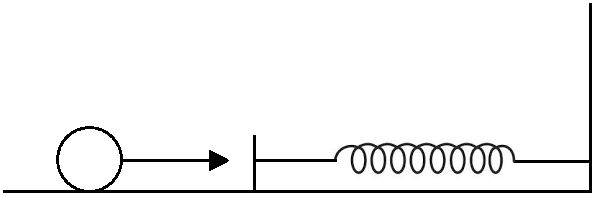
The maximum compression of the spring would be: - ✓
$0.15m$
- B
$0.12m$
- C
$1.5m$
- D
$0.5m$
AnswerCorrect option: A. $0.15m$
View full question & answer→MCQ 1121 Mark
A body of mass $2\ kg$ makes an elastic collision with another body at rest and comes to rest. The mass of the second body which collides with the first body is:
- ✓
$2\ kg$
- B
$1. 2\ kg$
- C
$3\ kg$
- D
$1\ kg$
AnswerCorrect option: A. $2\ kg$
View full question & answer→MCQ 1131 Mark
Which one of the following energies cannot be possessed by a body at rest?
AnswerKinetic energy is possessed by a body by virtue of its state of motion.
So, a body at rest cannot possess kinetic energy.
A body at rest will possess potential energy.
Thermal and magnetic energies are irrespective of state of rest or of motion of a body.
View full question & answer→MCQ 1141 Mark
Which one of the following possesses potential energy?
- A
Moving vehicle on the road.
- B
- C
- ✓
AnswerMoving vehicle on the road possesses kinetic energy.
A running athlete possesses kinetic energy.
Stone on the road possesses kinetic energy.
A stretched rubber band possesses potential energy.
View full question & answer→MCQ 1151 Mark
A ball is projected upwards. As it rises, there is increase in its:
AnswerWhen a ball is projected upwards it's height increases.
As height increases, $v$ velocity decreases $($Kinetic Energy Decreases$)$
so Potential energy increases.
Potential Energy $= mgh$
View full question & answer→MCQ 1161 Mark
One end of a light spring of spring constant $k$ is fixed to a wall and the other end is tied to a block placed on a smooth horizontal surface. In a displacement, the work done by the spring is $\frac{1}{2}\text{kx}^2.$ The possible cases are:
- A
At spring was initially compressed by a distance x and was finally in its natural length.
- B
It was initially stretched by a distance x and and finally was in its natural length.
- ✓
$A$ and $B$
- D
It was initially in its natural length and finally in a stretched position.
AnswerCorrect option: C. $A$ and $B$
For an elastic spring, the work done is equal to the negative of the change in its potential energy.When the spring was initially compressed or stretched by a distance $x$, its potential energy is given by,
$(\text{P.E.})_\text{i}=\frac{1}{2}\text{kx}^2$
When it finally comes to its natural length, its potential energy is given by,
$(\text{P.E.})_\text{f}=0$
$\therefore$ Work done $=-[(\text{P.E.})_\text{f}-(\text{P.E.})_\text{i}]$
$=-\Big[0-\frac{1}{2}\text{kx}^2\Big]$
$=\frac{1}{2}\text{kx}^2$
View full question & answer→MCQ 1171 Mark
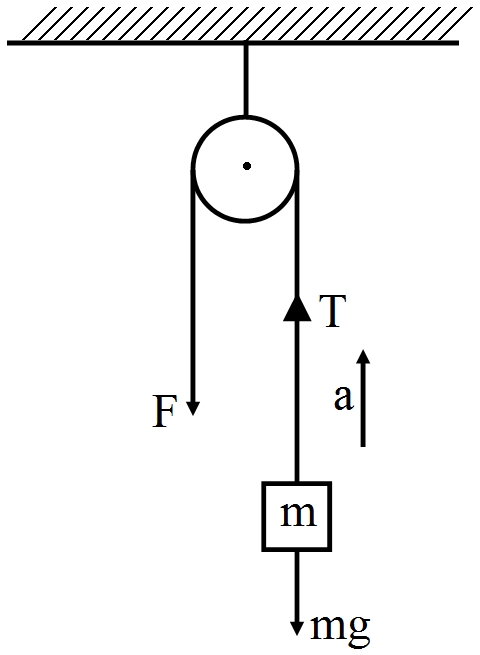
A block of mass $M$ is hanging over a smooth and light pulley through a light string. $T$ he other end of the string is pulled by a constant force $F.$ The kinetic energy of the block increases by $20J$ in $1s.$
- A
The tension in the string is $Mg.$
- ✓
The tension in the string is $F.$
- C
The work one by the tension on the block is $20J$ in the above $1s.$
- D
The work done by the force of gravity is $-20J$ in the above $1s.$
AnswerCorrect option: B. The tension in the string is $F.$
Tension in the string is equal to $F,$ as tension on both sides of a frictionless and massless pulley is the same.
i.e., $\ce{T - Mg = Ma}$
$\Rightarrow \ce{T = Mg + Ma}$
So, the tension in the string cannot be equal to $Mg.$
The change in kinetic energy of the block is equal to the work done by gravity.
Hence, the work done by gravity is $20J$ in $1s,$ while the the work done by the tension force is zero.
View full question & answer→MCQ 1181 Mark
A particle of mass my moves with velocity $v_1$ collides with another particle at rest of equal mass. The velocity of second particle after the elastic collision is:
AnswerGiven, mass $m_1= m_2=m$
and velocity, $v = v_1$
For elastic collision, $\text{v}_2=\Big(\frac{\text{m}_2-\text{m}_1}{\text{m}_1+\text{m}_2}\Big)\text{v}_2+\frac{2\text{m}_1\text{v}_1}{\text{m}_1+\text{m}_2}$
After putting given values, we will get
$\text{v}_2+\frac{2\text{m}_1\text{v}_1}{2\text{m}_1}$
$\Rightarrow\text{v}_1=\text{v}_2$
View full question & answer→MCQ 1191 Mark
Work done by a body against friction always results in:
- ✓
- B
Loss in potential energy.
- C
- D
Gain in potential energy.
View full question & answer→MCQ 1201 Mark
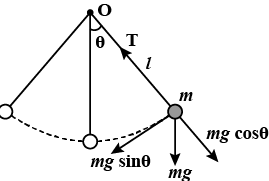
Let $\theta$ denote the angular displacement of a simple pendulum oscillating in a vertical plane. If the mass of the bob is $m,$ then tension in the string is $mg \cos\theta$
AnswerFor simple pendulum
$\frac{\text{min}}{\text{r}}=\text{T}-\text{mg}\cos\varnothing$
But when $F = I,$
i.e., the bob is at extreme position.
its velocity is zero, hence the equation becomes:
$\text{T−mg}\cos\theta =0$
$\Rightarrow\text{T−mg}\cos\theta =0$
View full question & answer→MCQ 1211 Mark
In a head-on elastic collision of two bodies of equal masses:
- A
The velocities are interchanged.
- B
The speeds are interchanged.
- C
The momenta are interchanged.
- ✓
Answerd. All of the above.
Explanation:
If u and v are the velocities before collision and u' and v' are the velocities after collision, then we have
$\text{u}'=\frac{(\text{m}-\text{m})\text{u}}{\text{m}+\text{m}}+\frac{2\text{m}}{\text{m}+\text{m}}=0+\text{v}=\text{v}$ and $\text{v}'=\frac{2\text{m}\text{u}}{(\text{m}+\text{m})}+\frac{(\text{m}-\text{m})\text{v}}{(\text{m}+\text{m})}=\text{u}+0=\text{u}$
So the velocities and speeds are interchanged. Hence (a) and (b) are true.
Since the velocities are interchanged and masses are equal hence the momenta are also interchanged. Hence (c) is true.
If u > v then after the collision the speeds of bodies are interchanged. Now the faster body slows down and the slower body speeds up. Hence (d) is true.
View full question & answer→MCQ 1221 Mark
Fast neutrons can easily be slowed down by
- A
- ✓
Passing them through water.
- C
Elastic collision with heavy nuclei.
- D
Applying a strong electric field.
AnswerCorrect option: B. Passing them through water.
Water is rich in hydrogen $($proton$)$. On collision, velocities of neutron and proton are interchanged. Fast neutrons come to rest and protons move with velocity of neutrons.
View full question & answer→MCQ 1231 Mark
The power of a windmill having blade area equal to $A$ and wind velocity equal to $v$ is $(\rho$ is density of air$):$
- ✓
$\frac{\text{A}\rho\text{v}^3}{2}$
- B
$\frac{\text{A}\rho\text{v}^2}{2}$
- C
$\frac{\text{A}\rho\text{v}}{2}$
- D
$\text{A}\rho\text{v}^3$
AnswerCorrect option: A. $\frac{\text{A}\rho\text{v}^3}{2}$
View full question & answer→MCQ 1241 Mark
Energy possessed by a body by virtue of its motion is:
AnswerKinetic energy is defined as the energy possessed by a body by virtue of its motion. and it is equal to $K.$ And, $\text{uh}=\frac{1}{2}\text{min}^2$
Where m and in are mass and Velocity of moving body.
View full question & answer→MCQ 1251 Mark
A mass attached to a string that is itself attached to the ceiling swings back and forth. If the bob is observed to be moving upward at a given instance, as shown to the right, which arrow best depicts the direction of the net force acting on the bob at that instant:
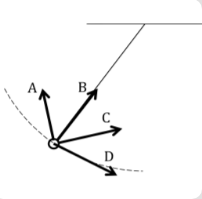
AnswerTwo forces act on the bob. $(i)$ is the tension in the string and the $(ii)\ mg \sin I,$ which will be tangential to the path.
The resultant of both the forces will be along vector $C$
View full question & answer→MCQ 1261 Mark
The moon revolves around the earth because the earth exerts a radial force on the moon. Does the earth perform work on the moon?
AnswerNo, the earth does not perform any work on the moon.
Work done$(W)$ is defined as the scalar product of force$(F)$ and displacement$(s).$
So, $W = F \times s = Fs\cos I$ where is the angle between force and displacement vector.
The radial force exerted on the moon by earth i.e attractive force due to gravity acts in direction perpendicular to which the moon suffers the displacement during rotation.
So, $I = 90$ hence $\cos I = 0$
So, $W = |F|| s| \times 0 = 0$
View full question & answer→MCQ 1271 Mark
An overhead tank having some water possesses $..........$ energy.
AnswerWe know that Potential energy is the energy possessed by a body by the virtue of its position.
$\therefore$ An overhead tank having some water possesses Potential energy, as it is at a height.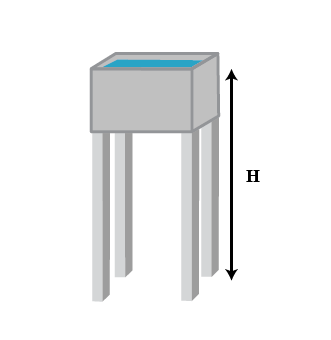
View full question & answer→MCQ 1281 Mark
Water stored in a dam possesses:
AnswerThe potential energy possessed by the object is the energy present in it by virtue of its position or configuration. Water stored in a dam, when allowed to flow, has kinetic energy which was earlier stored as potential energy.
View full question & answer→MCQ 1291 Mark
A particle is acted upon by a force $F$ which varies with position $x$ as shown in the figure. If the particle at $x = 0$ has the kinetic energy of $25J,$ then the kinetic energy of the particle at $x = 16m$ is?
- ✓
$45J$
- B
$30J$
- C
$70J$
- D
$135J$
View full question & answer→MCQ 1301 Mark
A coconut fruit hanging high in a palm tree has $.........$ owing to its location.
AnswerThe potential energy possessed by the object is the energy present in it by virtue of its position or configuration. So, the hanging coconut has potential energy due to its location $($height$).$
View full question & answer→MCQ 1311 Mark
A man, of mass $m,$ standing at the bottom of the staircase, of height $L$ climbs it and stands at its top.
AnswerCorrect option: D. $B$ and $C$
$-$Work done by gravitational force on man is $\ce{(-mgL)}$ as gravitational force is downward and displacement $L$ is upward.
The Work done by man to lift him up by muscular force will be $\ce{(+mgL)}$ as force applied by muscles is in the direction of displacement.
So net work done $= \ce{-mgL + mgL = 0}$.
$-$As there is no displacement point where the reaction acts
so, Work Done by reaction torce is zero.
As the velocity of person atmost zero at top.
So $KE = 0.$
Hence, Work Done by reaction force is zero.
View full question & answer→MCQ 1321 Mark
If the external forces acting on a system have zero resultant, the centre of mass:
AnswerExplanation:
When external forces acting on a system have zero resultant, the centre of mass may move with a constant velocity i.e. it must not accelerate.
View full question & answer→MCQ 1331 Mark
You lift a suitcase from the floor and keep it on a table. The work done by you on the suitcase does not depend on:
- A
The path taken by the suitcase.
- B
The time taken by you in doing so.
- C
- ✓
AnswerWork done by us on the suitcase is equal to the change in potential energy of the suitcase.
i.e., $\ce{W = mgh}$
Here, $mg$ is the weight of the suitcase and $h$ is height of the table.
Hence, work done by the conservative $($gravitational$)$ force does not depend on the path.
View full question & answer→MCQ 1341 Mark
A ball hits a floor and rebounds after an inelastic collision. In this case:
- A
The total energy of the ball and the earth remains the same.
- B
The total momentum of the ball and the earth is conserved.
- C
The momentum of the ball just after the collision is same as that just before the collision.
- ✓
AnswerExplanation:
As the collision is inelastic, body losses some energy, so that KE of ball does not remain the same. However, total energy and total momentum of ball and earth remain the same.
View full question & answer→MCQ 1351 Mark
Two equal masses are attached to the two ends of a spring of spring constant $k.$ The masses are pulled out symmetrically to stretch the spring by a length $x$ over its natural length. The work done by the spring on each mass is:
AnswerCorrect option: D. $-\frac{1}{4}\text{kx}^2$
The work done by the spring on both the masses is equal to the negative of the increase in the elastic potential energy of the spring.
The elastic potential energy of the spring is given by $\text{E}_\text{p}=\frac{1}{2}\text{kx}^2.$
Work done by the spring on both the masses $=-\frac{1}{2}\text{kx}^2$
$\therefore$ Work done by the spring on each mass $=\frac{1}{2}\Big(-\frac{1}{2}\text{kx}^2\Big)$
$=-\frac{1}{4}\text{kx}^2$
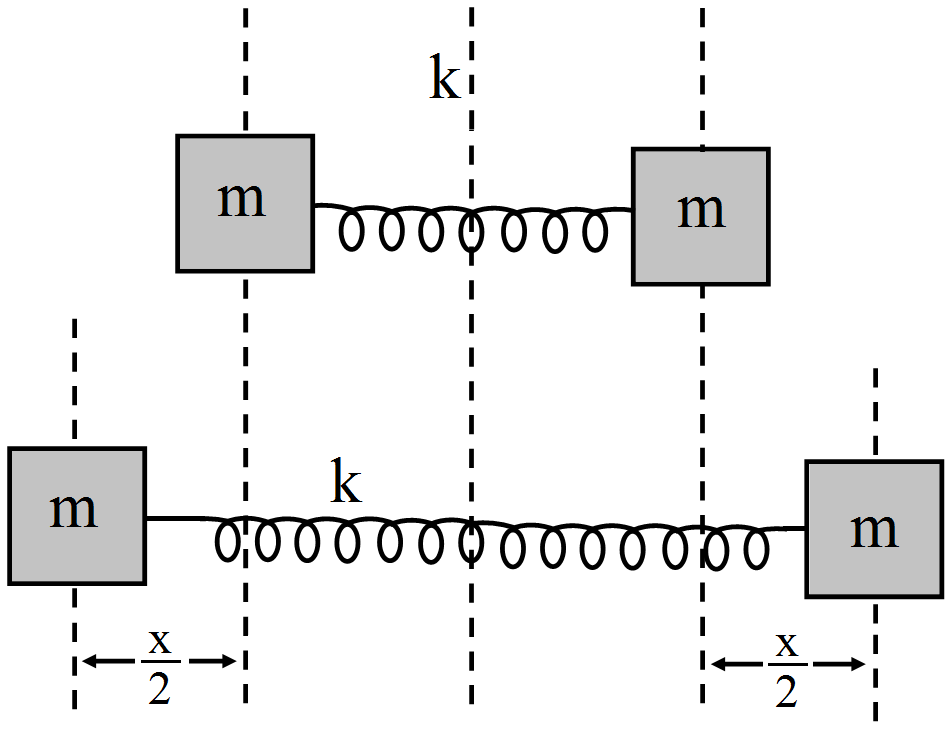
View full question & answer→MCQ 1361 Mark
The relationship between force and position is shown in the figure $($in one dimensional case$)$. Work done by the force in displacing a body from
$X = 1\ cm$ to $X = 5\ cm$ is:
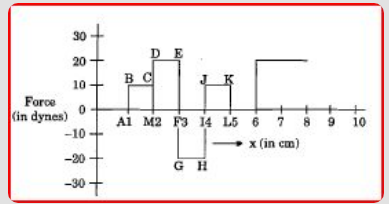
- A
$700$ ergs
- B
$70$ ergs
- ✓
$60$ ergs
- D
$20$ ergs
AnswerCorrect option: C. $60$ ergs
Work is area under the curve.
So $\ce{In = In_1 + In_2 + In_3 + In_4}$
$\ce{In_1}=$ arandaundandr $\ce{A_1BCM_2 In_2=}$ arandaundandr $\ce{M_2DEF_3}$
$\ce{In_3} =$ arandaundandr $\ce{F_3GHI_4 In_4=}$ arandaundandr $\ce{I_4JKL_5}$
$\ce{In_1}= 10 \times 1 = 10$ ergs
$\ce{In_2} = 20 \times 1 = 20$ ergs
$\ce{In_3}= −20 \times 1 = −20$ ergs
$\ce{In_4} = 10 \times 1 = 10$ ergs
$\ce{In = In_1 + In_2+ In_3 + In_4} = 10 + 20 − 20 + 10 = 20$ ergs
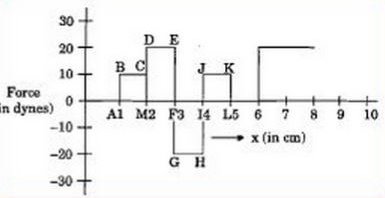
View full question & answer→MCQ 1371 Mark
When an aeroplane takes off from the ground:
- A
Kinetic energy increases and Potential energy decreases
- B
Potential energy increases and Kinetic energy remains constant
- C
Both Kinetic energy and Potential energy remain constant
- ✓
Both Kinetic energy and Potential energy increase
AnswerCorrect option: D. Both Kinetic energy and Potential energy increase
Kinetic energy is due to the motion of the object and potential energy is due to relative elevation.
So as the plane takes off height increases and also its speed increase,
so both kinetic and potential energy increases.
Kinetic energy$=\frac{1}{2}\text{min}^2$
Potential energy $= \ce{mgH}$
View full question & answer→MCQ 1381 Mark
Identify the wrong statement:
- ✓
A body can have momentum without energy.
- B
A body can have energy without momentum.
- C
The momentum is conserved in an elastic collision.
- D
Kinetic energy is not conserved in an inelastic collision.
AnswerCorrect option: A. A body can have momentum without energy.
View full question & answer→MCQ 1391 Mark
A force $\text{F}=5\hat{\text{i}}+6\hat{\text{j}}-4\hat{\text{k}}$ acting on a body produces a displacement $\text{s}=6\hat{\text{i}}+5\hat{\text{k}}$ The work done by the force is:
- A
$18$ units.
- B
$15$ units.
- C
$12$ units.
- ✓
$10$ units.
AnswerCorrect option: D. $10$ units.
View full question & answer→MCQ 1401 Mark
A bicyclist comes to a skidding stop in $10m.$ During this process, the force on the bicycle due to the road is $200N$ and is directly opposed to the motion. The work done by the cycle on the road is:
- A
$+2000J$
- B
$-200J$
- ✓
- D
$-20,000J$
AnswerAs the friction is present in fhis problem,
so mechanical energy is not conserved.
So energy will be lost due to dissipation by friction
Here, work is done by the frictional force on the cycle and is equal to $200 \times 10 = -2000J$
As the road does not move at all, therefore, work done by the cycle on the road is zero.
Important point.
We should be aware that here the energy of bicyclist is lost during the motion, but it is lost due to friction in the form of heat.
View full question & answer→MCQ 1411 Mark
During the displacement, which of the curves shown in the graph best represents the work done on the spring block system by the applied force ?
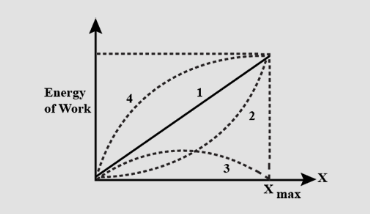
MCQ 1421 Mark
Energy equals of a mass of one microgram in kilo joules is:
- ✓
$9 \times 10^{10}kJ$
- B
$10 \times 10^3kJ$
- C
$8 \times 10^2kJ$
- D
$7 \times 10^4kJ$
AnswerCorrect option: A. $9 \times 10^{10}kJ$
We will use Energy mass equivalence
$E = mc^2$
$E = 10^{-6}kg \times (3 \times 10^8)^2m/ s^2$
$E = 9 \times 10^{10}J$
View full question & answer→MCQ 1431 Mark
In head on elastic collision of two bodies of equal masses:
$A.$The speeds are interchanged.
$B.$The velocities are interchanged.
$C.$ The faster body slows down and the slower body speeds up.
$D.$ The momenta are interchanged.
- A
Only $A$
- B
$B$ and $C$
- C
Only $C$
- ✓
AnswerWhen $m_1 = m_2$ the statements are true.
View full question & answer→MCQ 1441 Mark
Which of the diagrams shown in represents variation of total mechanical energy of a pendulum oscillating in air as function of time?
AnswerWhen a pendulum oscillates in air, its total mechanical energy decreases continuously in overcoming resistance due to air. Therefore, total mechanical energy of the pendulum decreases exponentially with time. The variation of E v/st is correctly represented by curve (c) in which the relation between energy and time is shown.
View full question & answer→MCQ 1451 Mark
A force of $10N$ is applied on an object of mass $2\ kg$ placed on a rough surface having coefficient of friction equal to $0.2.$ Work done by applied force in $4s$ is:
- A
$120J.$
- ✓
$240J.$
- C
$250J.$
- D
$100J.$
AnswerCorrect option: B. $240J.$
View full question & answer→MCQ 1461 Mark
A raindrop falling from a height h above ground, attains a near terminal velocity when it has fallen through a height (3/4)h. Which of the diagrams shown in correctly shows the change in kinetic and potential energy of the drop during its fall up to the ground?
AnswerAt height h from ground raindrop have maximum potential energy. And kinetic velocity will be zero (at the instant when it dropped its velocity will be zero), then as the rain drop falls its PE starts decreasing and kinetic energy start increasing.
The total mechanical energy will remain conserved if we neglect the air resistance. If there is some air resistance, there is some force called upthrust (in fluids) which opposes its motion. It depends upon velocity of object as the velocity increases, upthrust also increases. Hence during fall of raindrop first its velocity increases and then become constant after some time. This constant velocity is called terminal velocity, hence KE also become constant. PE decreases continuously as the drop is falling continuously. The variation in PE and KE is best represented by (b).
View full question & answer→MCQ 1471 Mark
How much amount of energy is liberated to convert $1\ kg$ of coal into energy?
- ✓
$9 \times 10^{16}$J.
- B
$9 \times 10^{15}$J.
- C
$3 \times 10^{14}$J.
- D
$4 \times 10^6$J.
AnswerCorrect option: A. $9 \times 10^{16}$J.
View full question & answer→MCQ 1481 Mark
A heavy stone is thrown in from a cliff of height h in a given direction. The speed with which it hits the ground:
- A
Must depend on the speed of projection.
- B
Must be larger than the speed of projectio.
- ✓
$A$ and $B$
- D
May be smaller than the speed of projection.
AnswerCorrect option: C. $A$ and $B$
Consider that the stone is projected with initial speed $v.$
As the stone is falls under the gravitational force,
which is a conservative force,
the total energy of the stone remains the same at every point during its motion.
From the conservation of energy, we have:
Initial energy of the stone $=$ final energy of the stone
i.e., $\ce{(K.E.)_i + (P.E.)_i= (K.E.)_f+ (P.E.)_f}$
$=\frac{1}{2}\text{mv}_\text{r}^2+\text{mgh}=\frac{1}{2}\text{m}(\text{v}_\text{max})^2$
$\Rightarrow\text{v}_\text{max}=\sqrt{\text{v}^2+2\text{gh}}$ From the above expression,
we can say that the maximum speed with which the stone hits the ground depends on the speed of projection and greater than it.
View full question & answer→MCQ 1491 Mark
A particle of mass $m_1$ moving with a velocity of $5\ m/ s$ collides head on with a stationary particle of mass $m_2$. After collision both the particle move with a common velocity of $4\ m/ s,$ then the value $m_1 / m_2\ Z$ is:
- ✓
$4 : 1$
- B
$2 : 1$
- C
$1 : 8$
- D
$1 : 2$
AnswerCorrect option: A. $4 : 1$
Conservation of Momentum principle, Initial momentum is $\ce{M_i=5 m_1}$
Final momentum is $\ce{M_f=4\left(m_1 + m_2\right)}$
By the above stated principle $\ce{M_i=M_f=5 m_1=4\left(m_1 + m_2\right)}$
$\Rightarrow \ce{m_1=4 m_2}$
$\therefore$ $\ce{m_1: m_2=4: 1}$
View full question & answer→MCQ 1501 Mark
The work done by the external forces on a system equals the change in:
AnswerWhen work is done by an external forces on a system, the total energy of the system will change.
View full question & answer→MCQ 1511 Mark
A girl weighing $50\ kg$ makes a high jump of $1.2m.$ What is her kinetic energy at the highest point? $(g = 10\ ms^{-2}$)
Answermass of girl $M = 50\ kg$
$h = 1. 2m$
A girl is jumping vertically upward, when it will reach at maximum Hight its velocity will become zero
i.e $in_f\ K.$
And $=\frac{1}{2}\text{min}^2=\frac{1}{2}\text{m}\times0=0$
View full question & answer→MCQ 1521 Mark
A rain drop of mass $\big(\frac{1}{10}\big)$ gram falls vertically at constant speed under the influence of the forces of gravity and viscous drag. In falling through $100m,$ the work done by gravity is:
- A
$0.98J$
- ✓
$0.098J$
- C
$9.8J$
- D
$98J$
AnswerCorrect option: B. $0.098J$
work done $= mgh$
$m =$ mass of drop $= 0.1g = 0.00001\ kg$
$g = 9.8m/ s$
$h = 100m$
work done $= 0.00001 \times 9.8 \times 10$
$= 0.098 J$
View full question & answer→MCQ 1531 Mark
A bullet of mass m fired at $30^\circ$ to the horizontal leaves the barrel of the gun with a velocity $v.$ The bullet hits a soft target at a height h above the ground while it is moving downward and emerges out with half the kinetic energy it had before hitting the target. Which of the following statements are correct in respect of bullet after it emerges out of the target?
- A
The velocity of the bullet will be more than half of its earlier velocity.
- B
The bullet will continue to move along the same parabolic path.
- C
The internal energy of the particles of the target will increase.The internal energy of the particles of the target will increase.
- ✓
Answer
$-$Let $\ce{KE_2, KE_1}$ are the kinetic energy of bullet before and after hitting and targrt,
$1\text{KE}_2=\frac{1}{2}\text{KE}_1$
$\frac{1}{2}\text{mv}^2_2=\frac{1}{2}\cdot\frac{1}{2}\text{mv}^2_1$
$\text{v}^2_2=\frac{1}{2}\text{v}^2_1=\Big(\frac{\text{v}_1}{\sqrt{2}}\Big)^2$
$=\Big(\frac{\text{v}_1\sqrt{2}}{2}\Big)^2=(0.707\text{v}_1)^2$
$-v_2= 0.707v_1$. Hence, the velocity of bullet after target is not reduce to half. If rejects option $(a).$
$-v_2= 0.707v_1$. So velocity of bullet after target is more than half of its earlier velocity verifies option $(b).$
$-$Bullet has horizontal velocity so its path will be parabolic but with new parabola as both components vx and vy changes after emerging out from target. So rejects the option $(c).$
$-$As above discussed path of bullet after target will be of new parabola, verifies the option $(c).$
$-$As bullet has horizontal and vertical components so has new parabola of range smaller than previous. So rejects the option $(c).$
$-$As some parts of kinetic energy of bullet converted into heat so internal energy target increased. Verifies option $(c).$
View full question & answer→MCQ 1541 Mark
In daily life, intake of a human adult is $10^7J,$ then average human consumption in a day is:
- ✓
$2400\ kcal.$
- B
$1000\ kcal.$
- C
$1200\ kcal.$
- D
$700\ kcal.$
AnswerCorrect option: A. $2400\ kcal.$
View full question & answer→MCQ 1551 Mark
A certain force acting on a body of mass $2\ kg$ increase its velocity from $6\ m/ s$ to $15\ m/ s$ in $2s.$ The work done by the force during this interval is ?
- A
$27J$
- B
$3J$
- C
$94.5J$
- ✓
$189J$
AnswerCorrect option: D. $189J$
$v = u + at$
$15 = 6 + a(2)$
$a = 4.5\ m/ s^2$
$s = ut + 0.5at^2$
$= 6(2) + 0.5(4.5)(4)$
$= 21m$
$W = mas = 2(4.5)(21) = 189J$
View full question & answer→MCQ 1561 Mark
Two masses of $1gm$ and of $4gm$ are moving with equal linear momenta. The ratio of their kinetic energies is:
- ✓
$4 : 1$
- B
$\sqrt{2}:1$
- C
$1 : 2$
- D
$1 : 16$
AnswerCorrect option: A. $4 : 1$
View full question & answer→MCQ 1571 Mark
A car of mass $400\ kg$ travelling at $72\ \ce{kmph}$ crashes a truck of mass $4000\ kg$ and travelling at $9\ \ce{kmph}$ in the same direction. The car bounces back with a speed of $18\ \ce{kmph.}$ The speed of the truck after the impact is
- A
$9\ \ce{kmph}$
- ✓
$18\ \ce{kmph}$
- C
$27\ \ce{kmph}$
- D
$36\ \ce{kmph}$
AnswerCorrect option: B. $18\ \ce{kmph}$
$\ce{m_{car}u_{car} + m_{truck}u_{truck}}$
$\ce{= m_{car}+v_{car} + m_{truck}v_{truck}}$
$= 400 \times 72 + 4000 \times 9$
$= −18 \times 400 + 4000 \times v$
$v = 18\ \ce{kmph}$
View full question & answer→MCQ 1581 Mark
The spring of the winding knob of a watch has:
- A
- B
- ✓
- D
Kinetic or potential energy.
AnswerWe know that total energy is kinetic energy plus potential energy.
Now, kinetic energy is,
And $=\frac{1}{2}\text{Min}^2$
Which depends on velocity.
In watch there is no displacement in the knob, hence velocity is zero.
So there is no kinetic energy.
Only potential energy is there.
View full question & answer→MCQ 1591 Mark
What will be the potential energy of a body of mass $5\ kg$ kept at a height of $10m ?$
- A
$50J$
- B
$0.5J$
- ✓
$500J$
- D
$25J$
AnswerCorrect option: C. $500J$
Potential energy is energy stored in an object.
This energy has the potential to do work.
Gravity gives potential energy to an object.
This potential energy is a result of gravity pulling downwards.
The gravitational constant, $g,$ is the acceleration of an object due to gravity.
This acceleration is about $10$ meters per second on earth.
The formula for potential energy due to gravity is $\ce{PE = mgh.}$
As the object gets closer to the ground, its potential energy decreases while its kinetic energy increases.
View full question & answer→MCQ 1601 Mark
Potential energy of a person is minimum when:
- A
- B
Person is sitting on a chair.
- C
Person is sitting on the ground.
- ✓
Person is lying on the ground.
AnswerCorrect option: D. Person is lying on the ground.
Potential energy of a body is defined as energy of a body due to its position in gravitational field.
In general, Potential energy $= M \times g \times h$
where: $h$ is the height above ground.
If the person will be lying on ground then it will have minimum height above the ground therefore potential energy of the person will also be minimum.
View full question & answer→MCQ 1611 Mark
A particle is tied to one end of a light inextensible string and is moved in a vertical circle, the other end of the string is fixed at the centre. Then for a complete motion in a circle, which is correct.
$($air resistance is negligible$).$
- A
Acceleration of the particle is directed towards the centre.
- ✓
Total mechanical energy of the particle and earth remains constant.
- C
Tension in the string remains constant.
- D
Acceleration of the particle remains constant.
AnswerCorrect option: B. Total mechanical energy of the particle and earth remains constant.
At any time force acting on particle vary and hence acceleration $($net$)$ will have different direction at different times.
Tension also changes and its minimum at top point. Magnitude of acceleration also varies.
Considering earth and particle as a system and no external force on system is acting, total mechanical energy will be conserved.
View full question & answer→MCQ 1621 Mark
The form of energy present in a wound spring is:
AnswerPotential energy is stored in a wound spring. Potential energy is a type of mechanical energy. Hence, energy present in a wound spring is mechanical energy.
View full question & answer→MCQ 1631 Mark
The power $(P)$ of an engine lifting a mass of $100\ kg$ upto a height of $10m$ in $1 \ce{min}$ is:
- A
$162.3W$
- ✓
$163.3W$
- C
$164.3W$
- D
$165W$
AnswerCorrect option: B. $163.3W$
$\text{power}=\frac{\text{Work}}{\text{Time}}=\frac{\text{mgh}}{\text{t}}$
Here, $m = 100\ kg, h = 10m$
and $t = 1 \ce{min} = 60s$
$\therefore\text{p}=\frac{100\times9.8\times10}{60}=163.3\text{W}$
View full question & answer→MCQ 1641 Mark
A hollow smooth uniform sphere $A$ of mass $m$ rolls without sliding on a smooth horizontal surface. It collides elastically and head$-$on with another stationary smooth hollow sphere $B$ of the same mass $mm$ and same radius. The ratio of the kinetic energy of $B$ to that of $A$ just after the collision is:
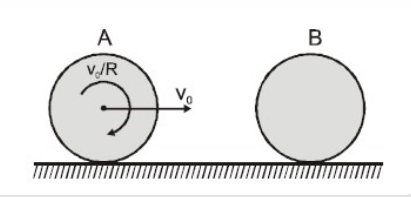
- ✓
$1 : 1$
- B
$2 : 3$
- C
$3 : 2$
- D
AnswerCorrect option: A. $1 : 1$
The sphere is rolling on a smooth surface
i.e., no energy is lost to friction and the kinetic energy of sphere $A$ is transferred to the sphere $B$ without any loss as the collision is head$-$on and elastic.
Thus, the kinetic energy of sphere $A$ and sphere $B$ are equal their ratio will be $1 : 1$
View full question & answer→MCQ 1651 Mark
Work done by gravitational force in one revolution of the earth around the sun on its elliptical path is zero because:
- A
Force is always perpendicular to displacement.
- ✓
- C
Displacement is positive.
- D
Displacement is negative.
View full question & answer→MCQ 1661 Mark
- ✓
Potential energy possessed by stored water is converted into electricity.
- B
Kinetic energy possessed by stored water is converted into potential energy.
- C
Water is heated to produce electricity.
- D
Water is converted into steam to produce electricity.
AnswerCorrect option: A. Potential energy possessed by stored water is converted into electricity.
Hydro power plant uses the potential energy stored in water. When water flows down the dam, potential energy is converted into kinetic energy which is used to rotate the turbine which produce electricity.
View full question & answer→MCQ 1671 Mark
A heavy stone is thrown from a cliff of height $h$ with a speed $v.$ The stone will hit the ground with maximum speed if it is thrown:
- A
- B
- C
- ✓
The speed does not depend on the initial direction.
AnswerCorrect option: D. The speed does not depend on the initial direction.
View full question & answer→MCQ 1681 Mark
A body of mass $0.5\ kg$ travels in a straight line with velocity $v = a x^{3/2}$ where ${a}=5 {~m}^{-1 / 2}{~s}^{-1}$. The work done by the net force during its displacement from $x = 0$ to $x = 2m$ is:
- A
$1.5J$
- ✓
$50J$
- C
$10J$
- D
$100J$
AnswerKey concept: When a variable force acts on a particle while it moves from point $A$ to $B,$ say along the path shown in the figure, work done by the force on the particle is given by
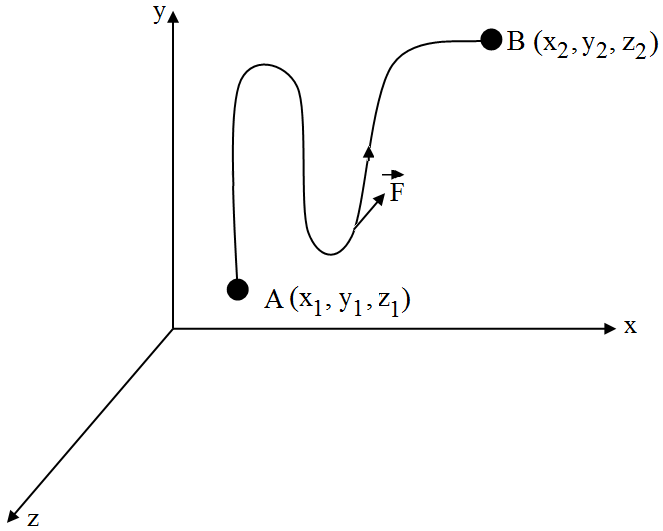
On the particle is given by
$\text{W}=\int\limits^{\text{B}}_\text{A}\vec{\text{F}}\cdot\vec{\text{ds}}\ ...(\text{i})$
Hence, $\int\limits^{\text{B}}_\text{A}\vec{\text{F}}\cdot\vec{\text{ds}}$ is to be integrated along the path the particle follows.
The vector integral is equivalent to
$\text{W}=\int\limits^{\text{x}_2}_{\text{x}_1}\text{f}_\text{x}\text{dx}+\int\limits^{\text{y}_2}_{\text{y}_1}\text{f}_\text{y}\text{dy}+\int\limits^{\text{z}_2}_{\text{z}_1}\text{f}_\text{z}\text{dz}$
According to the problem, velocity $={ax}^{3 / 2}$, mass $=0.5{~kg},{a}=5{~m}^{-1} / 2{~s}^{-1}$
We have to find work done $(W)$ by net force.
We know that,
Acceleration, $\text{a}_0=\frac{\text{dv}}{\text{dt}}=\text{v}\frac{\text{dv}}{\text{dx}}$
$=\text{ax}^{\frac{3}{2}}\frac{\text{d}}{\text{dx}}\Big(\text{ax}^{\frac{3}{2}}\Big)$
$=\text{ax}^{\frac{3}{2}}\times\text{a}\times\frac{3}{2}\times\text{x}^{\frac{1}{2}}=\frac{3}{2}\text{a}^2\text{x}^2$
Net Force $=\text{ma}_0=\text{m}\Big(\frac{3}{2}\text{a}^2\text{x}^2\Big)$
And work done due to variable force,
Work done $=\int\limits^{\text{x}=2}_{\text{x}=0}\text{F dx}=\int\limits^2_0\frac{3}{2}\text{ma}^2\text{x}^2\text{ dx}$
$=\frac{3}{2}\text{ma}^2\times\Big(\frac{\text{x}^3}{3}\Big)^2_0$
$=\frac{1}{2}\text{ma}^2\times8$
$=\frac{1}{2}\times(0.5)\times(25)\times8$
$=50\text{J}$ View full question & answer→MCQ 1691 Mark
Asha lifts a doll from the floor and places it on a table. If the weight of the doll is known, what else does one need to know in order to calculate the work Asha has done on the doll?
- A
- ✓
- C
The power she could deliver.
- D
Cost of the doll or the table.
AnswerWork done, $W =$ force $\times$ displacement $= \ce{mg \times h = mgh}$
This is the potential energy.
If weight $(mg)$ is known, then we need to know the height $(h)$ of the table.
View full question & answer→MCQ 1701 Mark
A man squatting on the ground gets straight up and stand. The force of reaction of ground on the man during the process is:
- A
Constant and equal to $mg$ in magnitude.
- B
Constant and greater than $mg$ in magnitude.
- C
Variable but always greater than $mg.$
- ✓
At first greater than $mg,$ and later becomes equal to $mg.$
AnswerCorrect option: D. At first greater than $mg,$ and later becomes equal to $mg.$
In the process of squatting on the ground he gets straight up and stand.
Then he is tilted somewhat, the man exerts a variable force on the ground to balance his weight,
hence he also has to balance frictional force besides his, weight in this case.
$N =$ Normal reaction force $=$ friction $+\ mg \Rightarrow N > mg$
Once the man gets straight up that variable force $= 0$
Normal reaction force $= mg$
View full question & answer→MCQ 1711 Mark
The potential energy, i.e., $U(x)$ can be assumed zero when:
- A
$x = 0.$
- B
Gravitational force is constant.
- C
Infinite distance from the gravitational source.
- ✓
View full question & answer→MCQ 1721 Mark
A pump is used to lift $500\ kg$ of water from a depth of $80m$ in $10s .$
$($Take $g = 10\ m s^{-2})$. Calculate the work done by the pump.
- A
$16 \times 10^5J$
- ✓
$4 \times 10^5J$
- C
$4 \times 10^8J$
- D
$2 \times 10^5J$
AnswerCorrect option: B. $4 \times 10^5J$
Mass of water lifted, $m = 500\ kg$
Displacement, $d = 80m$
Time taken, $t = 10s$
Force, $F = m \times g$
$F = 500 \times 10$
$F = 5000N$
Work done, $In = F \times d$
$In = 5000 \times 80$
$In = 4 \times 10^5 J.$
View full question & answer→MCQ 1731 Mark
A wound watch spring has $...........$ energy.
AnswerThe energy possessed by a body due to its change in position or shape is called the potential energy. A wound watch has potential energy.
View full question & answer→MCQ 1741 Mark
A student sitting at the top of a tree has $............$ than the student who is sitting on the ground.
- A
- ✓
- C
- D
More gravitational energy.
AnswerPotential energy $= \ce{mgh}$
$m \rightarrow$ mass
$g \rightarrow$ accelerationduetogravity
$h \rightarrow$ heightfromground
$P.E.$ is directly proportional to the height from the ground.
Hence a student sitting at the top of a tree has more potential energy than the student who is sitting on the ground.
View full question & answer→MCQ 1751 Mark
The height attained by a ball after $3$ rebounds on falling from a height of $h$ on floor having coefficient of restitution $e$ is:
- A
$e^3h$.
- B
$e^4h$.
- C
$e^5h$.
- ✓
$e^6h$.
AnswerCorrect option: D. $e^6h$.
View full question & answer→MCQ 1761 Mark
A heavy steel ball of mass greater than 1kg moving with a speed of 2m/ s collides head on with a stationary ping pong ball of mass less than 0.1 g. The collision is elastic. After the collision the ping pong ball moves approximately with a speed.
Answerb. 4m/ s
Explanation:
Since the body is much heavy these won't be much change in velocity & e = 1
$\text{i.e.,}\frac{\text{v-2}}{\text{0-2}}=-1$
⇒ v = 4m/ s
View full question & answer→MCQ 1771 Mark
A heavy stone is thrown force a cliff of height h in a given direction. The speed with which it hits the ground?
- A
Must be larger than the speed of projection.
- B
Must be independent of the speed of projection.
- C
Must depend on the speed of projection.
- ✓
AnswerExplanation:
The speed with which it hits the ground must depend upon the speed of projection and shall always be larger than the speed of projection, because potential energy of the body shall be converted into kinetic energy.
View full question & answer→MCQ 1781 Mark
When an arrow is released from a bow, potential energy changes into kinetic energy.
AnswerWhen an arrow is drawn back by a bow, the work done by us in stretching the bowstring gets stored at potential energy in the bow.
This potential energy of bow is transformed into kinetic energy when the bowstring is released and this gives kinetic energy to the arrow.
View full question & answer→MCQ 1791 Mark
Two bodies of masses $m,$ and $m,$ have same momentum. The ratio of their $KE$ is:
- A
$\sqrt{\frac{\text{m}_2}{\text{m}_1}}$
- B
$\sqrt{\frac{\text{m}_1}{\text{m}_2}}$
- C
$\frac{\text{m}_1}{\text{m}_2}$
- ✓
$\frac{\text{m}_2}{\text{m}_1}$
AnswerCorrect option: D. $\frac{\text{m}_2}{\text{m}_1}$
View full question & answer→MCQ 1801 Mark
Which of the diagrams in correctly shows the change in kinetic energy of an iron sphere falling freely in a lake having sufficient depth to impart it a terminal velocity?
AnswerConstant after some depth. This constant velocity is called terminal velocity, hence KE become constant beyond this depth, which is best represented by (b).
View full question & answer→MCQ 1811 Mark
A body of mass $2\ Kg$ moving $($initially$)$ with $10\ m/ s$ is acting upon by a resultant constar which is opposite to its initial velocity. Its speed decreases to $4\ m/ s$ in $1s.$ Then the force:
View full question & answer→MCQ 1821 Mark
- ✓
Energy possessed by a body by the virtue of its motion.
- B
Energy possessed by a body by the virtue of its shape.
- C
Energy possessed by a body by the virtue of its size.
- D
AnswerCorrect option: A. Energy possessed by a body by the virtue of its motion.
The energy which a body possesses by virtue of being in motion is called as kinetic energy.
If we want to stop a moving body then we must do some work on the body to stop it which means that a moving body possesses energy because of motion.
If an object of mass $m$ moving with the velocity $v$, The kinetic energy is defined as,
$\text{K.E}=\frac{1}{2}\text{mv}^2$
View full question & answer→MCQ 1831 Mark
In an inelastic collision:
- A
Conservation of momentum is not followed.
- B
Conservation of mechanical energy is not followed.
- ✓
Conservation of mechanical energy is followed.
- D
AnswerCorrect option: C. Conservation of mechanical energy is followed.
View full question & answer→MCQ 1841 Mark
A heavy stone is thrown from a cliff of height $h$ with a speed $\nu.$ The stone will hit the ground with maximum speed if it is thrown:
- A
- B
- C
- ✓
The speed does not depend on the initial direction.
AnswerCorrect option: D. The speed does not depend on the initial direction.
As the stone falls under the gravitational force, which is a conservative force, the total energy of the stone remains the same at every point during its motion.
From the conservation of energy, we have:
Initial energy of the stone $=$ final energy of the stone
i.e., $(\text { K.E. })_i+(\text { P.E. })_{\mathrm{i}}=(\text { K.E. })_{\mathrm{f}}+(\text { P.E. })_{\mathrm{f}}$
$=\frac{1}{2}\text{mv}^2+\text{mgh}=\frac{1}{2}\text{m}(\text{v}_\text{max})^2$
$\Rightarrow\text{v}_\text{max}=\sqrt{\text{v}^2+2\text{gh}}$
From the above expression, we can say that the maximum speed With which stone hits the ground does not depend on the initial direction.
View full question & answer→MCQ 1851 Mark
The negative of the work done by the conservative internal forces on a system equals the change in:
AnswerThe negative of the work done by the conservative internal forces on a system is equal to the changes in potential energy.
i.e. $\text{W}=-\triangle\text{ P.E.}$
View full question & answer→MCQ 1861 Mark
A body is moving unidirectionally under the influence of a source of constant power supplying energy. Which of the diagrams shown in correctly shows the displacement-time curve for its motion?
AnswerFor constant power
Displacement $\propto\text{t}^{\frac{3}{2}}$
Because, $\text{P}=\frac{\vec{\text{F}}\cdot\vec{\text{ds}}}{\text{dt}}=\vec{\text{F}}\cdot\vec{\text{v}}=\text{constant}$
$(\because$ P = constant according to the problem$)$
Now, will by dimensional analysis
[F][v] = constant
$\Rightarrow [MLT^{-2}][LT^{-1}]$ = constant
$\Rightarrow L^2T^{-3}$ = constant $(\because$ mass is constant$)$
$\Rightarrow\text{L}\propto\text{T}^{\frac{3}{2}}$
$\Rightarrow\text{ Displacement (d)}\propto\text{t}^{\frac{3}{2}}$
View full question & answer→MCQ 1871 Mark
A particle of mass $m$ is attached to a light string of length $l,$ the other end of which is fixed. Initially the string is kept horizontal and the particle is given an upward velocity $v.$ The particle is just able to complete a circle.
AnswerCorrect option: C. The kinetic energy of the ball in initial position was $\frac{1}{2}\text{m}\nu^2=\text{mgl}.$
The string becomes slack when the particle reaches its highest point. This is because at the highest point, the tension in the string is minimum. At this point, potential energy of the particle is maximum, while its kinetic energy is minimum. From the law of conservation of energy, we can see that the particle again passes through the initial position where its potential energy is minimum and its kinetic energy is maximum.
View full question & answer→MCQ 1881 Mark
The earth, moving around the sun in a circular orbit, is acted upon by a force and hence work done on the earth by the force is:
MCQ 1891 Mark
The force required to stretch a spring varies with the distance as shown in the figure. If the experiment is performed with the above spring of half the length, the line Then will:
- ✓
Shift towards $F−$axis
- B
Shift towards $X−$axis
- C
- D
AnswerCorrect option: A. Shift towards $F−$axis
When the length of the spring is halved, its spring constant will become double.
Slope of the force displacement graph gives the spring constant $(k)$ of spring.
If $k$ becomes double then slope of the graph increases,
i.e. Graph shifts towards force$-$axis.
View full question & answer→MCQ 1901 Mark
When the speed of a body is doubled, its kinetic energy becomes:
AnswerThe kinetic energy of a body is given by:
$\text{K}=\frac{1}{2}\text{min}^2$
Hence, Kinetic energy depends on the velocity as:
$\text{KE}\propto\text{in}^2$
View full question & answer→MCQ 1911 Mark
Which of the following physical quantities is different from others?
AnswerKinetic energy is the energy possessed by the body by virtue of its motion and potential energy is the energy possessed by the virtue of its position and shape. Energy is required to do work.
Hence work, kinetic energy, potential energy all can be measured using same unit, i.e joule.
So, force is the physical quantity here which is different from others as given by product of mass and acceleration. $S.I$ unit of force is $N ($newton$).$
View full question & answer→MCQ 1921 Mark
A ball tied to a string is swung in a vertical circle. Which of the following remains constant?
- A
- B
- C
- ✓
Earth's pull on the ball.
AnswerCorrect option: D. Earth's pull on the ball.
Earth's pull on the ball remains constant $(W = mg).$
Tension in the string changes along the vertical circular path.
Speed of the ball changes as sum of kinetic energy and potential energy remains constant during motion.
Speed changes, hence, centripetal force changes.
View full question & answer→MCQ 1931 Mark
Kinetic energy of a body depends on its:
Answer$\ce{uh}=\frac{1}{2}\text{min}^2$
So the kinetic energy of a body depends upon its mass and velocity.
View full question & answer→MCQ 1941 Mark
An object of mass $10\ kg$ is moving with velocity of $10\ ms^{-1}$. A force of $50N$ acted upon it for $2s.$ Percentage increase in its $KE$ is:
- A
$25\%$
- B
$50\%$
- C
$75\%$
- ✓
$300\%$
AnswerCorrect option: D. $300\%$
Initial velocity $= 10\ ms^{-1}$
Final velocity $=\frac{50}{10}\times2+10=20\ \text{ms}^{-1}$
$\Big(\text{Acceleration}=\frac{50}{10}=5\ \text{m/ s}^2\Big)$
Initial $\text{KE}=\frac{1}{2}\times10\times10\times10=5\times10^2\text{J}$
Final $\text{KE}=\frac{1}{2}\times10\times20\times20=20\times10^2\text{J}$
$\%$ increase $=\frac{(20-5)\times10^2}{5\times10^2}\times100=300\%$
View full question & answer→MCQ 1951 Mark
A bomb of mass $1\ kg$ is thrown vertically upwards with a speed of $100\ m/s.$ After $5$ seconds, it explodes into two fragments. One fragment of mass $400\ gm$ is found to go down with a speed of $25\ m/s.$ What will happen to second fragment just after explosion? $(g = 10\ m/s^2).$
- ✓
It will go upwards with speed $100\ m/s.$
- B
It will go upwards with speed $40\ m/s.$
- C
It will go upwards with speed $60\ m/s.$
- D
It will go downwards with speed $40\ m/s.$
AnswerCorrect option: A. It will go upwards with speed $100\ m/s.$
From $v = u + at = 100 – 10 \times 5 = 50\ m/s$
This is the velocity at the time of explosion.
According to principle of conservation of linear momentum,
$1\times50=\frac{400}{1000}\times(-25)+\frac{600}{1000}\times\text{v}$
$(50+10)=0.6\text{v}$
$\text{v}=\frac{60}{0.6}=100\ \text{m/s}$
The second fragment will go upwards with a speed of $100\ m/s.$
View full question & answer→MCQ 1961 Mark
A boy of mass $40\ kg$ runs up a flight of $50$ steps, each $10\ cm$ high in $14s.$ So, work done by the boy is:
- ✓
$1960J$
- B
$19.6J$
- C
$980J$
- D
$9.8J$
AnswerCorrect option: A. $1960J$
Mass of the boy, $m = 40\ kg$
Number of steps $= 50$
Height of each step $= 10\ cm$
Force on the boy due to gravity, $F = mg = 40 \times 9. 8 N = 392N$
While climbing up the steps, the boy does work against gravity.
Displacement in the vertical direction, $s = (50 \times 10)cm = 500\ cm = 5m$
Displacement is in the direction of force applied by the boy against gravity.
So, work done, In $= F \times s = 392 \times 5J = 1960J$
View full question & answer→MCQ 1971 Mark
Two identical ball bearings in contact with each other and resting on a frictionless table are hit head-on by another ball bearing of the same mass moving initially with a speed V as shown in:
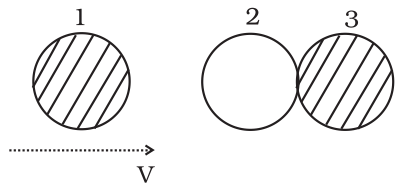
If the collision is elastic, which of the following is a possible result after collision?
AnswerKey concept: In a collision if the motion of colliding particles before and after the collision is along the same line, the collision is said to be head on or one dimensional.
When two bodies of equal masses collides elastically, their velocities are interchanged. Kinetic energy and linear momentum remains conserved Total kinetic energy of the system before collision
$=\frac{1}{2}\text{mv}^2+0=\frac{1}{2}\text{mv}^2$
In (a), kinetic energy of the system after collision,
$\text{K}_1=\frac{1}{2}(2\text{m})\Big(\frac{\text{v}}{2}\Big)^2=\frac{1}{4}\text{mv}^2$
Hence this option is incorrect.
In (b), kinetic energy of the system after collision,
$\text{K}_2=\frac{1}{2}(\text{m})(\text{v})^2=\frac{1}{2}\text{mv}^2$
Hence this option will be correct.
In (c), kinetic energy of the system after collision,
$\text{K}_3=\frac{1}{2}(3\text{m})\Big(\frac{\text{v}}{3}\Big)^2=\frac{1}{6}\text{mv}^2$
Hence this option is incorrect.
In (d), kinetic energy of the system after collision,
$\text{K}_4=\frac{1}{2}\text{mv}^2+\frac{1}{2}\text{m}\Big(\frac{\text{v}}{2}\Big)^2+\frac{1}{2}\text{m}\Big(\frac{\text{v}}{3}\Big)^2=\frac{49}{72}\text{mv}^2$
We see that kinetic energy is conserves only in (b).
View full question & answer→MCQ 1981 Mark
Complete the following sentence: The kinetic energy of a body is the energy by virtue of its$............$
AnswerThe kinetic energy of a body is the energy by virtue of its motion.
This is the definition of kinetic energy.
If it has motion then it will have velocity,
hence kinetic energy exists.
$\text{K.E}=\frac{1}{2}\text{mv}^2$
View full question & answer→MCQ 1991 Mark
A cricket ball of mass $150g$ moving with a speed of $126\ km/ h$ hits at the middle of the bat, held firmly at its position by the batsman. The ball moves straight back to the bowler after hitting the bat. Assuming that collision between ball and bat is completely elastic and the two remain in contact for $0.001s,$ the force that the batsman had to apply to hold the bat firmly at its place would be:
- A
$10.5N$
- B
$21N$
- ✓
$1.05 \times 10^4$
- D
$N$
AnswerCorrect option: C. $1.05 \times 10^4$
We know that force $\text{F}=\frac{\Delta\text{p}}{\Delta\text{t}}$ and $\frac{\Delta\text{p}}{\Delta\text{t}}=\frac{\text{m}[(-\text{v})-\text{u}]}{\text{t}}=\frac{-2\text{mv}}{\text{t}}$
And the magnitude of force will be, $\text{F}=\frac{2\text{mv}}{\text{t}}$
According to the problem, $\text{m}=150\text{g}=\frac{150}{1000}\text{kg}=\frac{3}{20}\text{kg}$
$\Delta\text{t}=\text{time of contact}=0.001\text{s}$
$\text{u}=126\text{km/ h}=\frac{126\times1000}{60\times60}\text{m/ s}=35\text{}\text{m s}$
$\text{v}=-126\text{km/ h}=-35\text{m/ s}$
Change in momentum of the ball
$\Delta\text{P}=\text{m(v}-\text{u})$
$=\frac{3}{20}(-70)=-\frac{21}{2}$
We know that force
$\text{F}=\frac{\Delta\text{P}}{\Delta\text{t}}$
$=\frac{\frac{-21}{2}}{0.001}\text{N}$
$=-1.05\times10^4\text{N}$
Here, $-ve$ sign shows that force will be opposite to the direction of movement of the ball before hitting.
So the force that the batsman had to apply to hold the bat firmly at its place would be $F = 1.05 \times 10^4$N K
View full question & answer→MCQ 2001 Mark
Which of the diagrams shown in most closely shows the variation in kinetic energy of the earth as it moves once around the sun in its elliptical orbit?
AnswerAs the earth moves once around the sun in its elliptical orbit, when the earth is closest to the sun, speed of the earth is maximum, hence KE is maximum. When the earth is farthest from the sun speed is minimum hence KE is minimum but never zero and negative.
This variation of KE vs t is correctly represented by option (d).
View full question & answer→MCQ 2011 Mark
Which one of the following possesses both kinetic and potential energies?
- A
A man walking on the road.
- ✓
- C
- D
A man running in the garden.
AnswerKinetic energy is due to motion of the object and potential energy is due to relative position of object wrt earth.
In option $A.$ Relative position is same so no potential energy if we assume reference as level of road( assuming horizontal road), but have kinetic energy as the man is in motion.
In option $C$ he is lying on bed so neither relative change in position nor body in motion so have none of the energies kinetic or potential.
In option $D$ this is same case as that of option $A. ($assuming level park$).$
But in option $B,$ man is climbing a hill so relative position wrt ground level changes so it gain some potential energy and also he is moving so also have kinetic energy.
View full question & answer→MCQ 2021 Mark
In a head on elastic collision of a very heavy body moving with velocity $v$ with a light body at rest. Then, the velocity of heavy body after collision is:
- ✓
$v.$
- B
$2.$
- C
- D
$\frac{\text{v}}{2}$.
View full question & answer→MCQ 2031 Mark
The ratio of spring constants of two springs is $2 : 3.$ What is the ratio of their potential energy if they are stretched by the same force?
- A
$2 : 3$
- ✓
$3 : 2$
- C
$4 : 9$
- D
$9 : 4$
AnswerCorrect option: B. $3 : 2$
View full question & answer→MCQ 2041 Mark
what is the work done by a force $4N$ in moving the body from $d = 1m$ to $4m\ ?$
Answer$W = F.S \rightarrow 4(4 − 1)J = 12J$
View full question & answer→MCQ 2051 Mark
No work is done by a force on an object if :
- A
The force is always perpendicular to its velocity.
- B
The object moves in such a way that the point of application of the force remains fixed.
- C
The object is stationary but the point of application of the force moves on the object.
- ✓
AnswerNo work is done by a force on an object if the force is always perpendicular to its velocity.
Acceleration does not always provide the direction of motion,
so we cannot say that no work is done by a force on an object if it is always perpendicular to the acceleration.
Work done is zero when the displacement is zero.
In a circular motion, force provides the centripetal acceleration.
The angle between this force and the displacement is $90^\circ$,
so work done by the force on an object is zero.
View full question & answer→MCQ 2061 Mark
The decrease in the potential energy of a ball of mass $20\ kg$ which falls from a height of $50\ cm$ is:
AnswerDecrease in potential energy $\ce{\triangle U = mg(h_2−h_1)}$
$\ce{\triangle U = mgh} = 20 \times 9.8 \times 0.5 = 98J$
View full question & answer→MCQ 2071 Mark
The potential energy of a spring when stretched through a distance $x$ is $10J$. What is the amount of work done on the same spring to stretch it through an additional distance $x\ ?$
View full question & answer→MCQ 2081 Mark
If $g$ is acceleration due to gravity on earth's surface, the gain in potential energy of an object of mass $m$ raised from surface of earth to a height equal to radius $R$ of the earth is:
- ✓
$\frac{1}{2}\text{mgR}$
- B
$2\text{mgR}$
- C
$\text{mgR}$
- D
$\frac{1}{4}\text{mgR} $
AnswerCorrect option: A. $\frac{1}{2}\text{mgR}$
View full question & answer→