MCQ
A ball hits a vertical wall horizontally at $10m/s$  bounces back at $10 m/s$ 
  • A
    There is no acceleration because $10\,\frac{m}{s} - \,10\frac{m}{s} = 0$
  • B
    There may be an acceleration because its initial direction is horizontal
  • There is an acceleration because there is a momentum change
  • D
    Even though there is no change in momentum there is a change in direction. Hence it has an acceleration
Answer

Correct option: C.
There is an acceleration because there is a momentum change
c
(c)As the ball bounces back with same speed so change in momentum $= 2 mv$
and we know that force = rate of change of momentum
i.e. force will act on the ball so there is an acceleration.

Need a full question paper?

Generate a complete, print-ready paper with questions like this in minutes — across 16+ boards, with answer keys.

Start Generating Free

Similar questions

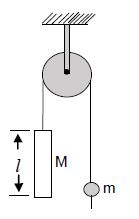
Figure shows an arrangement of a rod of length $l$ and mass $M$ and a bead of mass $m$ attached to a weightless string passing over a frictionless pulley. At $t = 0$ , the bead is in level with the lower end of the rod. The bead slides down the string with considerable friction and is opposite to the other end of the rod after $T\ second$ . Assuming friction between the beadand the string to be constant all through, the frictional force is
The path of projectile is
Which is different from others by units
One mole of an ideal gas expands adiabatically from an initial state $\left(T_A, V_0\right)$ to final state $\left(T_f, 5 V_0\right)$. Another mole of the same gas expands isothermally from a different initial state ( $T_{\mathrm{B}}, \mathrm{V}_0$ ) to the same final state $\left(T_{\mathrm{f}}, 5 V_0\right)$. The ratio of the specific heats at constant pressure and constant volume of this ideal gas is $\gamma$. What is the ratio $T_{\mathrm{A}} / T_{\mathrm{B}}$ ?
An ideal fluid flows through a pipe of circular cross-section made of two sections with diameters 2.5cm and 3.75cm. The ratio of the velocities in the two pipes is:
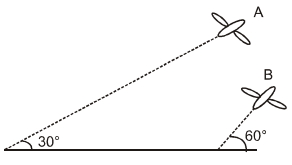
Airplanes $A$ and $B$ are flying with constant velocity in the same vertical plane at angles $30^{\circ}$ and $60^{\circ}$ with respect to the horizontal respectively as shown in figure . The speed of $A$ is $100 \sqrt{3} ms ^{-1}$. At time $t=0$, an observer in A finds $B$ at a distance of $500 \ m$. This observer sees $B$ moving with a constant velocity perpendicular to the line of motion of $A$. If at $t = t _0$, $A$ just escapes being hit by $B , t _0$ in seconds is:
Two bodies of masses $0.1 \,kg$ and $0.4 \,kg$ move towards each other with the velocities $1\, m/s$ and $0.1 \,m/s$ respectively, After collision they stick together. In $10 \,sec$ the combined mass travels .......... $m$
Roads are banked on curves so that
A pump draws water from a tank which is at $2.5\; m$ down from outlet and issues it from the end of a hose which the water is drawn. The cross sectional area is $10\; cm ^{2}$, and the water leaves the end of the hose at a speed of $5\; m / s$. What is the rate at which the pump is working ?
Two projectiles are projected at $30^{\circ}$ and $60^{\circ}$ with the horizontal with the same speed. The ratio of the maximum height attained by the two projectiles respectively is: