MCQ
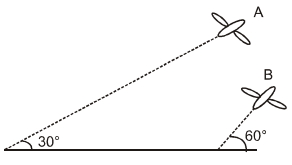
Airplanes $A$ and $B$ are flying with constant velocity in the same vertical plane at angles $30^{\circ}$ and $60^{\circ}$ with respect to the horizontal respectively as shown in figure . The speed of $A$ is $100 \sqrt{3} ms ^{-1}$. At time $t=0$, an observer in A finds $B$ at a distance of $500 \ m$. This observer sees $B$ moving with a constant velocity perpendicular to the line of motion of $A$. If at $t = t _0$, $A$ just escapes being hit by $B , t _0$ in seconds is:
  • $5$
  • B
    $6$
  • C
    $7$
  • D
    $8$

Answer

Correct option: A.
$5$
a
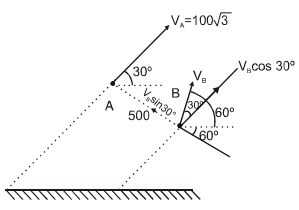
For relative motion perpendicular to line of motion of $A$ $A$

$V_A=100 \sqrt{3}=V_B \operatorname{Cos} 30^{\circ} $

$\Rightarrow \quad V_B=100 m / s $

$t_0=\frac{50}{V_B \sin 30^{\circ}}=\frac{500}{200 \times \frac{1}{2}}=5 sec \text { Ans. }$

Need a full question paper?

Generate a complete, print-ready paper with questions like this in minutes — across 16+ boards, with answer keys.

Start Generating Free

Similar questions

The solid angle subtended by the periphery of an area 1cm2 at a point situated symmetrically at a distance of 5cm from the area is:
Two identical satellites are at $R$ and $7R$ away from earth surface, the wrong statement is ($R $ = Radius of earth)
Consider a body of mass $1.0 \mathrm{~kg}$ at rest at the origin at time $\mathrm{t}=0$. A force $\overrightarrow{\mathrm{F}}=(\alpha \mathrm{t} \hat{\mathrm{i}}+\beta \hat{\mathrm{j}})$ is applied on the body, where $\alpha=1.0 \mathrm{Ns}^{-1}$ and $\beta=1.0 \mathrm{~N}$. The torque acting on the body about the origin at time $\mathrm{t}=1.0 \mathrm{~S}$ is $\vec{\tau}$. Which of the following statements is (are) true?

$(A)$ $|\vec{\tau}|=\frac{1}{3} \mathrm{Nm}$

$(B)$ The torque $\vec{\tau}$ is in the direction of the unit vector $+\hat{\mathrm{k}}$

$(C)$ The velocity of the body at $\mathrm{t}=1$ is $\overrightarrow{\mathrm{v}}=\frac{1}{2}(\hat{\mathrm{i}}+2 \hat{\mathrm{j}}) \mathrm{m} \mathrm{s}^{-1}$

$(D)$ The magnitude of displacement of the body at $\mathrm{t}=1 \mathrm{~s}$ is $\frac{1}{6} \mathrm{~m}$

A particle executes $S.H.M.,$ the graph of velocity as a function of displacement is :-
$A$ horizontal force $F = mg/3$ is applied on the upper surface of a uniform cube of mass $‘m’$ and side $‘a’$ which is resting on a rough horizontal surface having $\mu_S = 1/2$. The distance between lines of action of $‘mg’$ and normal reaction $‘N’$ is :
A heavy stone is thrown force a cliff of height h in a given direction. The speed with which it hits the ground?
The breaking stress of a wire of length $L$ and radius $r$ is $5$ $kg - wt/{m^2}$. The wire of length $2l$ and radius $2r$ of the same material will have breaking stress in $kg - wt/{m^2}$
A hydrogen atom in ground state absorbs 10.2eV of energy. The orbital angular momentum of the electron is increased by:
  1. 1.05 × 10⁻³⁴Js
  2. 2.11 × 10⁻³⁴Js
  3. 3.16 × 10⁻³⁴Js
  4. 4.22 × 10⁻³⁴Js
A spherical body of mass $2\,kg$ starting from rest acquires a kinetic energy of $10000\,J$ at the end of $5^{\text {th }}$ second. The force acted on the body is $.....N$
Two masses of 1g and 4g are moving with equal kinetic energy. The ratio of the magnitudes of their momentum is: