MCQ
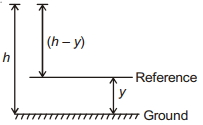
A ball is dropped from a height $h$ above ground. Neglect the air resistance, its velocity $(v)$ varies with its height above the ground as
  • $\sqrt{2 g(h-y)}$
  • B
    $\sqrt{2 g h}$
  • C
    $\sqrt{2 g y}$
  • D
    $\sqrt{2 g(h+y)}$

Answer

Correct option: A.
$\sqrt{2 g(h-y)}$
a
(a)

$v=\sqrt{2 g(h-y)}$

Need a full question paper?

Generate a complete, print-ready paper with questions like this in minutes — across 16+ boards, with answer keys.
Start Generating Free

Similar questions

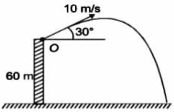
A ball is projected from a point $O$ as shown in figure. It will strike the ground after ........ $s$ $\left(g=10 \,m / s ^2\right)$
A tube with both open end its fundamental frequency is n. If half of tube is dipped in water vertically the fundamental frequency of air column.
A $6000 \,kg$ rocket is set for firing. If the exhaust speed is $1000 \,m / s$, how much gas must be ejected each second to supply the thrust needed to overcome the weight of the rocket is .......... $kg$
An underwater sonar source operating at a frequency of $60 KHz$ directs its beam towards the surface. If the velocity of sound in air is $330\, m/s,$ the wavelength and frequency of waves in air are:
There is no atmosphere on the moon because
The escape velocity of a planet having mass $6$ times and radius $2$ times as that of earth is
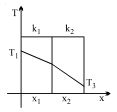
The temperature drop through each layer of a two layer furnace wall is shown in figure. Assume that the external temperature $T_1$ and $T_3$ are maintained constant and $T_1 > T_3$. If the thickness of the layers $x_1$ and $x_2$ are the same, which of the following statements are correct.
The equation of progressive wave is $y = a\sin (200\,t - x)$. where $x$ is in meter and $t$ is in second. The velocity of wave is  ..... $m/sec$
Spherical balls of radius $ 'r'$  are falling in a viscous fluid of viscosity '$\eta$' with a velocity $ 'v'. $ The retarding viscous force acting on the spherical ball is
Two simple harmonic motions are represented by the equations

${x}_{1}=5 \sin \left(2 \pi {t}+\frac{\pi}{4}\right)$ and ${x}_{2}=5 \sqrt{2}(\sin 2 \pi {t}+\cos 2 \pi {t})$

The amplitude of second motion is ....... times the amplitude in first motion.