MCQ
A ball is projected at $60^o$ from horizontal at $200\, m/s$. At maximum height during its  flight it explodes into $3$ equal fragments. Out of them one part travel at $100\, m/s$  vertically up while other at $100\, m/s$ vertically down, then third part will have  speed just after explosion :-
  • A
    $100\, m/s$ horizontal
  • $300\, m/s$ horizontal
  • C
    $300\, m/s\, 60^o$ to horizontal
  • D
    $200\, m/s\, 60^o$ to horizontal

Answer

Correct option: B.
$300\, m/s$ horizontal
b
Total momentum just before explosion

$=$ Total momentum just after explosion

$\mathrm{m} \times\left(200 \cos 60^{\circ}\right) \hat{\mathrm{i}}=\frac{\mathrm{m}}{3} \times 100 \hat{\mathrm{j}}+\frac{\mathrm{m}}{3} \times 100(-\hat{\mathrm{j}})+\frac{\mathrm{m}}{3} \times \overrightarrow{\mathrm{V}}$

$\mathrm{m} \times\left(200 \cos 60^{\circ}\right) \hat{\mathrm{i}}=\frac{\mathrm{m}}{3} \times \vec{\mathrm{V}}$

$\overrightarrow{\mathrm{V}}=3\left(200 \cos 60^{\circ}\right) \hat{\mathrm{i}}$

$\overrightarrow{\mathrm{V}}=300 \mathrm{m} / \mathrm{s} \hat{\mathrm{i}}$

Need a full question paper?

Generate a complete, print-ready paper with questions like this in minutes — across 16+ boards, with answer keys.

Start Generating Free

Similar questions

A light rod of length $l$ has two masses $m_1$ and $m_2$ attached to its two ends. The moment of inertia of the system about an axis perpendicular to the rod and passing through the centre of mass is 
A particle executes linear simple harmonic motion with an ampilitude of $3\,cm$ . When the particle is at $2\,cm$ from the mean position , the magnitude of its velocity is equal to that of its acceleration. Then its time period in seconds is 
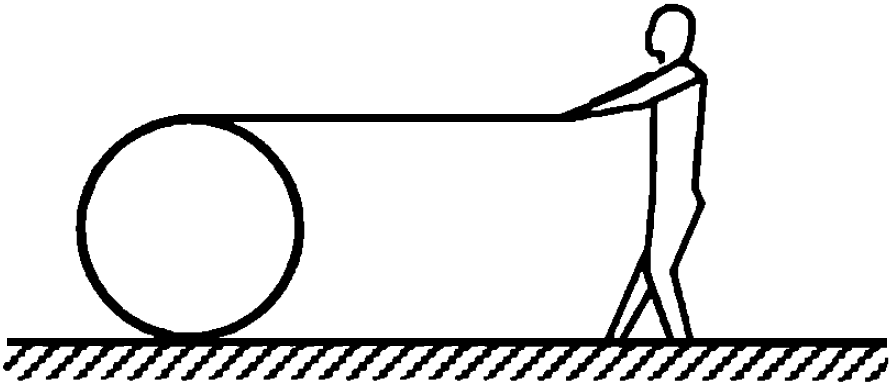
A string of negligible thickness is wrapped several times around a cylinder kept on a rough horizontal surface. A man standing at a distance 1 from the cylinder holds one end of the string and pulls the cylinder towards him. There is no slipping anywhere. The length of the string passed through the hand of the man while the cylinder reaches his hands is:
  1. l
  2. 2l
  3. 3l
  4. 4l

In a resonance tube experiment when the tube is filled with water up to height of $17.0\, cm$ from bottom, it resonates with a given tuning fork. When the water level is raised the next resonance with the same tuning fork occurs at a height of $24.5\, cm$. If the velocity of sound in air is $330\, m / s ,$ the tuning fork frequency is$......Hz$
A solid cube is first floating in a liquid. The coefficient of linear expansion of cube is $\alpha$ and the coefficient of volume expansion of liquid is $\gamma$. On increasing the temperature of (liquid + cube) system, the cube will sink if
A certain mass of gas at $273 K$ is expanded to $81$ times its volume under adiabatic condition. If $\gamma = 1.25$ for the gas, then its final temperature is ..... $^oC$
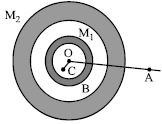
Two concentric shells of uniform density of mass $M_1$ and $M_2$ are situated as shown in the figure. The forces experienced by a particle of mass $m$ when placed at positions $A, B$ and $C$ respectively are (given $OA = p, \,OB = q$ and $OC = r$)
By opening the door of a refrigerator placed inside a room you
The heat required to change $1 \,kg$ of ice at $-8^{\circ} C$ into water at $20^{\circ} C$. at $1 \,atm$ of pressure, is closest to .............$\,kJ$ (Assume that ice has a specific heat capacity $2.1 \,kJ / kg / K$. water has a specific heat capacity $4.2 \,kJ / kg / K$, and latent heat of fusion of ice is $333 \,kJ / kg$ )
A particle of mass $2 \,kg$ travels along a straight line with velocity $v=a \sqrt{x}$, where $a$ is a constant. The work done by net force during the displacement of particle from $x=0$ to $x=4 \,m$ is .........