MCQ
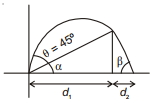
A ball is projected from ground at an angle $45^{\circ}$ with horizontal from distance $d_1$ from the foot of a pole and just after touching the top of pole it the falls on ground at distance $d_2$ from pole on other side, the height of pole is ...........
  • A
    $2 \sqrt{d_1 d_2}$
  • B
    $\frac{d_1+d_2}{4}$
  • C
    $\frac{2 d_1 d_2}{d_1+d_2}$
  • $\frac{d_1 d_2}{d_1+d_2}$

Answer

Correct option: D.
$\frac{d_1 d_2}{d_1+d_2}$
d
(d)

Repeated.

$\tan \alpha+\tan \beta=\tan \theta$

$\frac{y}{d_1}+\frac{y}{d_2}=\tan 45^{\circ}$

$y=\left(\frac{d_1 d_2}{d_1+d_2}\right)$

Need a full question paper?

Generate a complete, print-ready paper with questions like this in minutes — across 16+ boards, with answer keys.

Start Generating Free

Similar questions

If a cycle wheel of radius $4 \,m$ completes one revolution in two seconds. Then acceleration of a point on the cycle wheel will be
Which of the four arrangements in the figure correctly shows the vector addition of two forces $\overrightarrow {{F_1}} $ and $\overrightarrow {{F_2}} $ to yield the third force $\overrightarrow {{F_3}} $
A body $A$ is placed on a railway platform and an identical body $B$ in a moving train. Which of the following energies of $B$ are greater than those of $A$, as seen from the ground?
If by applying a force F on an object that object gets velocity v then the value of power will be :
A pipe $17\, cm$ long is closed at one end. Which harmonic mode of the pipe resonates  a $1.5\, kHz$ source ? 
(Speed of sound in air $= 340\, m\, s^{-1}$)
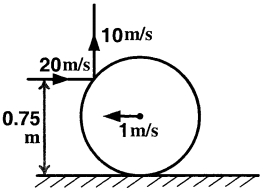
A thin ring of mass $2 \ kg$ and radius $0.5 \ m$ is rolling without slipping on a horizontal plane with velocity $1 \ m / s$. A small ball of mass $0.1 \ kg$, moving with velocity $20 \ m / s$ in the opposite direction, hits the ring at a height of $0.75 \ m$ and goes vertically up with velocity $10 \ m / s$. Immediately after the collision

$(A)$ the ring has pure rotation about its stationary $CM$.

$(B)$ the ring comes to a complete stop.

$(C)$ friction between the ring and the ground is to the left.

$(D)$ there is no friction between the ring and the ground.

A string of length $1 \mathrm{~m}$ and mass $2 \times 10^{-5} \mathrm{~kg}$ is under tension $\mathrm{T}$. when the string vibrates, two successive harmonics are found to occur at frequencies $750 \mathrm{~Hz}$ and $1000 \mathrm{~Hz}$. The value of tension $\mathrm{T}$ is. . . . . . .Newton.
A uniform cable of mass $‘M’$ and length $‘L’$ is placed on a horizontal surface such that its ${\left( {\frac{1}{n}} \right)^{th}}$  part is hanging below the edge of the surface. To lift the hanging part of the cable upto the surface, the work done should be
A projectile is thrown in the upward direction making an angle of $60^o$ with the horizontal direction with a velocity of $150\, ms^{-1}$. Then the time after which its inclination with the horizontal is $45^o$ is
Take the effect of bulging of earth and its rotation in account. Consider the following statements:
  1. There are points outside the earth where the value of $g$ is equal to its value at the equator.
  2. There are points outside the earth where the value of $g$ is equal to its value at the poles.