MCQ
A pipe $17\, cm$ long is closed at one end. Which harmonic mode of the pipe resonates  a $1.5\, kHz$ source ? 
(Speed of sound in air $= 340\, m\, s^{-1}$)
  • A
    $1$
  • $3$
  • C
    $5$
  • D
    $7$

Answer

Correct option: B.
$3$
b
Here, speed of sound, $\mathrm{v}=340 \mathrm{\,ms}^{-1}$

Length of pipe, $\mathrm{L}=17 \mathrm{cm}=17 \times 10^{-2} \mathrm{\,m}$

In a closed pipe (open at one end), the frequency of its $\mathrm{n}^{\text {th }}$ harmonic is

$\mathrm{v}_{\mathrm{n}}=\frac{\mathrm{nv}}{4 \mathrm{L}}$ where $\mathrm{n}=1,3,5,7,.........$

Let $\mathrm{n}^{\text {th }}$ harmonic of closed pipe resonates with $1.5 \,kHz$ source.

$\therefore v_{n}=1.5 \times 10^{3} \mathrm{\,Hz}$

$\therefore 1.5 \times 10^{3}=\frac{\mathrm{nv}}{4 \mathrm{L}}$

$\mathrm{n}=\frac{1.5 \times 10^{3} \times 4 \times 17 \times 10^{-2}}{340}$

$n=3$

Need a full question paper?

Generate a complete, print-ready paper with questions like this in minutes — across 16+ boards, with answer keys.
Start Generating Free

Similar questions

A parrot sitting on the floor of a wire cage which is being carried by a boy starts flying. The boy will feel that the box is now:
The velocity of upper layer of water in a river is $36 kmh ^{-1}$. Shearing stress between horizontal layers of water is $10^{-3} Nm ^{-2}$. Depth of the river is $m$. (Co-efficiency of viscosity of water is $10^{-2} \,Pa . s$ )
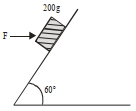
A block of mass $200\, g$ is kept stationary on a smooth inclined plane by applying a minimum horizontal force $F =\sqrt{ x }N$ as shown in figure. The value of $x =.....$
A bullet of mass $0.01\, kg$ and travelling at a speed of $500 \,m/s$. strikes a block of  mass $2 \,kg$. which is suspended by a string of length $5\,m$. The centre of gravity of the  block is found to raise a vertical distance of $0.1\,m$. What is the speed of the bullet  after it emerges from the block- ................ $\mathrm{m}/ \mathrm{s}$
$Assertion$: The total translational kinetic energy of all the molecules of a given mass of an ideal gas is $1.5\, times$ the product of its pressure and its volume.
$Reason$ : The molecules of a gas collide with each other and the velocities of the molecules change due to the collision.
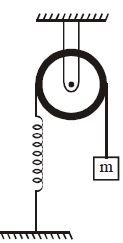
A mass $m = 8\,kg$ is attahced to a spring as shown in figure and held in position so that the spring remains unstretched. The spring constant is $200\,N/m$. The mass $m$ is then released and begins to undergo small oscillations. The maximum velocity of the mass will be ..... $m/s$ $(g = 10\,m/s^2)$
A body with mass $5\ kg$ is acted upon by a force $\text{F}=(-3\hat{\text{i}}+4\hat{\text{j}})\text{N.}$ If its initial velocity at $t = 0$ is $\text{v}=(6\hat{\text{i}}-12\hat{\text{j}})\text{m s}^{-1},$ the time at which it will just have a velocity along the $y-$axis is:
The density of a cube is measured by measuring its mass and length of its sides. If the maximum error in the measurement of mass and length are $4\%$ and $3\%$ respectively, the maximum error in the measurement of density will be   ........ $\%$
A particle moves in the $X-Y$ plane under the influence of a force such that its linear momentum is $\overrightarrow{\mathrm{p}}(t)=A[\hat{\mathrm{i}} \cos (\mathrm{kt})-\hat{\mathrm{j}} \sin (\mathrm{kt})]$, where $A$ and $k$ are constants. The angle between the force and the momentum is
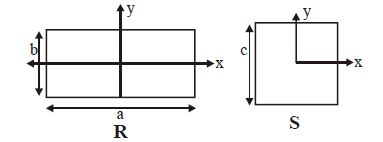
A uniform square plate $S$ (side $c$) and a uniform rectangular plate $R$ (sides $b$, $a$) ($a > b$) have identical areas and masses figure. Which of the following is correct

$(a)\ I_{xR}/I_{xS} <1;\  (b)\ I_{yR}/I_{yS}  >1; \  (c)\ I_{zR}/I_{zS} >1$