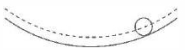
A ball is rolling without slipping in a spherical shallow bowl (radius $R$ ) as shown in the figure and is executing simple harmonic motion. If the radius of the ball is doubled, then the time period of oscillation
KVPY 2013, Medium
Download our app for free and get started
(d)
Time period of oscillation of ball (radius $r$ ) in a bowl (radius $R$ ) rolling without slipping is
$T=2 \pi \sqrt{\frac{R-r}{g}}$
So, if $r$ increases, then time period is decreases.

Download our appand get started for free
Experience the future of education. Simply download our apps or reach out to us for more information. Let's shape the future of learning together!No signup needed.*
Similar Questions
- 1A $1.00 \times 10^{-20} \,kg$ particle is vibrating under simple harmonic motion with a period of $1.00 \times 10^{-5} \,s$ and with a maximum speed of $1.00 \times 10^3 \,m / s$. The maximum displacement of particle from mean position is .......... $mm$View Solution
- 2A simple pendulum of length $L$ and mass (bob) $M$ is oscillating in a plane about a vertical line between angular limits $ - \varphi $ and $ + \varphi $. For an angular displacement $\theta (|\theta | < \varphi )$, the tension in the string and the velocity of the bob are $T$ and $ v$ respectively. The following relations hold good under the above conditionsView Solution
- 3A particle of mass $10\, gm$ moves in a field where potential energy per unit mas is given by expression $v = 8 \times 10^4\, x^2\, erg/gm$. If the total energy of the particle is $8 \times 10^7\, erg$ then the relation between $x$ and time $t$ isView Solution
- 4View SolutionIn a simple harmonic oscillation, what fraction of total mechanical energy is in the form of kinetic energy, when the particle is midway between mean and extreme position.
- 5A simple harmonic wave having an amplitude a and time period $T$ is represented by the equation $y = 5\sin \pi (t + 4)m.$ Then the value of amplitude $(a)$ in $(m)$ and time period $(T) $ in second areView Solution
- 6The composition of two simple harmonic motions of equal periods at right angle to each other and with a phase difference of $\pi $ results in the displacement of the particle alongView Solution
- 7A bead of mass $m$ is attached to the mid-point of a tant, weightless string of length $l$ and placed on a frictionless horizontal table.Under a small transverse displacement $x$, as shown in above figure. If the tension in the string is $T$, then the frequency of oscillation isView Solution
- 8View SolutionA second's pendulum is mounted in a rocket. Its period of oscillation decreases when the rocket
- 9A particle of mass $10$ grams is executing simple harmonic motion with an amplitude of $0.5\, m$ and periodic time of $(\pi /5)$ seconds. The maximum value of the force acting on the particle is ... $N$View Solution
- 10Initially system is in equilibrium. Time period of $SHM$ of block in vertical direction isView Solution