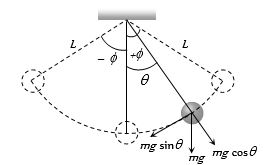
A simple pendulum of length $L$ and mass (bob) $M$ is oscillating in a plane about a vertical line between angular limits $ - \varphi $ and $ + \varphi $. For an angular displacement $\theta (|\theta | < \varphi )$, the tension in the string and the velocity of the bob are $T$ and $ v$ respectively. The following relations hold good under the above conditions
IIT 1986, Diffcult


Download our appand get started for free
Experience the future of education. Simply download our apps or reach out to us for more information. Let's shape the future of learning together!No signup needed.*
Similar Questions
- 1Match $List - I$ with $List - II$View Solution
Choose the correct answer from the options given below

- 2The resultant of two rectangular simple harmonic motions of the same frequency and equal amplitudes but differing in phase by $\frac{\pi }{2}$ isView Solution
- 3Two particles are performing simple harmonic motion in a straight line about the same equilibrium point. The amplitude and time period for both particles are same and equal to $A$ and $T,$ respectively. At time $t=0$ one particle has displacement $A$ while the other one has displacement $\frac {-A}{2}$ and they are moving towards each other. If they cross each other at time $t,$ then $t$ isView Solution
- 4View SolutionIf a hole is bored along the diameter of the earth and a stone is dropped into hole
- 5Two particles oscillating in $SHM$ along two very close parallel path such that they have same mean position. The equation of $SHM$ of two particles are $x_1 = A\, sin\,\omega t$ and $x_2 = A\,sin(\omega t + \phi )$ respectively. If maximum distance between them is $\frac{6A}{5}$ then $\phi $ equal to ..... $^o$View Solution
- 6In a seconds pendulum, mass of bob is $30\, g$. If it is replaced by $90\, g$ mass. Then its time period will be ... $\sec$View Solution
- 7A particle executes harmonic motion with an angular velocity and maximum acceleration of $3.5\, rad/sec$ and $ 7.5\, m/s^2$ respectively. The amplitude of oscillation is .... $m$View Solution
- 8A spring has a certain mass suspended from it and its period for vertical oscillation is $T$. The spring is now cut into two equal halves and the same mass is suspended from one of the halves. The period of vertical oscillation is nowView Solution
- 9A $1.00 \times {10^{ - 20}}kg$ particle is vibrating with simple harmonic motion with a period of $1.00 \times {10^{ - 5}}sec$ and a maximum speed of $1.00 \times {10^3}m/s$. The maximum displacement of the particle isView Solution
- 10The maximum speed of a particle executing $S.H.M.$ is $1\,m/s$ and its maximum acceleration is $1.57\,m/se{c^2}$. The time period of the particle will be .... $\sec$View Solution