MCQ
A ball is thrown vertically upwards. Which of the following graph/graphs represent velocity-time graph of the ball during its flight (air resistance is neglected)
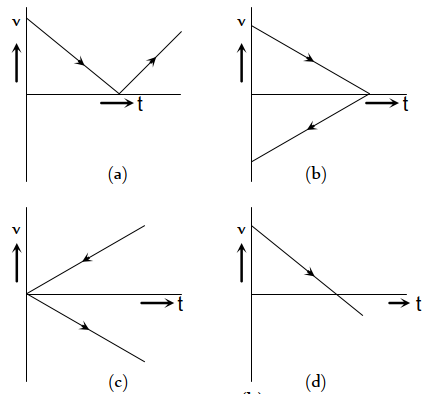
Image
  • A
    $A$
  • B
    $B$
  • C
    $C$
  • $D$

Answer

Correct option: D.
$D$
(d) In the positive region the velocity decreases linearly (during rise) and in the negative region velocity increases linearly (during fall) and the direction is opposite to each other during rise and fall, hence fall is shown in the negative region.

Need a full question paper?

Generate a complete, print-ready paper with questions like this in minutes — across 16+ boards, with answer keys.

Start Generating Free

Similar questions

A rectangular coil of $300$ turns has an average area of average area of $25 \mathrm{~cm} \times 10 \mathrm{~cm}$. The coil rotates with a speed of $50 \mathrm{cps}$ in a uniform magnetic field of strength $4 \times 10^{-2} T$ about an axis perpendicular of the field. The peak value of the induced e.m.f. is (in volt)
Two particles $P$ and $Q$ start from origin and execute Simple Harmonic Motion along $X$-axis with same amplitude but with periods 3 seconds and 6 seconds respectively. The ratio of the velocities of $P$ and $Q$ when they meet is
If two bodies are projected at 30 and 60 respectively, with the same velocity, then
An ideal gas expands isothermally from a volume $V_1$ to $V_2$ and then compressed to original volume $V_1$ adiabatically. Initial pressure is $P_1$ and final pressure is $P_3$. The total work done is $W$. Then
A solid disc of mass $M$ is just held in air horizontally by throwing $40$ stones per sec vertically upwards to strike the disc each with a velocity $6\  ms ^{-1}$. If the mass of each stone is $0.05\  kg$ what is the mass of the $\operatorname{disc}\left(g=10 ms ^{-2}\right)$
If the initial velocity of a projectile be doubled, keeping the angle of projection same, the maximum height reached by it will
Which has more luminous efficiency
There is a current of 40 ampere in a wire of $10^{-6} \mathrm{~m}^2$ area of cross-section. If the number of free electron per $\mathrm{m}^3$ is $10^{29}$, then the drift velocity will be
For an isotropic medium $B, \mu, H$ and $M$ are related as (where $B, \mu_0, H$ and $M$ have their usual meaning in the context of magnetic material
A mercury drop of $1 \mathrm{~cm}$ radius is broken into $10^6$ small drops. The energy used will be (surface tension of mercury is $\left.35 \times 10^{-3} \mathrm{~N} / \mathrm{cm}\right)$