MCQ 11 Mark
A body is thrown vertically upwards with velocity $u$. The distance travelled by it in the fifth and the sixth seconds are equal. The velocity $u$ is given by $(g=9.8 m / s )$
- A
$24.5 m / s$
- ✓
$49.0 m / s$
- C
$73.5 m / s$
- D
$98.0 m / s$
AnswerCorrect option: B. $49.0 m / s$
(b) The given condition is possible only when body is at its highest position after 5 second lt means time of ascent $=5 \mathrm{sec}$ and time off light $(T=\frac{2}{u} \ g=10\Rightarrow u=50\mathrm{~m}/ \mathrm{s})$
View full question & answer→MCQ 21 Mark
A particle when thrown, moves such that it passes from same height at 2 and $10 s$, the height is
AnswerCorrect option: D. $10 g$
(d) If $t_1$ and $t_2$ are the time, when body is at the same height then, $h=\frac{1}{2} g t_1 t_2=\frac{1}{2} \times g \times 2 \times 10=10 g$
View full question & answer→MCQ 31 Mark
If a train travelling at $72 kmph$ is to be brought to rest in a distance of 200 metres, then its retardation should be
- A
$20 ms ^{-2}$
- B
$10 ms ^{-2}$
- C
$2 ms ^{-2}$
- ✓
$1 ms ^{-2}$
AnswerCorrect option: D. $1 ms ^{-2}$
(d) $u=72 \mathrm{kmph}=20 \mathrm{~m} / \mathrm{s}, v=0$By using $v^2=u^2-2 a s \Rightarrow a=\frac{u^2}{2 s}=\frac{(20)^2}{2 \times 200}=1 \mathrm{~m} / \mathrm{s}^2$
View full question & answer→MCQ 41 Mark
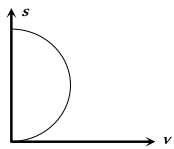
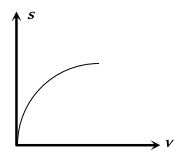
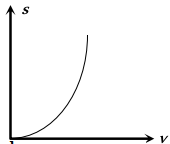
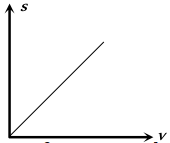
An object is moving with a uniform acceleration which is parallel to its instantaneous direction of motion. The displacement $(s)$ - velocity $(v)$ graph of this object is
Answer(c) $v^2=u^2+2 a S$, If $u=0$ then $v^2 \propto S$i.e. graph should beparabolasymmetric to displacement axis.
View full question & answer→MCQ 51 Mark
The displacement of a particle starting from rest (at $t=0$ ) is given by $s=6 t^2-t^3$. The time in seconds at which the particle will attain zero velocity again, is
Answer(b) $v=\frac{d s}{d t}=12 t-3 t^2$Velocity is zero for $t=0$ and $t=4 \mathrm{sec}$
View full question & answer→MCQ 61 Mark
Acceleration of a particle changes when
- A
Direction of velocity changes
- B
Magnitude of velocity changes
- ✓
- D
Answer(c) Because acceleration is a vector quantity
View full question & answer→MCQ 71 Mark
Time taken by an object falling from rest to cover the height of $h_1$ and $h_2$ is respectively $t_1$ and $t_2$ then the ratio of $t_1$ to $t_2$ is
- A
$h_1: h_2$
- ✓
$\sqrt{h_1}: \sqrt{h_2}$
- C
$h_1: 2 h_2$
- D
$2 h: h$
AnswerCorrect option: B. $\sqrt{h_1}: \sqrt{h_2}$
(b) $t=\sqrt{\frac{2 h}{g}} \Rightarrow \frac{t_1}{t_2}=\sqrt{\frac{h_1}{h_2}}$
View full question & answer→MCQ 81 Mark
An express train is moving with a velocity $v$. Its driver finds another train is moving on the same track in the same direction with velocity $v$. To escape collision, driver applies a retardation $a$ on the train. the minimum time of escaping collision will be
AnswerCorrect option: A. $t=\frac{v_1-v_2}{a}$
As the trains are moving in the same direction. So the initial relative speed $(\left(v_1-v_2)\right)$ and by applying retardation final relative speed becomes zero.
From $v=u-a t \Rightarrow 0=\left(v_1-v_2\right)-a t \Rightarrow t=\frac{v_1-v_2}{a}$
View full question & answer→MCQ 91 Mark
Starting from rest, acceleration of a particle is $a=2(t-1)$. The velocity of the particle at $t=5 s$ is
- ✓
$15 m / sec$
- B
$25 m / sec$
- C
$5 m / sec$
- D
AnswerCorrect option: A. $15 m / sec$
(a)$\because a=\frac{d v}{d t}=2(t-1)$
$ \Rightarrow d v=2(t-1) d t $
$\Rightarrow v=\int_0^52(t-1)dt$
$=2\left[\frac{t^2}{2t}\right]_0^5$
$=2\left[\frac{25}{2}-5\right]=15 \mathrm{~m} / \mathrm{s}$
View full question & answer→MCQ 101 Mark
A body is thrown vertically upwards. If air resistance is to be taken into account, then the time during which the body rises is
- A
Equal to the time of fall
- ✓
Less than the time of fall
- C
Greater than the time of fall
- D
AnswerCorrect option: B. Less than the time of fall
(b) Let the initial velocity of ball be $u$Time of rise $t_1=\frac{u}{g+a}$ and height reached $=\frac{u^2}{2(g+a)}$
Time of fall $t_2$ is given by
$\frac{1}{2}(g-a) {t_2}^2=\frac{u^2}{2(g+a)} $
$\Rightarrow t_2=\frac{u}{\sqrt{(g+a)(g-a)}}$
$=\frac{u}{(g+a)} \sqrt{\frac{g+a}{g-a}} $
$\therefore t_2>t_1 \text { because } \frac{1}{g+a}<\frac{1}{g-a}$
View full question & answer→MCQ 111 Mark
An object start sliding on a frictionless inclined plane and from same height another object start falling freely
- ✓
Both will reach with same speed
- B
Both will reach with same acceleration
- C
Both will reach in same time
- D
AnswerCorrect option: A. Both will reach with same speed
View full question & answer→MCQ 121 Mark
The distance travelled by a particle is proportional to the squares of time, then the particle travels with
Answer(a) $s \propto t^2$ (given) $\therefore s=K t^2$Acceleration $a=\frac{d^2 s}{d t^2}=2 k$ (constant)It means the particle travels with uniform acceleration.
View full question & answer→MCQ 131 Mark
A person travels along a straight road for the first half time with a velocity $v_1$ and the next half time with a velocity $v_2$. The mean velocity $V$ of the man is
AnswerCorrect option: B. $V=\frac{v_1+v_2}{2}$
View full question & answer→MCQ 141 Mark
The distance between two particles is decreasing at the rate of 6 $m / sec$. If these particles travel with same speeds and in the same direction, then the separation increase at the rate of $4 m / sec$. The particles have speeds as
- ✓
$5 m / sec ; 1 m / sec$
- B
$4 m / sec ; 1 m / sec$
- C
$4 m / sec ; 2 m / sec$
- D
$5 m / sec ; 2 m / sec$
AnswerCorrect option: A. $5 m / sec ; 1 m / sec$
(a) When two particles moves towards each other then
$v_1+v_2=6$
When these particlesmoves in the same direction then
$v_1-v_2=4$
By solving $v_1=5$ and $v_2=1 \mathrm{~m} / \mathrm{s}$
View full question & answer→MCQ 151 Mark
Two cars $A$ and $B$ at rest at same point initially. If $A$ starts with uniform velocity of $40 m / sec$ and $B$ starts in the same direction with constant acceleration of $4 m / s ^2$, then $B$ will catch $A$ after how much time
- A
$10 sec$
- ✓
$20 sec$
- C
$30 sec$
- D
$35 sec$
AnswerCorrect option: B. $20 sec$
(b) Let $A$ and $B$ will meet after time $t$ sec. it means the distance travelledbyboth will be equal.
$ S_A=u t=40 t \text { and } S_B=\frac{1}{2}at^2=\frac{1}{2}\times 4 \times t^2 $
$S_A=S_B$
$\Rightarrow 40t=\frac{1}{2}4t^2\Rightarrow t=20\mathrm{sec}$
View full question & answer→MCQ 161 Mark
A boggy of uniformly moving train is suddenly detached from train and stops after covering some distance. The distance covered by the boggy and distance covered by the train in the same time has relation
AnswerCorrect option: B. First will be half of second
View full question & answer→MCQ 171 Mark
A car moves for half of its time at $80 km / h$ and for rest half of time at $40 km / h$. Total distance covered is $60 km$. What is the average speed of the car
- ✓
$60 km / h$
- B
$80 km / h$
- C
$120 km / h$
- D
$180 km / h$
AnswerCorrect option: A. $60 km / h$
(a) Time average speed $=\frac{v_1+v_2}{2}=\frac{80+40}{2}=60 \mathrm{~km} / \mathrm{hr}$.
View full question & answer→MCQ 181 Mark
The engine of a car produces acceleration $4 m / s ^2$ in the car. If this car pulls another car of same mass, what will be the acceleration produced
- A
$8 m / s^2$
- ✓
$2 m / s ^2$
- C
$4 m / s^2$
- D
$\frac{1}{2} m / s^2$
AnswerCorrect option: B. $2 m / s ^2$
(b) $F=m \times a$, If force is constant then $a \propto \frac{1}{m}$. So If mass is doubled then acceleration becomes half.
View full question & answer→MCQ 191 Mark
If a freely falling body travels in the last second a distance equal to the distance travelled by it in the first three second, the time of the travel is
- A
$6 sec$
- ✓
$5 sec$
- C
$4 \sec$
- D
$3 sec$
AnswerCorrect option: B. $5 sec$
View full question & answer→MCQ 201 Mark
The effective acceleration of a body, when thrown upwards with acceleration $a$ will be :
- A
$\sqrt{a-g^2}$
- B
$\sqrt{a^2+g^2}$
- ✓
$(a-g)$
- D
$(a+g)$
AnswerCorrect option: C. $(a-g)$
(c) Net acceleration of a body when thrown upward
$=\text { acceleration of body }- \text { acceleration due to gravity } $
$=a-g$
View full question & answer→MCQ 211 Mark
A body is thrown vertically up from the ground. It reaches a maximum height of $100 m$ in $5 sec$. After what time it will reach the ground from the maximum height position
- A
$1.2 sec$
- ✓
$5 sec$
- C
$10 sec$
- D
$25 sec$
AnswerCorrect option: B. $5 sec$
(b) Time of ascent $=$ Time of descent $=5 \mathrm{sec}$
View full question & answer→MCQ 221 Mark
A body is moving with uniform acceleration describes $40 m$ in the first $5 sec$ and $65 m$ in next $5 sec$. lts initial velocity will be
- A
$4 m / s$
- B
$2.5 m / s$
- ✓
$5.5 m / s$
- D
$11 m / s$
AnswerCorrect option: C. $5.5 m / s$
View full question & answer→MCQ 231 Mark
A boat is moving with velocity of $3 \hat{i}+4 \hat{j}$ in river and water is moving with a velocity of $-3 \hat{i}-4 \hat{j}$ with respect to ground. Relative velocity of boat with respect to water is :
- A
$-6 \hat{i}-8 \hat{j}$
- ✓
$6 \hat{i}+8 \hat{j}$
- C
$8 \hat{i}$
- D
$6 \hat{i}$
AnswerCorrect option: B. $6 \hat{i}+8 \hat{j}$
(b) The relative velocity of boat w.r.t. water$=v_{\text {boat }}-v_{\text {พаater }}=(3 \hat{i}+4 \hat{j})-(-3 \hat{i}-4 \hat{j})=6 \hat{i}+8 \hat{j}$
View full question & answer→MCQ 241 Mark
The displacement of a particle is proportional to the cube of time elapsed. How does the acceleration of the particle depends on time obtained
- A
$a \propto t^2$
- B
$a \propto 2 t$
- C
$a \propto t^3$
- ✓
$a \propto t$
AnswerCorrect option: D. $a \propto t$
(d)$x \propto t^3 \quad \therefore x=K t^3 $
$\Rightarrow v=\frac{d x}{d t}=3 K t^2 \text { and } a=\frac{d v}{d t}=6 K t$
i.e. $a \propto t$
View full question & answer→MCQ 251 Mark
For a body moving with relativistic speed, if the velocity is doubled, then
- A
Its linear momentum is doubled
- B
lts linear momentum will be less than double
- ✓
Its linear momentum will be more than double
- D
Its linear momentum remains unchanged
AnswerCorrect option: C. Its linear momentum will be more than double
(c) Relativistic momentum $=\frac{m_0 v}{\sqrt{1-v^2 / c^2}}$If velocity is doubled then the relativistic mass also increases.Thus value of linear momentum will be more than double.
View full question & answer→MCQ 261 Mark
Three particles $A, B$ and $C$ are thrown from the top of a tower with the same speed. $A$ is thrown up, $B$ is thrown down and $C$ is horizontally. They hit the ground with speeds $V_A, V_B$ and $V_C$ respectively.
- ✓
$V_A=V_B=V_C$
- B
$V_A=V_B>V_C$
- C
$V_B>V_C>V_A$
- D
$V_A>V_B=V_C$
AnswerCorrect option: A. $V_A=V_B=V_C$
View full question & answer→MCQ 271 Mark
A ball is dropped from top of a tower of $100 m$ height. Simultaneously another ball was thrown upward from bottom of the tower with a speed of $50 m / s \left(g=10 m / s ^2\right)$. They will cross each other after
- A
$1 s$
- ✓
$2 s$
- C
$3 s$
- D
$4 s$
View full question & answer→MCQ 281 Mark
For a moving body at any instant of time
- A
If the body is not moving, the acceleration is necessarily zero
- B
If the body is slowing, the retardation is negative
- C
If the body is slowing, the distance is negative
- ✓
If displacement, velocity and acceleration at that instant are known, we can find the displacement at any given time in future
AnswerCorrect option: D. If displacement, velocity and acceleration at that instant are known, we can find the displacement at any given time in future
View full question & answer→MCQ 291 Mark
An athlete completes one round of a circular track of radius $R$ in 40 $sec$. What will be his displacement at the end of $2 min .20 sec$
- A
- ✓
$2 R$
- C
$2 \pi R$
- D
$7 \pi R$
Answer(b) Total time of motion is $2 \mathrm{~min} 20 \mathrm{sec}=140 \mathrm{sec}$.As time period of circular motion is $40 \mathrm{sec}$ so in $140 \mathrm{sec}$. athlete will complete 3.5 revolution i.e., $\mathrm{He}$ will be at diametrically opposite point i.e., Displacement $=2 R$.
View full question & answer→MCQ 301 Mark
The relation between time and distance is $t=\alpha x^2+\beta x$, where $\alpha$ and $\beta$ are constants. The retardation is
- ✓
$2 \alpha v^3$
- B
$2 \beta v^3$
- C
$2 \alpha \beta v^3$
- D
$2 \beta^2 v^3$
AnswerCorrect option: A. $2 \alpha v^3$
View full question & answer→MCQ 311 Mark
An electron starting from rest has a velocity that increases linearly with the time that is $v=k t$, where $k=2 m / sec ^2$. The distance travelled in the first 3 seconds will be
- ✓
$9 m$
- B
$16 m$
- C
$27 m$
- D
$36 m$
Answer(a) $S=\int_0^3 v d t=\int_0^3 k t d t=\left[\frac{1}{2} k t^2\right]_0^3=\frac{1}{2} \times 2 \times 9=9 m$
View full question & answer→MCQ 321 Mark
A body is released from the top of a tower of height $h$. It takes $t$ $sec$ to reach the ground. Where will be the ball after time $t / 2 sec$
- A
At $h / 2$ from the ground
- B
At $h / 4$ from the ground
- C
Depends upon mass and volume of the body
- ✓
At $3 h / 4$ from the ground
AnswerCorrect option: D. At $3 h / 4$ from the ground
View full question & answer→MCQ 331 Mark
An object is projected upwards with a velocity of $100 m / s$. It will strike the ground after (approximately)
- A
$10 sec$
- ✓
$20 sec$
- C
$15 sec$
- D
$5 sec$
AnswerCorrect option: B. $20 sec$
(b) Time of flight $=\frac{2 u}{g}=\frac{2 \times 100}{10}=20 \mathrm{sec}$
View full question & answer→MCQ 341 Mark
The displacement $x$ of a particle along a straight line at time $t$ is given by $x=a_0+a_1 t+a_2 t^2$. The acceleration of the particle is
- A
$a_0$
- B
$a_1$
- ✓
$2 a_2$
- D
$a_2$
AnswerCorrect option: C. $2 a_2$
(c) Acceleration $=\frac{d^2 x}{d t^2}=2 a_2$
View full question & answer→MCQ 351 Mark
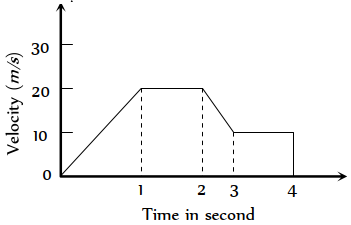
The variation of velocity of a particle with time moving along a straight line is illustrated in the following figure. The distance travelled by the particle in four seconds is
- A
$60 m$
- ✓
$55 m$
- C
$25 m$
- D
$30 m$
AnswerCorrect option: B. $55 m$
View full question & answer→MCQ 361 Mark
Two bodies of different masses $m_a$ and $m_b$ are dropped from two different heights $a$ and $b$. The ratio of the time taken by the two to cover these distances are
- A
$a: b$
- B
$b: a$
- ✓
$\sqrt{a}: \sqrt{b}$
- D
$a^2: b^2$
AnswerCorrect option: C. $\sqrt{a}: \sqrt{b}$
(c)$h=\frac{1}{2} g t^2 \Rightarrow t=\sqrt{2 h / g} $
$t_a=\sqrt{\frac{2 a}{g}} \text { and } t_b=\sqrt{\frac{2 b}{g}} \Rightarrow \frac{t_a}{t_b}=\sqrt{\frac{a}{b}}$
View full question & answer→MCQ 371 Mark
A particle experiences a constant acceleration for $20 sec$ after starting from rest. If it travels a distance $S_1$ in the first $10 sec$ and a distance $S_2$ in the next $10 sec$, then
- A
$S_1=S_2$
- ✓
$S_1=S_2 / 3$
- C
$S_1=S_2 / 2$
- D
$S_1=S_2 / 4$
AnswerCorrect option: B. $S_1=S_2 / 3$
(b) As $S=u t+\frac{1}{2} a t^2 \therefore S_1=\frac{1}{2} a(10)^2=50 a$As $v=u+$ at $\therefore$ velocity acquired by particle in $10 \mathrm{sec}$ $v=a \times 10$For next $10 \mathrm{sec}, \quad S_2=(10 a) \times 10+\frac{1}{2}(a) \times(10)^2$$S_2=150 a$From (i) and (ii) $S_1=S_2 / 3$
View full question & answer→MCQ 381 Mark
The $v-t$ graph of a moving object is given in figure. The maximum acceleration is 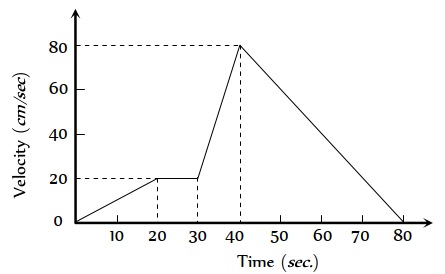
- A
$1 cm / sec c^2$
- B
$2 cm / sec ^2$
- C
$3 cm / sec ^2$
- ✓
$6 cm / sec ^2$
AnswerCorrect option: D. $6 cm / sec ^2$
(d) Maximum acceleration means maximum change in velocity in minimum time interval.In time interval $t=30$ to $t=40 \mathrm{sec}$$a=\frac{\Delta v}{\Delta t}=\frac{80-20}{40-30}=\frac{60}{10}=6 \mathrm{~cm} / \mathrm{sec}^2$
View full question & answer→MCQ 391 Mark
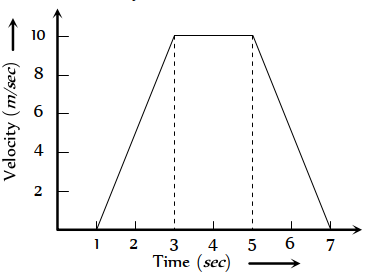
For the velocity-time graph shown in figure below the distance covered by the body in last two seconds of its motion is what fraction of the total distance covered by it in all the seven seconds
- A
$\frac{1}{2}$
- ✓
$\frac{1}{4}$
- C
$\frac{1}{3}$
- D
$\frac{2}{3}$
AnswerCorrect option: B. $\frac{1}{4}$
(b) $\frac{(S)_{(\text {last } 2 s)}}{(S)_{7 s}}=\frac{\frac{1}{2} \times 2\times10{\frac{1}{2} \times 2 \times 10+2 \times 10+\frac{1}{2} \times 2 \times 10}=\frac{1}{4}$
View full question & answer→MCQ 401 Mark
A car starts from rest and moves with uniform acceleration $a$ on a straight road from time $t=0$ to $t=T$. After that, a constant deceleration brings it to rest. In this process the average speed of the car is
- A
$\frac{a T}{4}$
- B
$\frac{3 a T}{2}$
- ✓
$\frac{a T}{2}$
- D
$a T$
AnswerCorrect option: C. $\frac{a T}{2}$
View full question & answer→MCQ 411 Mark
If a car covers $2 / 5^{\circ}$ of the total distance with $v$ speed and $3 / 5^{\circ}$ distance with $v$ then average speed is
- A
$\frac{1}{2} \sqrt{v_1 v_2}$
- B
$\frac{v_1+v_2}{2}$
- C
$\frac{2 v_1 v_2}{v_1+v_2}$
- ✓
$\frac{5 v_1 v_2}{3 v_1+2 v_2}$
AnswerCorrect option: D. $\frac{5 v_1 v_2}{3 v_1+2 v_2}$
(d)$\text { Average speed }=\frac{\text { Total distance travelled }}{\text { Total time taken }} $
$=\frac{x}{\frac{2 x / 5}{v_1}+\frac{3 x / 5}{v_2}}=\frac{5 v_1 v_2}{3 v_1+2 v_2}$
View full question & answer→MCQ 421 Mark
If a body is thrown up with the velocity of $15 m / s$ then maximum height attained by the body is $(g=10 m / s )$
- ✓
$11.25 m$
- B
$16.2 m$
- C
$24.5 m$
- D
$7.62 m$
AnswerCorrect option: A. $11.25 m$
(a) $h_{\max }=\frac{u^2}{2 g}=\frac{(15)^2}{2 \times 10}=11.25 \mathrm{~m}$.
View full question & answer→MCQ 431 Mark
A body falling from a high Minaret travels 40 meters in the last 2 seconds of its fall to ground. Height of Minaret in meters is (take $g=10 m / s^2$ )
Answer(b) Let height of minaret is $H$ and body take time $T$ to fall from top to bottom.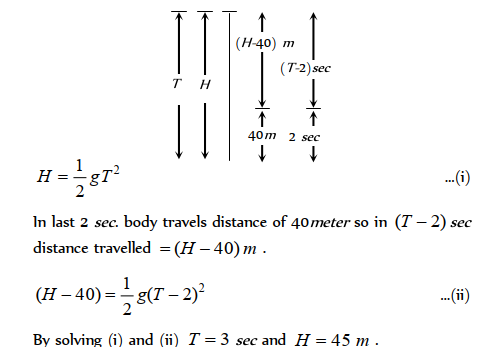
View full question & answer→MCQ 441 Mark
A person travels along a straight road for half the distance with velocity $v_1$ and the remaining half distance with velocity $v_2$ The average velocity is given by
AnswerCorrect option: D. $\frac{2 v_1 v_2}{v_1+v_2}$
(d) As the total distance is divided into two equal parts therefore distance averaged speed (=\frac{2 v_1 v_2}{v_1+v_2}$
View full question & answer→MCQ 451 Mark
A body of $5 kg$ is moving with a velocity of $20 m / s$. If a force of $100 N$ is applied on it for $10 s$ in the same direction as its velocity, what will now be the velocity of the body
- A
$200 m / s$
- ✓
$220 m / s$
- C
$240 m / s$
- D
$260 m / s$
AnswerCorrect option: B. $220 m / s$
(b) $\quad v=u+a t=u+\left(\frac{F}{m}\right) t=20+\left(\frac{100}{5}\right) \times 10=220 \mathrm{~m} / \mathrm{s}$
View full question & answer→MCQ 461 Mark
One car moving on a straight road covers one third of the distance with $20 km / hr$ and the rest with $60 km / hr$. The average speed is
- A
$40 km / hr$
- B
$80 km / hr$
- C
$46 \frac{2}{3} km / hr$
- ✓
$36 km / hr$
AnswerCorrect option: D. $36 km / hr$
(d)$\text { Average speed }=\frac{\text { Total distance }}{\text { Total time }}=\frac{x}{t_1+t_2} $
$=\frac{x}{\frac{x / 3}{v_1}+\frac{2 x / 3}{v_2}}=\frac{1}{\frac{1}{3 \times 20}+\frac{2}{3 \times 60}}=36 \mathrm{~km} / \mathrm{hr}$
View full question & answer→MCQ 471 Mark
A body starts from rest from the origin with an acceleration of $6 m / s ^2$ along the $x$-axis and $8 m / s ^2$ along the $y$-axis. Its distance from the origin after 4 seconds will be
- A
$56 m$
- B
$64 m$
- ✓
$80 m$
- D
$128 m$
AnswerCorrect option: C. $80 m$
(c)
$S_x=u_x t+\frac{1}{2} a_x t^2 \Rightarrow S_x=\frac{1}{2} \times 6 \times 16=48 \mathrm{~m} $
$S_y=u_y t+\frac{1}{2} a_y t^2 \Rightarrow S_y=\frac{1}{2}\times 8 \times 16=64 \mathrm{~m} $
$S=\sqrt{S_x^2+S_y^2}=80 \mathrm{~m}$
View full question & answer→MCQ 481 Mark
If body having initial velocity zero is moving with uniform acceleration $8 m / sec ^2$ the distance travelled by it in fifth second will be
Answer(a) Distance travelled in $n^{\text {th }}$ second $=u+\frac{a}{2}(2 n-1)$Distance travelled in $5^{\text {th }}$ second $=0+\frac{8}{2}(2 \times 5-1)=36 \mathrm{~m}$
View full question & answer→MCQ 491 Mark
A car moving with a speed of $40 km / h$ can be stopped by applying brakes after atleast $2 m$. If the same car is moving with a speed of $80 km / h$, what is the minimum stopping distance
- ✓
$8 m$
- B
$2 m$
- C
$4 m$
- D
$6 m$
Answer(a) $S \propto u^2 \therefore \frac{S_1}{S_2}=\left(\frac{u_1}{u_2}\right)^2 \Rightarrow \frac{2}{S_2}=\frac{1}{4} \Rightarrow S_2=8 \mathrm{~m}$
View full question & answer→MCQ 501 Mark
A mass $m$ slips along the wall of a semispherical surface of radius $R$. The velocity at the bottom of the surface is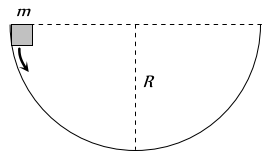
- A
$\sqrt{R g}$
- ✓
$\sqrt{2 R g}$
- C
$2 \sqrt{\pi R g}$
- D
$\sqrt{\pi R g}$
AnswerCorrect option: B. $\sqrt{2 R g}$
(b) By applying law of conservation of energy$m g R=\frac{1}{2} m v^2\Rightarrowv=\sqrt{2 R g}$
View full question & answer→