A ball of mass $1\, g$ and charge ${10^{ - 8}}\,C$ moves from a point $A$. where potential is $600\, volt$ to the point $B$ where potential is zero. Velocity of the ball at the point $B$ is $20\, cm/s$. The velocity of the ball at the point $A$ will be
Medium
Download our app for free and get started
(a) By using $\frac{1}{2}m(v_1^2 - v_2^2) = QV$
$==>$ $\frac{1}{2} \times {10^{ - 3}}\{ v_1^2 - {(0.2)^2}\} = {10^{ - 8}}(600 - 0)$
$==>$ ${v_1} = 22.8\,cm/s$
$==>$ $\frac{1}{2} \times {10^{ - 3}}\{ v_1^2 - {(0.2)^2}\} = {10^{ - 8}}(600 - 0)$
$==>$ ${v_1} = 22.8\,cm/s$

Download our appand get started for free
Experience the future of education. Simply download our apps or reach out to us for more information. Let's shape the future of learning together!No signup needed.*
Similar Questions
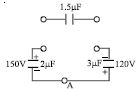
- 1Two capacitors of $2$ $\mu F$ and $3$ $\mu F$ are charged to $150$ $volt$ and $120$ $volt$ respectively. The plates of capacitor are connected as shown in the figure. A discharged capacitor of capacity $1.5$ $\mu F$ falls to the free ends of the wire. ThenView Solution
- 2A parallel plate capacitor has plates with area $A$ and separation $d$ . A battery charges the plates to a potential difference $V_0$ . The battery is then disconnected and a dielectric slab of thickness $d$ is introduced. The ratio of energy stored in the capacitor before and after the slab is introduced, isView Solution
- 3At distance of $5$ $cm$ and $10$ $cm $ outwards from the surface of a uniformly charged solid sphere, the potentials are $100$ $V$ and $75$ $V$ respectively . ThenView Solution
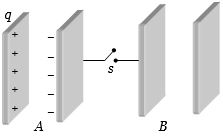
- 4Consider the situation shown in the figure. The capacitor $A$ has a charge $q$ on it whereas $B$ is uncharged. The charge appearing on the capacitor $B$ a long time after the switch is closed isView Solution
- 5When a positive $q$ charge is taken from lower potential to a higher potential point, then its potential energy willView Solution
- 6Assertion : If three capacitors of capacitances $C_1 < C_2 < C_3$ are connected in parallel then their equivalent capacitance $C_P > C_S$.View Solution
Reason : $\frac{1}{{{C_p}}} = \frac{1}{{{C_1}}} + \frac{1}{{{C_2}}} + \frac{1}{{{C_3}}}$
- 7The radius of a soap bubble whose potential is $16\,V$ is doubled. The new potential of the bubble will be.....$V$View Solution
- 8Force of interaction between two co-axial short electric dipoles whose centres are $R$ distance apart varies asView Solution
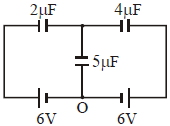
- 9In the circuit shown, charge on the $5\, \mu F$ capacitor is$........\mu C$View Solution
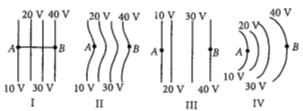
- 10The diagrams below show regions of equipotentials.A positive charge is moved from $A$ to $B$ in each diagram.View Solution