MCQ
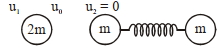
A ball of mass $2 \,m$ and a system of two balls with equal masses $m$ connected by a massless spring, are placed on a smooth horizontal surface (see figure below). Initially, the ball of mass $2 \,m$ moves along the line passing through the centres of all the balls and the spring, whereas the system of two balls is at rest. Assuming that the collision between the individual balls is perfectly elastic, the ratio of vibrational energy stored in the system of two connected balls to the initial kinetic energy of the ball of mass $2 \,m$ is

- A$1$
- ✓$\frac{4}{9}$
- C$\frac{1}{2}$
- D$\frac{2}{3}$