A ball rises to surface at a constant velocity in a liquid whose density is $4$ times greater than that of the material of the ball. The ratio of the force of friction acting on the rising ball and its weight is
Medium
Download our app for free and get started
$\mathrm{F}_{\mathrm{B}}=\mathrm{F}_{\mathrm{v}}+\mathrm{F}_{\mathrm{G}}$
$\mathrm{F}_{\mathrm{v}}=3 \rho \mathrm{vg}$
$\frac{\mathrm{F}_{\mathrm{v}}}{\mathrm{F}_{\mathrm{G}}}=\frac{3 \mathrm{pvg}}{\rho \mathrm{vg}}$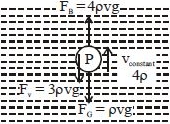

Download our appand get started for free
Experience the future of education. Simply download our apps or reach out to us for more information. Let's shape the future of learning together!No signup needed.*
Similar Questions
- 1A water drop of radius $1\,\mu m$ falls in a situation where the effect of buoyant force is negligible. Coefficient of viscosity of air is $1.8 \times 10^{-5}\,Nsm ^{-2}$ and its density is negligible as compared to that of water $10^{6}\,gm ^{-3}$. Terminal velocity of the water drop is________ $\times 10^{-6}\,ms ^{-1}$View Solution
(Take acceleration due to gravity $=10\,ms ^{-2}$ )
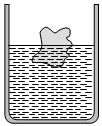
- 2View SolutionA body floats in a liquid contained in a beaker. If the whole system as shown in figure falls freely under gravity, then the upthrust on the body due to liquid is
- 3A plane is in level flight at constant speed and each of its two wings has an area of $40 \mathrm{~m}^2$. If the speed of the air is $180 \mathrm{~km} / \mathrm{h}$ over the lower wing surface and $252 \mathrm{~km} / \mathrm{h}$ over the upper wing surface, the mass of the plane is______ $\mathrm{kg}$. (Take air density to be $1 \mathrm{~kg} \mathrm{~m}^{-3}$ and $\mathrm{g}=10 \mathrm{~ms}^{-2}$ )View Solution
- 4The density of the atmosphere at sea level is $1.29 \;kg / m ^{3} .$ Assume that it does not change with altitude. Then how high (in $km$) would the atmosphere extend?View Solution
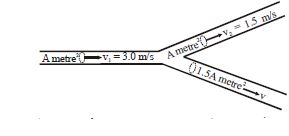
- 5An incompressible liquid flows through a horizontal tube as shown in the figure. Then, the velocity $v$ of the fluid is ......... $m/s$View Solution
- 6View SolutionThe pans of a physical balance are in equilibrium. Air is blown under the right hand pan; then the right hand pan will
- 7A pressure-pump has a horizontal tube of cross-sectional area $10\,cm ^{2}$ for the outflow of water at a speed of $20\,m / s$. The force exerted on the vertical wall just in front of the tube which stops water horizontally flowing out of the tube, is $...N$ [given : density of water $=1000\,kg / m ^{3}$ ]View Solution
- 8The reading of spring balance when a block is suspended from it in air, is $60\,N$. This reading is changed to $40\, N$ when the block is immersed in water. The specific density of the block isView Solution
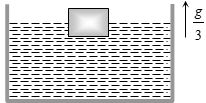
- 9A cubical block is floating in a liquid with half of its volume immersed in the liquid. When the whole system accelerates upwards with acceleration of $g/3,$ the fraction of volume immersed in the liquid will beView Solution
- 10View SolutionIf there were no gravity. which of the following will not be there for a fluid?