MCQ
A balloon of total mass $‘M’$ and a fixed size starts coming down with an acceleration $f(f < g)$ . The fraction of the total mass of the balloon which must be dropped from it so that it starts going up with an acceleration of $‘f’$ (assuming negligible air resistance) is
  • A
    $\frac{f}{{g + f}}$
  • $\frac{{2f}}{{\left( {g + f} \right)}}$
  • C
    $\frac{{g + f}}{f}$
  • D
    $\frac{{2f}}{{g + 2f}}$

Answer

Correct option: B.
$\frac{{2f}}{{\left( {g + f} \right)}}$
b
$\mathrm{Mg}-\mathrm{B}=\mathrm{Mf}$

$\mathrm{B}-(\mathrm{M}-\mathrm{CM}) \mathrm{g}=(\mathrm{M}-\mathrm{CM}) \mathrm{f}$

$\mathrm{CMg}=(2 \mathrm{M}-\mathrm{CM}) \mathrm{f}$

$\mathrm{Cg}+\mathrm{Cf}=2 \mathrm{f}$

$\mathrm{C}=\frac{2 \mathrm{f}}{\mathrm{g}+\mathrm{f}}$

Need a full question paper?

Generate a complete, print-ready paper with questions like this in minutes — across 16+ boards, with answer keys.

Start Generating Free

Similar questions

According to the kinetic theory of gases the $r.m.s.$ velocity of gas molecules is directly proportional to
Universal time is based on
A ball of mass $400\, gm$ is dropped from a height of $5\,m.$ A boy on the ground hits the ball vertically upwards with a bat with an average force of $100$ newton so that it attains a vertical height of $ 20 \,m$. The time for which the ball remains in contact with the bat is  ........... $\sec$. $[g = 10\,m/{s^2}]$
The velocity of a small ball of mass $\mathrm{M}$ and density $d,$ when dropped in a container filled with glycerine becomes constant after some time. If the density of glycerine is $\frac{\mathrm{d}}{2}$, then the viscous force acting on the ball will be :
When heat in given to a gas in an isobaric process, then
The potential energy of a particle executing S.H.M. is $ 2.5\, J$, when its displacement is half of amplitude. The total energy of the particle be .... $J$
$Assertion$ : Centripetal and centrifugal forces cancel each other.
$Reason$ : Centrifugal force is a reaction of centripetal force
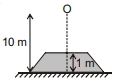
A body falling from a vertical height of $10 \,m$ pierces through a distance of $1 \,m$ in sand. It faces an average retardation in sand equal to ( $g$ = acceleration due to gravity)
The acceleration of moon with respect to earth is $0.0027 \mathrm{~ms}^{-2}$ and the acceleration of an apple falling on earth's surface is about $10 \mathrm{~ms}^{-2}$. Assume that the radius of the moon is one fourth of the earth's radius. If the moon is stopped for an instant and then released, it will fall towards the earth. The initial acceleration of the moon towards the earth will be:
 
A thin circular ring of mass $M$ and radius $r$ is rotating about its axis with an angular speed $\omega.$ Two particles having mass $m$ each are now attached at diametrically opposite points. The angular speed of the ring will become: