MCQ
When heat in given to a gas in an isobaric process, then
  • A
    The work is done by the gas
  • B
    Internal energy of the gas increases
  • Both $ (a)$ and $(b)$
  • D
    None from $(a)$ and $(b)$

Answer

Correct option: C.
Both $ (a)$ and $(b)$
c
(c)When heat is supplied at constant pressure, a part of it goes in the expansion of gas and remaining part is used to increase the temperature of the gas which in turn increases the internal energy.

Need a full question paper?

Generate a complete, print-ready paper with questions like this in minutes — across 16+ boards, with answer keys.

Start Generating Free

Similar questions

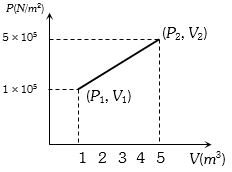
A system changes from the state $({P_1},\;{V_1})$ to $({P_2},{V_2})$ as shown in the figure. What is the work done by the system
Select the incorrect statement about Maxwell's speed distribution
Two masses of $10 \,kg$ and $20 \,kg$ respectivety are connected by a massless spring as shown in fig. A force of $200 \,N$ acts on the $20 \,kg$ mass At the instant shown the $10 \,kg$ mass has acceleration $12 \,m / s ^2$ towards right. The acceleration of $20 \,kg$ mass at this instant is ........ $m / s ^2$
A vibrating string of certain length $l$ under a tension $T$ reasonates with a mode corresponding to the first overtone (third harmonic) of an air column of length $75$ $cm$ inside a tube closed at one end. The string also generates $4$ beats per second when excited along with a tuning fork of frequency $n$. Now when the tension of the string is slightly increased the number of beats reduces to $2$ per second. Assuming the velocity of sound in air to be $340$ $m/s$, the frequency $n$ of the tuning fork in $Hz $ is
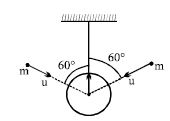
A bob of mass $10$ $M$ is suspended through an inextensible string of length $l$. When the bob is at rest at the equilibrium position, two particles of mass $m$ each moving with velocity $u$ making an angle $60^o $ with the string strike and get simultaneously attached to the bob. What is the value of impulsive tension $(l)$ in the string during the impact ?
The linear momentum $p$ of a body moving in one dimension varies with time according to the equation $p = a + b{t^2}$ where a and b are positive constants. The net force acting on the body is
$Assertion :$ Two waves moving in a uniform string having uniform tension cannot have different velocities.
$Reason :$ Elastic and inertial properties of string are same for all waves in same string. Moreover speed of wave in a string depends on its elastic and inertial properties only.
A ship of mass $3 \times {10^7}\,kg$ initially at rest is pulled by a force of $5 \times {10^4}\,N$ through a distance of $3 \,m$. Assume that the resistance due to water is negligible, the speed of the ship is ........... $m/s$
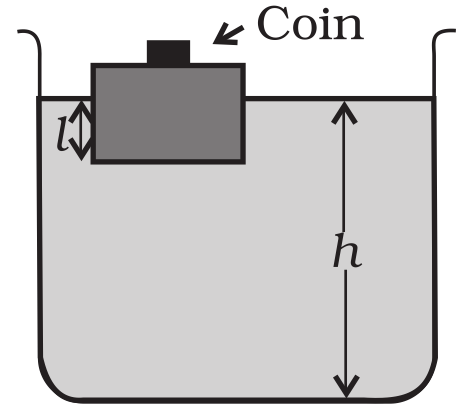
A wooden block with a coin placed on its top, floats in water as shown in the distance $l$ and $h$ are shown in the figure. After some time the coin falls into the water. Then:
  1. l decreases.
  2. h decreases.
  3. l increases.
  4. h increase.
A metal rod $\mathrm{AB}$ of length $10 x$ has its one end $\mathrm{A}$ in ice at $0^{\circ} \mathrm{C}$ and the other end $\mathrm{B}$ in water at $100^{\circ} \mathrm{C}$. If a point $\mathrm{P}$ on the rod is maintained at $400^{\circ} \mathrm{C}$, then it is found that equal amounts of water and ice evaporate and melt per unit time. The latent heat of evaporation of water is $540 \ \mathrm{cal} / \mathrm{g}$ and latent heat of melting of ice is $80 \ \mathrm{cal} / \mathrm{g}$. If the point $\mathrm{P}$ is at a distance of $\lambda x$ from the ice end $\mathrm{A}$, find the value of $\lambda$.

[Neglect any heat loss to the surrounding.|