Question
A balloon partially filled with Helium has a volume of $30m^3$, at the earth's surface, where pressure is $76cm$ of Hg and temperature is $27°C$. What will be the increase in volume of gas if balloon rises to a height, where pressure is $7.6cm$ of Hg and temperature is $-54°C$?
Answer

$\frac{\text{P}_1\text{V}_1}{\text{T}_1}=\frac{\text{PV}}{\text{T}}$$\text{V}_1=\frac{\text{PVT}_1}{\text{TP}_1}$
$=\frac{76\times30\times(273-54)}{(273+27)\times7.6}$
$=219\text{m}^3$
Hence increase in volume
$=\text{V}_1-\text{V}$
$=219-30$
$=189\text{m}^3$

Need a full question paper?

Generate a complete, print-ready paper with questions like this in minutes — across 16+ boards, with answer keys.

Start Generating Free

Similar questions

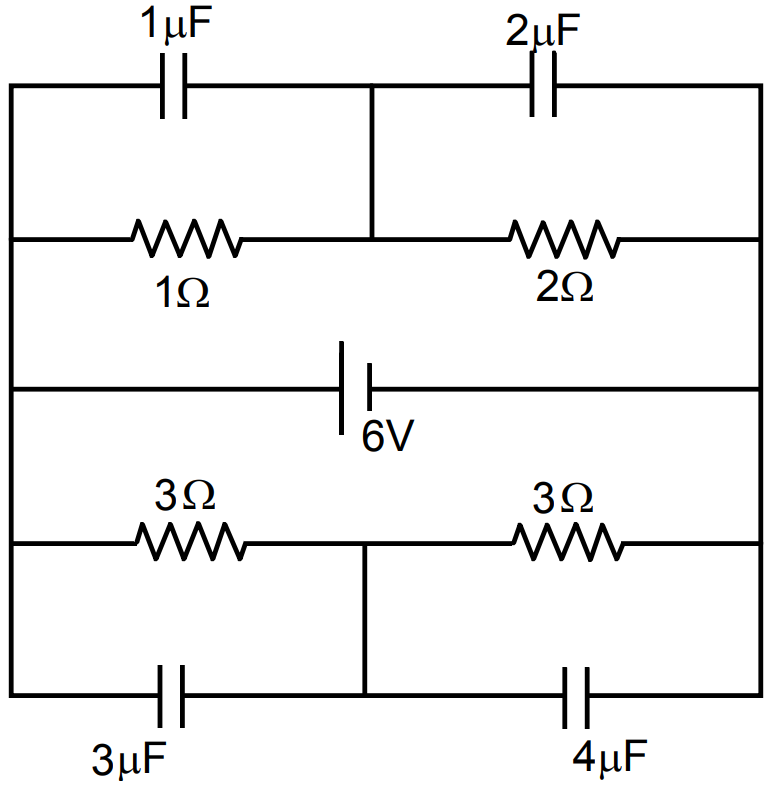
Find the charges on the four capacitors of capacitances $1\mu\text{F},2\mu\text{F},3\mu\text{F}$ and $4\mu\text{F}$ shown in the figure.
A hundred metre sprinter increases his speed from rest uniformly at the rate of $1m/s^2$ for three quarters of the length and covers the last quarter with a uniform speed. How long does he take to cover the first half and second half of the run?
Obtain equations of motion for constant acceleration using method of calculus.
A glass vessel measures exactly $10 \mathrm{~cm} \times 10 \mathrm{~cm} \times 10 \mathrm{~cm}$ at $0^{\circ} \mathrm{C}$. It is filled completely with mercury at this temperature. When the temperature is raised to $10^{\circ} \mathrm{C}, 1.6 \mathrm{~cm}^3$ of mercury overflows. Calculate the coefficient of volume expansion of mercury. Coefficient of linear expansion of glass $=6.5 \times 10^{-6}{ }^{\circ} \mathrm{C}$.
A solid sphere of mass 0.50kg is kept on a horizontal surface. The coefficient of static friction between the surfaces in contact is $\frac{2}{7}.$ What maximum force can be applied at the highest point in the horizontal direction so that the sphere does not slip on the surface?
A uniform spring whose unstretched length is l has a force constant k. The spring is cut into two pieces of unstretched lengths. $l_1$, and $l_2$ where $l_1 = nl_2$, and n is an integer. What are the corresponding force constants $k_1$ and $k_1$ in terms of n and k?
What are the methods of heat transmission? Describe them and explain their practical applications.
Two billiard balls each of mass $0.05kg$ moving in opposite directions with speed $6ms^{-1}$ collide and rebound with the same speed. What is the impulse imparted to each ball due to the other?
Using the correspondence of S.H.M. and uniform circular motion, find displacement, velocity, amplitude, time period and frequency of a particle executing S.H.M?
A thin rod having length $L_0$ at $0°C$ and coefficient of linear expansion $\alpha$ has its two ends maintained at temperatures $\theta_1$ and $\theta_2,$ respectively. Find its new length.