Question
A bar magnet M is dropped so that it falls vertically through the coil C. The graph obtained for voltage produced across the coil versus time is showing in figure (b).
  1. Explain the shape of the graph.
  2. Why is the negative peak longer than the positive peak?
Answer

  1. When the bar magnet falls through the coil, the magnetic flux linked with the coil changes, so an emf (or pd) is developed across the coil.
Initially, the rate of increase of flux increases, becomes maximum and then it decreases, becomes zero. Now, magnetic flux begins to decrease, the rate of decrease increases becomes maximum and then it decreases and when the magnet is sufficiently far on the other side, the flux becomes zero and so pd induced becomes zero.
  1. Negative peak is longer than Positive peak because magnet moves out of coil faster than it moves into the coil, so the rate of decrease of magnetic flux is faster than the rate of increase of flux.

Need a full question paper?

Generate a complete, print-ready paper with questions like this in minutes — across 16+ boards, with answer keys.

Start Generating Free

Similar questions

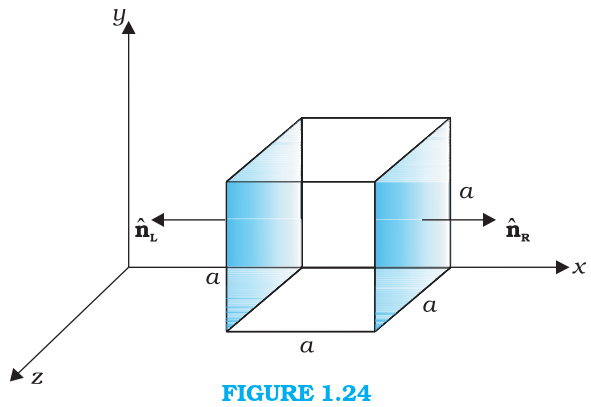
The electric field components in Fig. $1.24$ are $E_x=\alpha x^{1 / 2}, E_y=E_z=0$, in which $\alpha=800 N / C m ^{1 / 2}$. Calculate $(a)$ the flux through the cube, and$ (b)$ the charge within the cube. Assume that $a=0.1 m$.
Image
If the separation between the slits in a Young's double slit experiment is increased, what happens to the fringe-width? If the separation is increased too much, will the fringe pattern remain detectable?
A lawyer alleges in court that the police has forced his client to issue a statement of confession. What kind of force is this?
A vertical cylinder of height 100cm contains air at a constant temperature. The top is closed by a frictionless light piston. The atmospheric pressure is equal to 75cm of mercury. Mercury is slowly poured over the piston. Find the maximum height of the mercury column that can be put on the piston.
The near vision of an average person is 25cm. To view an object with an angular magnification of 10, what should be the power of the microscope?
Explain with proper diagram, the application of a $p$ - $n$ junction diode as a halfwave rectifier.
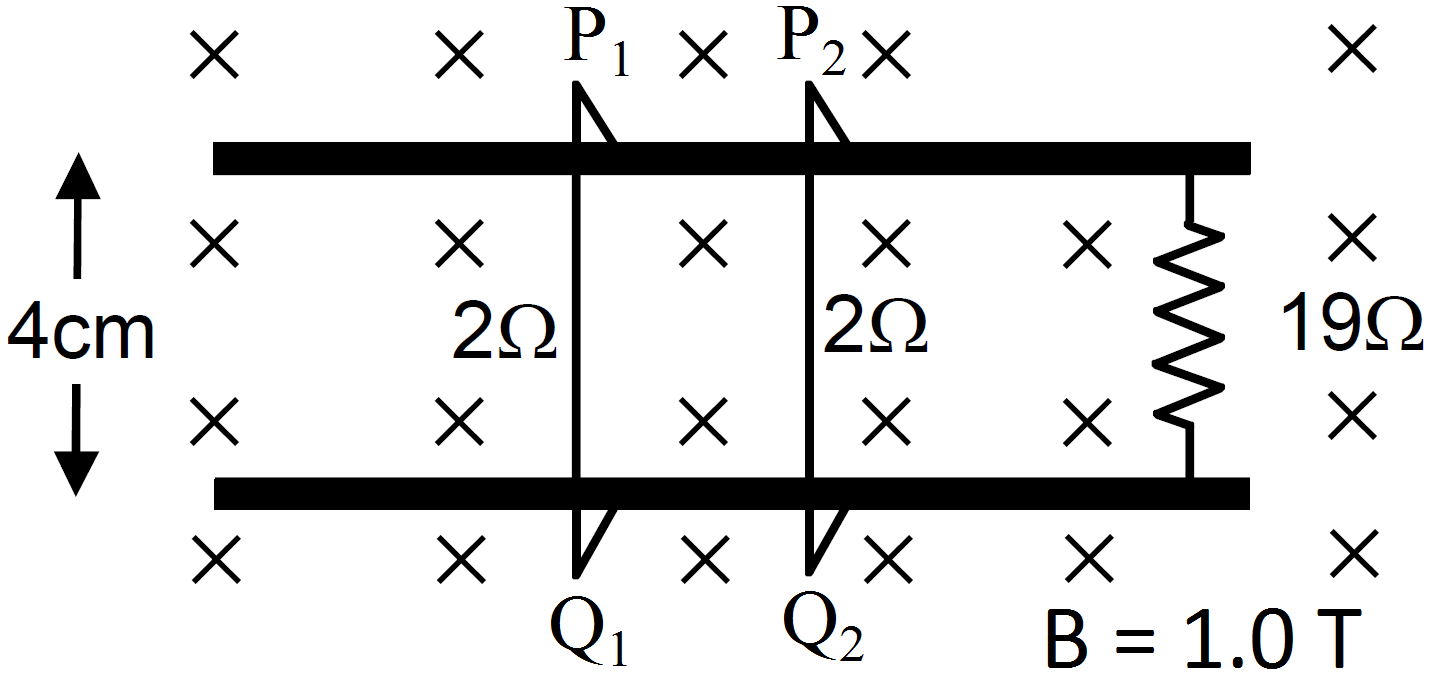
Consider the situation shown in figure. The wires $P_1Q_1$ and $P_2Q_2$ are made to slide on the rails with the same speed 5cm/s. Find the electric current in the $19\Omega$ resistor if:
  1. Both the wires move towards right.
  2. If $P_1Q_1$ moves towards left but $P_2Q_2$ moves towards right.
A particle is subjected to two simple harmonic motions of same time period in the same direction. The amplitude of the first motion is 3.0cm and that of the second is 4.0cm. Find the resultant amplitude if the phase difference between the motions is:
  1. 60°
  2. 90°
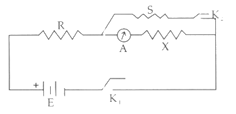
The reading of the $($ideal$)$ ammeter, in the circuit shown here, is equal too. 
Image
$i. I$ when key $K_1$ is closed but key $K_2$ is open.
$ii. \frac{I}{n}$ when both keys $K _1$ and $K _2$ are closed.
Find the expression of the resistance of X in terms of the resistances of $R$ and $S.$
In Joly's differential steam calorimeter, 3g of an ideal gas is contained in a rigid closed sphere at 20°C. The sphere is heated by steam at 100°C and it is found that an extra 0.095g of steam has condensed into water as the temperature of the gas becomes constant. Calculate the specific heat capacity of the gas in $Jg^{-1}\  K^{-1}.$ The latent heat of vaporisation of water $= 540cal-g^{-1}.$