Question
Explain with proper diagram, the application of a $p$ - $n$ junction diode as a halfwave rectifier.

Answer


Image
Image
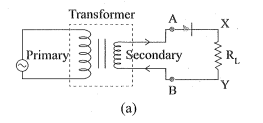
The circuit diagram for the half-wave rectifier is shown in the figure. One $p-n$ junction diode is required in the half wave rectifier circuit.
As shown in fig. (a), the primary coil of a step down transformer is connected to an A.C. source. The secondary coil of transformer is connected in series with the $p-n$ junction diode and load resistance $R_L$.
The secondary of a transformer supplies the desired ac voltage across terminals A and B. When A is positive the diode is forward biased and it conducts. So, some output voltage is obtained between two terminals of load resistance $R_L$.
When A is negative, the diode is reverse-biased and it does not conduct. The reverse saturation current of a diode is negligible and can be considered equal to zero for practical purposes.
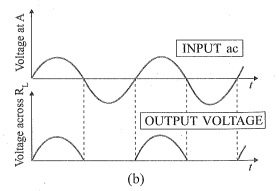
As shown in fig. (b), in the positive half cycle of ac there is a current through the load resistor $R _{ L }$ and we get an output voltage. Whereas there is no current in the negative half-cycle. In the next positive half cycle, again we get the output voltage.
Thus, the output voltage, though still varying, is restricted to only one direction and is said to be rectified. Since the rectified output of this circuit is only for half of the input ac wave so it is called the half-wave rectifier.

Need a full question paper?

Generate a complete, print-ready paper with questions like this in minutes — across 16+ boards, with answer keys.
Start Generating Free

Similar questions

Consider the situation of the previous problem. A particle having charge q and mass m is projected from the point Q in a direction going into the plane of the diagram. It is found to describe a circle of radius r between the two plates. Find the speed of the charged particle.
The spectrum of a star in the visible and the ultraviolet region was observed and the wavelength of some of the lines that could be identified were found to be:
$824\mathring{\text{A}},970\mathring{\text{A}},1120\mathring{\text{A}},2504\mathring{\text{A}},5173\mathring{\text{A}},6100\mathring{\text{A}}$
Which of these lines cannot belong to hydrogen atom spectrum? (Given Rydberg constant $\text{R}=1.03\times10^7\text{m}^{-1}$ and $\frac{1}{\text{R}}=970\mathring{\text{A}}$ Support your answer with suitable calculations.
Consider the situation of the previous problem. Suppose the production of the radioactive isotope starts at t = 0. Find the number of active nuclei at time t.
Figure shows a uniform rod of length 30cm having a mass of 3.0kg. The strings shown in the figure are pulled by constant forces of 20N and 32N. Find the force exerted by the 20cm part of the rod on the 10cm part. All the surfaces are smooth and the strings and the pulleys are light.
An object is to be seen through a simple microscope of focal length 12cm. Where should the object be placed so as to produce maximum angular magnification? The least distance for clear vision is 25cm.
A semiconducting material has a band gap of 1eV. Acceptor impurities are doped into it which create acceptor levels 1meV above the valence band. Assume that the transition from one energy level to the other is almost forbidden if kT is less than $\frac{1}{50}$ of the energy gap. Also, if kT is more than twice the gap, the upper levels have maximum population. The temperature of the semiconductor is increased from 0K. The concentration of the holes increases with temperature and after a certain temperature it becomes approximately constant. As the temperature is further increased, the hole concentration again starts increasing at a certain temperature. Find the order of the temperature range in which the hole concentration remains approximately constant.
Two isolated metal spheres A and B have radii R and 2R respectively, and same charge q. Find which of the two spheres have greater energy density just outside the surface of the spheres.
In a single slit diffraction experiment, when a tiny circular obstacle is placed in the path of light from a distant source, a bright spot is seen at the centre of the shadow of the obstacle. Explain why? State two points of difference between the interference pattern obtained in Young’s double slit experiment and the diffraction pattern due to a single slit.
In a pure semiconductor, the number of conduction electrons is $6 \times 10^{19}$ per cubic metre. How many holes are there in a sample of size 1cm × 1cm × 1mm?
Boron has two stable isotopes, $^{10}_5\text{B }\text{ and }\ ^{11}_5\text{B}.$ Their respective masses are 10.01294 u and 11.00931 u, and the atomic mass of boron is 10.811 u. Find the abundances of $^{10}_5\text{B }\text{ and }\ ^{11}_5\text{B}.$