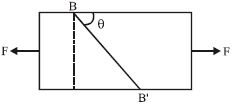
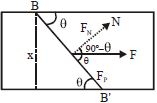
A bar of cross-sectional area $A$ is subjected two equal and opposite tensile forces at its ends as shown in figure. Consider a plane $BB'$ making an angle $\theta $ with the length The ratio of tensile stress to the shearing stress on the plane $BB'$ is
Diffcult


Download our appand get started for free
Experience the future of education. Simply download our apps or reach out to us for more information. Let's shape the future of learning together!No signup needed.*
Similar Questions
- 1A copper wire and a steel wire of the same diameter and length are connected end to end and a force is applied, which stretches their combined length by $1\, cm$. The two wires will haveView Solution
- 2A brass rod of length $2\,m$ and cross-sectional area $2.0\,cm^2$ is attached end to end to a steel rod of length $L$ and cross-sectional area $1.0\,cm^2$ . The compound rod is subjected to equal and opposite pulls of magnitude $5 \times 10^4\,N$ at its ends. If the elongations of the two rods are equal, then length of the steel rod $(L)$ is ........... $m$ $(Y_{Brass}=1.0\times 10^{11}\,N/m^2$ and $Y_{Steel} = 2.0 \times 10^{11}\,N/m^2)$View Solution
- 3The strain energy stored in a body of volume $V$ due to shear strain $\phi$ is (shear modulus is $\eta$ )View Solution
- 4View SolutionThe following four wires are made of same material. Which one will have the largest elongation when subjected to the same tension ?
- 5View SolutionThere is no change in the volume of a wire due to change in its length on stretching. The poisson's ratio of the material of the wire is
- 6One end of a horizontal thick copper wire of length $2 L$ and radius $2 R$ is welded to an end of another horizontal thin copper wire of length $L$ and radius $R$. When the arrangement is stretched by a applying forces at two ends, the ratio of the elongation in the thin wire to that in the thick wire is :View Solution
- 7A $0.1 \mathrm{~kg}$ mass is suspended from a wire of negligible mass. The length of the wire is $1 \mathrm{~m}$ and its crosssectional area is $4.9 \times 10^{-7} \mathrm{~m}^2$. If the mass is pulled a little in the vertically downward direction and released, it performs simple harmonic motion of angular frequency $140 \ \mathrm{rad} \mathrm{s}^{-1}$. If the Young's modulus of the material of the wire is $\mathrm{n} \times 10^9 \mathrm{Nm}^{-2}$, the value of $\mathrm{n}$ isView Solution
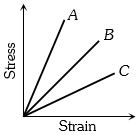
- 8The stress-strain curves for brass, steel and rubber are shown in the figure. The lines $A, B$ and $C$ are forView Solution
- 9The density of a metal at normal pressure is $\rho$. Its density when it is subjected to an excess pressure $p$ is $\rho^{\prime}$ If $B$ is Bulk modulus of the metal, the ratio of $\frac{{\rho '}}{\rho }$ isView Solution
- 10The length of metallic wire is $\ell_{1}$ when tension in it is $T _{1}$. It is $\ell_{2}$ when the tension is $T _{2}$. The original length of the wire will be ...... .View Solution