There is no change in the volume of a wire due to change in its length on stretching. The poisson's ratio of the material of the wire is
Medium
Download our app for free and get started
$\therefore$ Volume $=$ constant $\quad \mathrm{K}=\frac{\mathrm{PV}}{\Delta \mathrm{V}}=\infty$
$Y=3 K(1-2 \sigma)$
$\Rightarrow 1-2 \sigma=\frac{Y}{3 K}=0 \Rightarrow \sigma=\frac{1}{2}$

Download our appand get started for free
Experience the future of education. Simply download our apps or reach out to us for more information. Let's shape the future of learning together!No signup needed.*
Similar Questions
- 1View SolutionIn materials like aluminium and copper, the correct order of magnitude of various elastic modulii is
- 2Force constant of a spring $(K)$ is synonymous toView Solution
- 3When a load of $10 \,kg$ is suspended on a metallic wire, its length increase by $2 \,mm$. The force constant of the wire is $....... N / m$View Solution
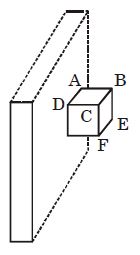
- 4A steel rod is projecting out of rigid wall. The shearing strength of steel is $345 \,\,MN/m^2.$ The dimensions $AB = 5\,\, cm,\,BC = BE = 2\,\, cm.$ The maximum load that can be put on the face $ABCD$ is .......... $kg$ (neglect bending of the rod) $(g = 10\,\, m/s^2)$View Solution
- 5A brass rod of cross-sectional area $1\,c{m^2}$ and length $0.2\, m$ is compressed lengthwise by a weight of $5\, kg$. If Young's modulus of elasticity of brass is $1 \times {10^{11}}\,N/{m^2}$ and $g = 10\,m/{\sec ^2}$, then increase in the energy of the rod will beView Solution
- 6In a wire of length $L,$ the increase in its length is $l.$ If the length is reduced to half, the increase in its length will beView Solution
- 7View SolutionTo keep constant time, watches are fitted with balance wheel made of
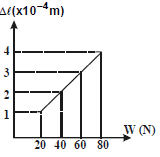
- 8The adjacent graph shows the extension $(\Delta l)$ of a wire of length $1\, m$ suspended from the top of a roof at one end and with a load $W$ connected to the other end. If the cross-sectional area of the wire is $10^{-6}\, m^2$, calculate the Young’s modulus of the material of the wire.View Solution
- 9In the Young’s experiment, If length of wire and radius both are doubled then the value of $Y$ will becomeView Solution
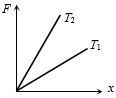
- 10The diagram shows the change $x$ in the length of a thin uniform wire caused by the application of stress $F$ at two different temperatures $T_1$ and $T_2$. The variations shown suggest thatView Solution