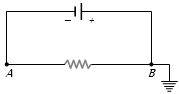
A battery is connected to a uniform resistance wire $AB$ and $B$ is earthed. Which one of the graphs below shows how the current density $J$ varies along $AB$
- A
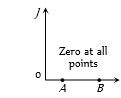
- B

- C

- D

Medium


Download our appand get started for free
Experience the future of education. Simply download our apps or reach out to us for more information. Let's shape the future of learning together!No signup needed.*
Similar Questions
- 1View SolutionThe internal resistance of a cell depends on
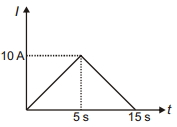
- 2Current $l$ versus time $t$ graph through a conductor is shown in the figure. Average current through the conductor in the interval $0$ to $15 \,s$ is ............ $A$View Solution
- 3View SolutionTwo identical heater filaments are connected first in parallel and then in series. At the same applied voltage, the ratio of heat produced in same time for parallel to series will be:
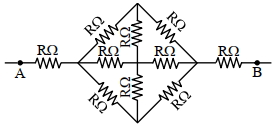
- 4The effective resistance between $A$ and $B$, if resistance of each resistor is $R$, will beView Solution
- 5Two electric bulbs whose resistances are in the ratio of $1 : 2$ are connected in parallel to a constant voltage source. The powers dissipated in them have the ratioView Solution
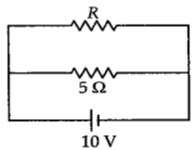
- 6he power dissipated in the circuit shown in the figure is $30\,W$. The value of $R$ is ............. $\Omega$View Solution
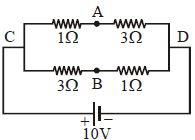
- 7A battery of $emf$ $10\,V$ is connected to resistances as shown in the figure. The potential difference between $A$ and $B,\,\,(V_A -V_B)$ is ................ $V$View Solution
- 8View SolutionA constant voltage is applied between the two ends of a metallic wire. If both the length and the radius of the wire are doubled, the rate of heat developed in the wire
- 9View SolutionIn the given circuit, with steady current, the potential drop across the capacitor must be
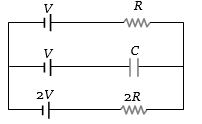
- 10Two identical cells, when connected either in parallel or in series gives same current in an external resistance $5\,\Omega$. The internal resistance of each cell will be $.............\,\Omega$.View Solution